Share the post "Femur fracture"
Whether you’re a weekend cyclist or a high-level athlete, injuries spare no one. They make us sad and grumpy and deserve a detailed explanation sheet using the 5W1H method (Who, What, Where, When, Why, How). The idea is to continue our series of short articles that we started last year, to better understand them, adopt the right behaviors to avoid them, and the proper course of action for better recovery.
After the knee, the clavicle, saddle sores, spinal pain, iliac artery endofibrosis, Achilles tendonitis, compartment syndrome, carpal tunnel syndrome, head trauma, digestive issues and periostitis, plantar fasciitis, today I offer you an explanatory sheet – still using the 5W1H approach (What, Who, Where, When, How, How Much, Why) – this time for a fractured femur.
By Jean-François Tatard – Photos: Nicolas Götz / Flickr.com, Israel Start Up Nation, Wikimedia Commons, JF Tatard.
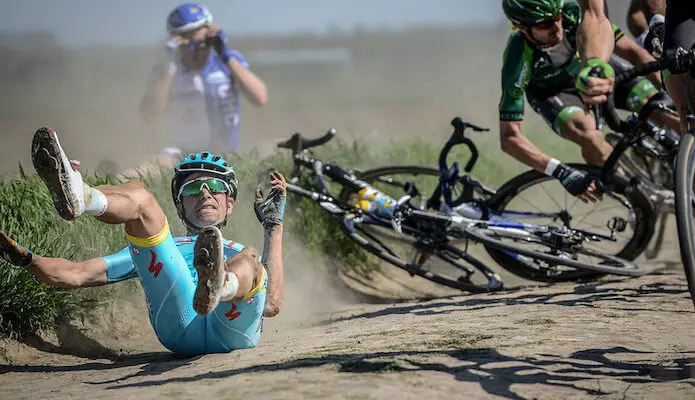
When we think of a bike crash, we often think of an accident with a car, or a fall in a peloton, or a missed turn on a winding descent. The risk of exposure is indeed highest in these conditions. But sometimes, a fall while stationary in one’s garage, trying out new cleats, has more serious consequences than in a more accident-prone situation. This is precisely what happened to Alexandre. At that precise moment when Alexandre was adjusting his new cleats, the risk seemed non-existent. Yet Alexandre lacked vigilance and was caught off guard. He lost his balance, his feet remained stuck on the pedals, and the impact with the ground was such that his femur fractured in two. His mind didn’t have time to anticipate and send the information to his body to contract and protect itself. The bone gave way without resistance…
WHAT?
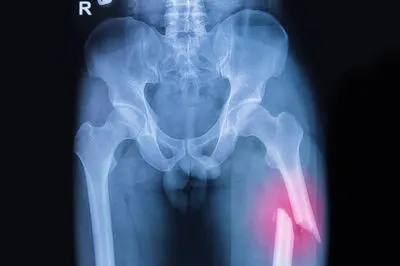
First, what is the femur? The femur is the single bone of the thigh. It is the longest, largest, and strongest of all bones. It represents about a quarter of the body’s height and can withstand very high pressures (up to 280 kg/cm2 during a jump). It is located between the pelvic bone and the knee.
WHO?
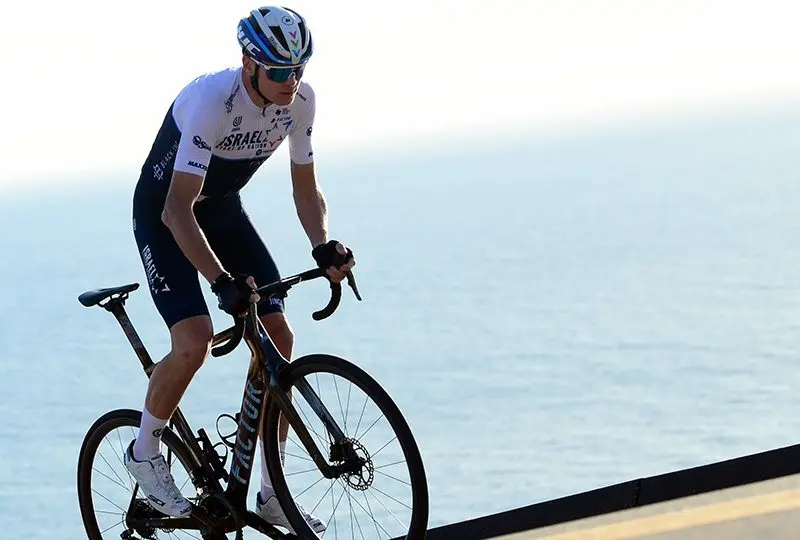
It is often said that a fractured femoral neck is an injury of the elderly, yet cyclists are also a population at risk. Unfortunately, not all falls end in a slide. Some cause a violent impact with the ground or against objects (trees, cars, barriers, railings, etc.). It is in these circumstances that the break is most significant. Recently, Colombian Miguel Florez suffered a fracture of the left femoral neck during a fall on the 3rd stage of the Tour des Alpes-Maritimes et du Var. In 2019, Christopher Froome broke his femur during training while reconnoitering the time trial course of the Critérium du Dauphiné Libéré.
WHERE?
A fractured femur in cyclists occurs almost exclusively during a fall. And it is often the femoral head that takes the brunt of it. For a simple reason: it is normally more fragile than the rest of the skeleton and therefore becomes even more vulnerable.
WHEN?
A fractured femur generally occurs during a violent trauma. Even very violent, as the femur is a very dense and resistant bone.
HOW?
Clinical signs include very exacerbated pain. It is no longer possible to walk. In all cases, the patient is unable to mobilize their lower limb. A deformity is also sometimes observed; the thigh is often shortened and itself increased in volume. The confirmed diagnosis will be made using an X-ray.
As for treatment, it is almost always surgical. However, depending on the complexity, the therapeutic method will differ. If it is a consequence of a fall and not premature wear, osteosynthesis is often required. This consists of repairing the fracture by placing a screw-plate or several screws to stabilize the fracture, which will then consolidate on its own in about two months.
HOW MUCH?
Each case is different, but it will take an average of at least two months for the bone to re-consolidate. And probably three to six months before getting back on the bike where you left it before the fall. As for the length of hospitalization, it takes three to ten days. It is also noted that the rehabilitation phase is initiated earlier and earlier today. Indeed, weight-bearing is most often immediate, albeit with crutches. Weight-bearing work will still be resumed progressively, with full weight-bearing authorized around six weeks. This does not prevent supplementing with muscle strengthening and maintaining joint range of motion.
WHY?
Femur fractures are therefore not so rare among cyclists. However, it is necessary to distinguish between fractures of the femoral shaft (the long part of the bone) and those of the femoral neck. Shaft fractures generally occur in a traumatic context of a fall. Whereas neck fractures preferentially occur in a context of osteoporosis which makes bones more fragile. The upper end of the femur, which includes the neck and head, is highly exposed to osteoporosis, placing it at the top of the list of fractures in “older people.”
IN CONCLUSION
A fractured femur is a serious injury and often difficult to avoid. When it occurs after a violent fall, it means there was nothing else that could be done. Nevertheless, surgery responds well in the majority of cases to this type of fracture, using osteosynthesis (screws and plates) when it is a shaft fracture. And whatever happens, the prognosis is never 100% bleak, and in most cases, the unfortunate cyclist will regain full mobility, but certainly not immediately… Even if excellent initial physical fitness, as in Alexandre’s case, is a major asset in the prospect of recovering physical capabilities.
=> SEE ALSO: All our Infirmary articles
Share the post "Femur fracture"