Share the post "Sram Rival eTap AXS Groupset Test: Wireless Shifting Made Affordable"
With the new Rival, SRAM is bringing its wireless electronic shifting technology, eTap AXS, previously seen only on its higher-end Red and Force groupsets, to a more affordable level. A comfortable, high-performing drivetrain at a relatively affordable price, which outclasses every cable-operated system on the market in terms of how it works. SRAM also adds a power meter option to the Rival crankset, at an equally accessible price. Here is the first test of a promising groupset that should soon, and happily, be fitted to many mid-range bikes.
By Guillaume Judas – Photos: @Billy Ceusters / DR
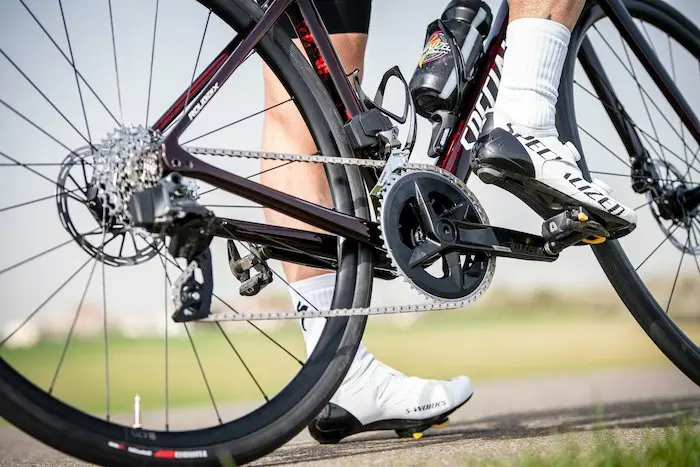
In terms of how it works, nothing now separates the two groupsets known from SRAM’s eTap AXS range, the Red and Force, from the new Rival. Better still, this newcomer, fitted for our test on a Specialized Roubaix Comp, proves completely smooth and quiet in the drivetrain, which has not always been the case with the Red and Force we tried on other bikes. This is thanks as much to the Roubaix frame (with a rigid, perfectly aligned derailleur hanger) as to the design of the steel cassette sprockets, which greatly limits resonance noise as the chain moves from one sprocket to the next. The SRAM Rival AXS chain is just as rigid and durable as the Red and Force, but wrapping around the 10-tooth small cog seems to create a little less friction here. At least, that was our impression on the handlebars of the test bike.
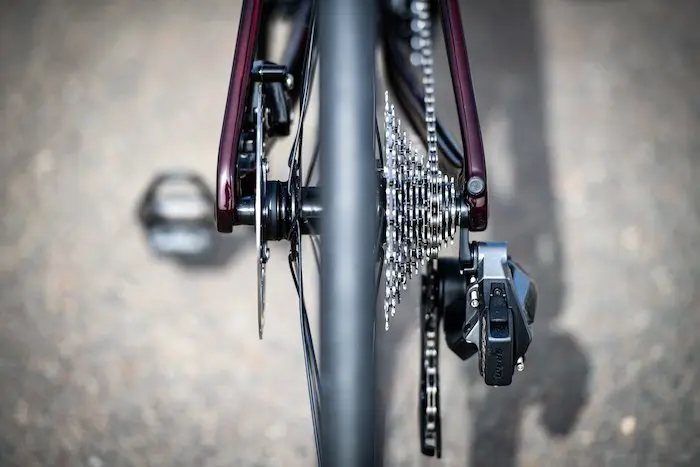
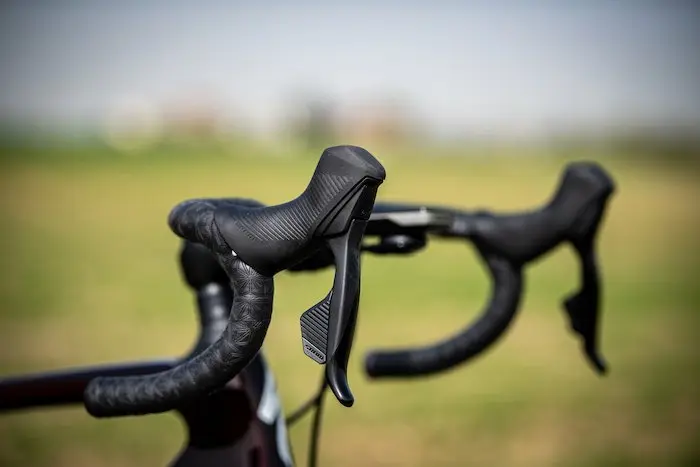
Shifting on the Rival eTap AXS works the same way as on the other two groupsets, with a paddle behind the right brake lever to move down the cassette, and a paddle behind the left lever to move up it. Pressing both paddles at once changes the front chainring. The technology used on the Rival is identical to that of the Red and Force, with wireless communication between the levers and the derailleurs, which are powered by small interchangeable batteries that last around 1000 km. Two small flat CR2032 coin cells power the levers themselves, promising up to two years of battery life.
=> SEE ALSO: Sram Red AXS Groupset Test
Wireless connectivity
The system is therefore easy to install, with no electrical cable, no extra battery and no junction connector. Derailleur shifting speed is more than sufficient for everyday use and, once again, does not differ from a Red eTap, for example, even though communication is a tiny bit slower than a wired connection (we are talking about a few hundredths of a second). It also benefits from AXS connectivity to a dedicated smartphone app.
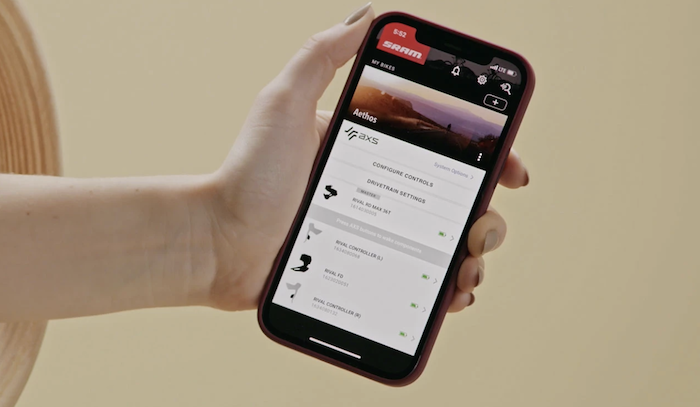
The SRAM Rival eTap groupset also benefits from AXS connectivity to a dedicated smartphone app, where you can customize how it works.
The app lets you, among other things, customize the functions of the shift paddles, reversing the controls or setting how many sprockets change with a sustained press, or choose a sequential shifting mode or a compensation mode. In the first case, you let the system handle front chainring changes automatically, based on the position of the chain on the cassette and on whether you need a bigger or smaller gear. In the second case, each time the front chainring changes, the rear derailleur automatically moves one or two sprockets to avoid breaks in pedaling cadence. Pretty complete features for a mid-range groupset, and ones we already know from competitor Shimano (with its Synchronized and semi-synchro modes).
Braking with no complaints
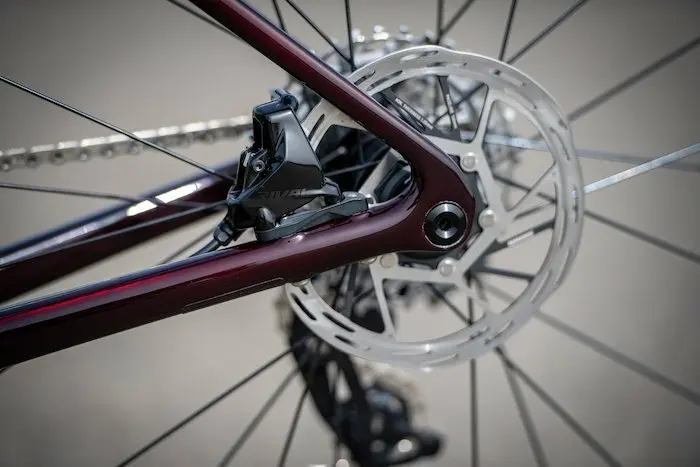
The other strong point of the Rival eTap AXS groupset is its brakes, as reliable and effective as those of the other two AXS groupsets. Effective in all conditions, they are also quiet, and disc-pad rubbing is very rare, even after heavy braking. The sense of security, whether dry or wet, is further boosted by the 30 mm tires of the Specialized Roubaix, which offer excellent grip and better control to avoid unwanted wheel lockup. That control is enhanced further by the option to adjust the lever reach on SRAM brakes, so you can personalize the feel to your riding preferences.
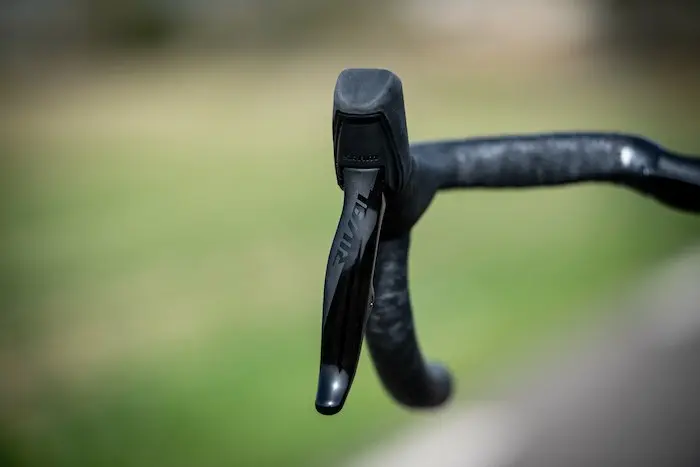
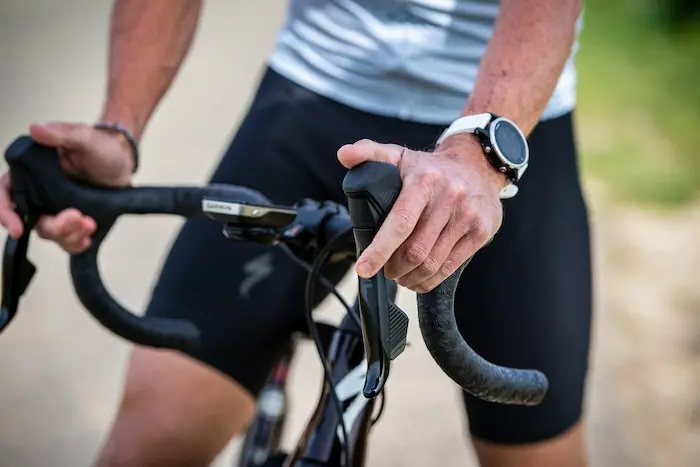
As for the levers, SRAM has made a real effort to slightly reduce their size compared with the Red and Force AXS, as well as to improve their ergonomics and finish. The slightly smaller size is possible thanks to the absence of ports for the additional shift controls (SRAM’s “Blips,” which can be used with the Force and Red). Better suited to smaller hands, the Rival levers are also much more comfortable, thanks to the care taken with the hidden part of the levers, where the fingers grip during hard efforts. The contact is much softer than a Red lever, which can even feel sharp in that spot. Also worth noting is the textured part of the hoods and shift paddles, which improves grip. These levers are a real success, and their finish even raises the level of the groupset.
A wide range of gear ratios
Three chainring combinations and two cassettes are available with the new Rival groupset, as well as a single-chainring option, which could be a good choice for gravel riding, for example. The original concept behind AXS was a crankset with two chainrings only 13 teeth apart, paired with a cassette starting at 10 teeth, to widen the range of available gear ratios. Rival double cranksets are therefore offered in 48-35, 46-33 (as on our test bike) and 43-30 in the Wide version, which requires a different front derailleur (Rival AXS Wide) so the setup leaves more room for the wider chainstays and big tires. The 1x crankset (single ring) is only available in the Wide version, for frames with a rear spacing of 135 mm, 142 mm or Boost, with a chainring of your choice from 38 to 46 teeth (in steps of two).
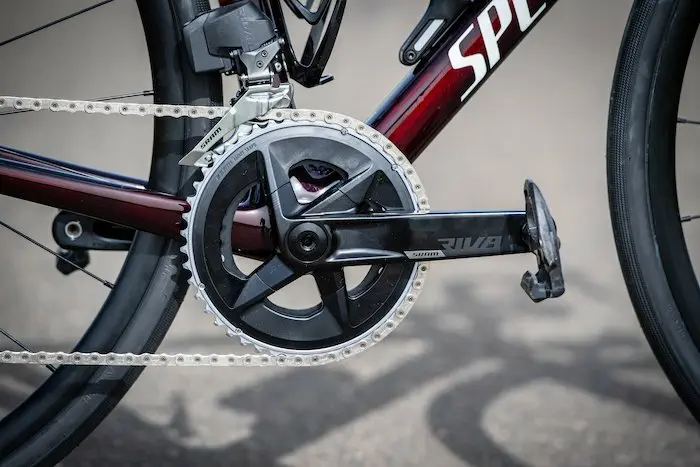
Both cassettes come in 10-30 (sprockets of 10, 11, 12, 13, 14, 15, 16, 17, 19, 21, 24, 27, 30 teeth) and 10-36 (sprockets of 10, 11, 12, 13, 15, 17, 19, 21, 24, 28, 32, 36 teeth, as on our test bike). The rear derailleur has a maximum capacity of 36 teeth, although it is also compatible with a Red or Force 10-28 cassette. Very low gears make it possible to tackle tough routes, even if you have to live with large gaps between sprockets. Still, it must be said that with a 46-tooth big ring, as on the Roubaix, the jump between the 13 and 15 teeth, for example, is less noticeable than with a smaller ring.
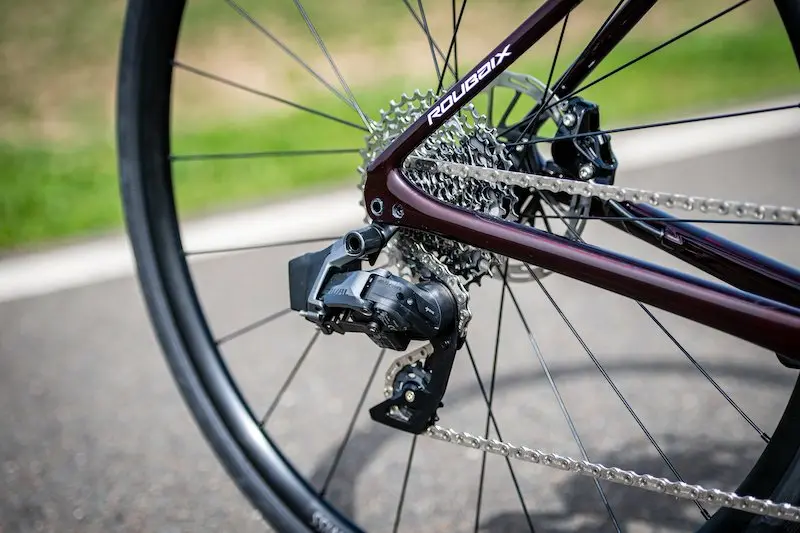
Whatever the case, on our test bike, you can go from a 46/10 gear (equivalent to a 55/12 or a 51/11) to a 33/36 gear, a difference of more than 1 to 5 between the two extremes.
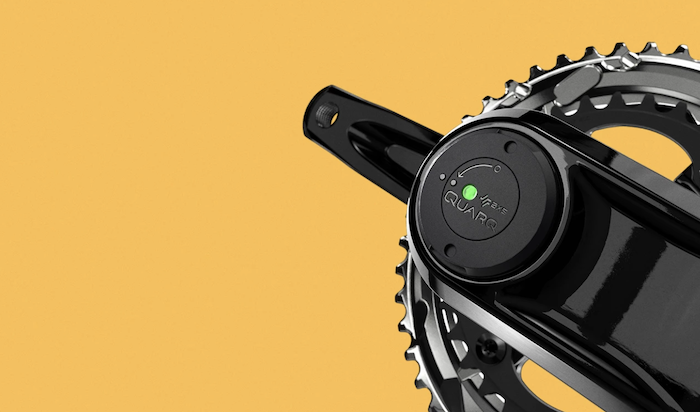
An affordable power meter With the new Rival AXS, SRAM takes the opportunity to offer an option with a brand-new Quarq power meter (the specialist brand, long recognized in its field, has belonged to SRAM for years) at an extremely attractive price. Expect to pay €360 for a complete crankset in double or 1x, and €260 for an upgrade from the standard Rival crankset, for an extra weight of only 40 g.
For the first time, Quarq is offering a simple, affordable sensor, with a unit placed in the bottom bracket spindle that measures power on the left crank arm. The principle is known to be a little less precise than measuring both sides at once (since the system doubles the reading taken on the left and infers total power without accounting for any differences between the two legs), but it opens up new training possibilities for a new category of riders. We have not been able to test this sensor yet, since it does not come with the Roubaix Expert equipped with the Rival groupset. |
Almost everything a top-tier groupset offers
With the Rival AXS, SRAM hits hard with a technologically advanced, very well-finished groupset at the lowest official price for an electronic drivetrain. Depending on the option, it is priced at €1176 for 1x (without bottom bracket: +€41) and €1411 for double (without bottom bracket). That is almost €300 less than the Force AXS or the Shimano Ultegra Di2 groupset. Prices are €1401 and €1636 with the power meter, an option not offered on the Force and Ultegra. On the other hand, it should be noted that Rival is only offered with disc brakes.

Features, performance, precision and finish: it would all be almost perfect, obviously, if it weren’t for the weight of the groupset, which is also the heaviest of the electronic drivetrains. At just over 3000 g with all the parts added up in its double version, the Rival AXS is 500 g heavier than a Red, and about 300 g heavier than a Force, which use the same technologies. Compared with the competition in this category, the Rival AXS weighs about the same as a Shimano 105 with disc brakes and mechanical derailleurs. But it feels far more modern.
The SRAM RIVAL ETAP AXS groupset in brief… Rating: ***** Pros: Finish, shifting, precision, value for money Weight and Prices: Contact: sram.com |
=> SEE ALSO: Road Groupset Prices and Weights 2019/2020
=> SEE ALSO: All Our Gear Articles
Share the post "Sram Rival eTap AXS Groupset Test: Wireless Shifting Made Affordable"