Share the post "Orbea Orca OMR M25Team Review"
A year after the launch of the new high-end Orca, Orbea has introduced a slightly less exclusive version, but one that features an almost identical design and the same degree of integration. We tested this new Orca, designed with OMR-level carbon fibers, in its M25Team version – under €4000 – over 6000 km to find out how this “diluted” version of the brand’s best-seller performs on the road and in all weather conditions. Here’s our verdict.
By Guillaume Judas – Photos: @3bikes.fr

=> SEE ALSO: Long-term test of the Orbea Orca OMX
The Orca has always been Orbea’s flagship model, and this new opus, introduced in 2019, is no exception. Stiff, agile, lively, versatile, and aerodynamically improved thanks to excellent cable and hose integration at the head tube, the Orca is appealing, especially since Orbea’s customization program, which allows choosing certain components and selecting colors from thousands of combinations, is very successful. The only downside: like many brands, Orbea is experiencing supply problems due to the health crisis and high demand in the cycling sector. Therefore, ordering an Orca sometimes requires a lot of patience.

Highly efficient, the Orca was previously only available with OMX carbon fibers, the highest level of design from the Basque brand. These lightweight and stiff fibers are combined with a very precise manufacturing process designed to eliminate the slightest imperfection. Since last summer, the Orca has been offered in a softer and less expensive version, with OMR fibers, Orbea’s second level of carbon. The brand announces an additional 200 g for the frame, but also a slightly more accessible ride. The geometry is the same as for the OMX, and only the seat tube is modified. By returning to a round shape and with a “classic” 27.2 mm diameter seatpost, it also promises more comfort.
A complete range, starting from €2099
The Orca OMR is available in seven versions, starting from €2099. The most expensive model, the M21eTeam, is equipped with Sram Force eTap AXS and Fulcrum Racing 700 wheels for €4799. Next is the M20iTeam with the same wheels and a Shimano Ultegra Di2 groupset for €4599. Then comes our test model, the M25Team, with a mechanical Ultegra groupset and Vision 40SC carbon wheels for €3999. This build is also available with Fulcrum Racing 700 aluminum wheels for €3599 for the M20Team. Finally, at the entry level, we find the M20 with Ultegra/105 and Orbea wheels for €2899, the M30 with Shimano 105 for €2299, and finally the M40 with Shimano Tiagra (10 speeds) for €2099. These last three models are equipped with a fork whose steerer tube remains aluminum, while maintaining the same lines and level of integration as all other Orca models.

Between the Orca OMX and OMR (12 models in total), two slightly different frames, several equipment levels, and the customization possibilities of the MyO program, you can create an ideal bike tailored to your budget and athletic goals.
Successful aesthetics
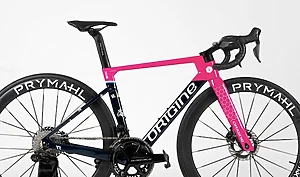
The finish on the M25Team test bike is, as always with Orbea, remarkably well done, with a “Raw Carbon” (glossy raw carbon) paint job that looks stunning in the sunlight. Three standard colors are available, but you can customize the paint from thousands of possibilities, at no extra cost, starting with the M20Team model at €3599. The fit of the parts during assembly is flawless. The integration of the derailleur cables and brake hoses with the ICR system provides no resistance, and the fluidity of the controls remains even after several thousand kilometers. The only drawback of the system appears when changing the headset bearings, as it is then necessary to disassemble everything and bleed the brakes. Not simple, but we know that disc brakes inevitably involve more complicated maintenance than rim brakes.


The right balance
In terms of equipment, the Orca M25Team is very well balanced, with the Ultegra disc groupset and its mechanical derailleurs, and especially the very good Vision 40SC carbon wheels that we had already tested extensively with the Orca OMX last year. The whole package constitutes an excellent mid-range machine with reliable, efficient, and proven equipment such as the Orbea OC1 Road handlebar (available in a 15 mm raised version, or an optional carbon version), and the Prologo Scratch-M5 Pas T2.0 saddle (you can also choose from four other models). Regarding the wheels, it is possible to choose Vision SC with 55 mm deep rims, or the excellent Fulcrum Racing Speed 40 which radically beef up the Orca’s game, but at an additional cost of €1000.


Like its big brother OMX, the Orca OMR is compatible with 32 mm tire widths, which greatly expands its possibilities. Instead of the initially supplied Vittoria Rubino IVs, we chose the option of Hutchinson Fusion 5 Performance TLR 700×30 tires (+€20), which adds comfort and grip while making it possible to venture onto poorly paved bike paths or well-packed gravel roads.


But it was with high-end 25 mm tires that we rode this bike the most, first Pirelli PZero 4S, then Michelin Power Road, in order to maintain the same road contact as our habits, and to find a bit of dynamism. We also tested this bike with RAR Magnum 60 mm deep wheels, intended for fast and rolling courses.

Easy to live with
On the scale, the Orca M25Team weighs 8.150 kg without pedals in size 49, which brings us to almost 8.5 kg ready to ride and even a good 9 kg with a water bottle. It’s a bit heavy, but consistent with the weight of the Shimano Ultegra Disc groupset and the announced overweight of the OMR frame compared to the OMX. Fortunately, the Vision 40 SC wheels limit the damage by proving reactive, dynamic, and versatile. These are excellent carbon wheels for their retail price of around €1100. From the first few hectometers on the road, the Orca seems a little lighter than it actually is and even proves easy to ride and accelerate. The 30 mm tires penalize sharp accelerations a bit and provide rather vague sensations when riding out of the saddle because their width exceeds the rim width. Their weight of almost 300 g also does not favor an ultra-nervous behavior. Nevertheless, they shine with their comfort and the very good grip they provide on wet and greasy winter roads. By maintaining a sustained and regular pace, they do not penalize the average speed, even if they feel a bit like “braking” the bike beyond 35-37 km/h. Note also that with this setup, the disc braking with the two 160 mm rotors is powerful and progressive, perfect for maintaining control whatever the circumstances.
=> SEE ALSO: Buy Vision 40 SC Disc Tubeless wheels for €899.99
=> SEE ALSO: Buy Hutchinson Fusion 5 Performance TLR tires for €37.99
By fitting tires with a section more suited to aggressive bike use (25 mm), the Orca M25Team gains in liveliness what it loses a little in comfort. Braking – especially at the rear – also becomes a little more delicate to modulate in wet conditions. The fact remains that the bike expands its performance possibilities, whether on the flat at high speed with a favorable wind, or on more hilly courses that require frequent changes of pace.
The Orca M25Team falls into the category of accessible bikes that you enjoy riding even on days when your form and mood are not at their best.
The frame shows a bit of lateral flexibility, but without being soft. It rather falls into the category of accessible bikes, which you enjoy riding even on days when your form and mood are not at their best. Its behavior is balanced and pleasant whatever the gear and pace chosen. It filters vibrations correctly and allows you to accumulate kilometers without having to suffer. The bike also proves stable and reassuring on fast descents or when chaining technical turns. And if it is one of the rare bikes that remains comfortable despite a sporty geometry, it also supports more muscular use, whether it’s long sequences of sustained efforts on the flat or even sprints to town signs against riding companions.

With even higher-end wheels like the RAR Magnum 60, its behavior is a bit more “rouleur” oriented, and it gains points on the flat, even if it becomes very sensitive to crosswinds. These tall and stiff wheels make it a bit more demanding, but they do not distort the chassis’ behavior, which, despite the soft impression it leaves under the pedal, does not come apart under strong solicitations. The potential of the Orca OMR is therefore very real, and this frame constitutes a very interesting base when your budget is not unlimited.

The impact of the fibers
The question now concerns the real difference between the two Orca frames, i.e., the high-end version with OMX carbon fibers, and the OMR version of the M25Team. There is a €900 difference between the two frame kits (€3499 for the OMX and €2599 for the OMR), and a clearer difference when looking at the range of bikes offered.

Aesthetically and in terms of geometry and finish, the two models are very difficult to distinguish. On the road, the OMR is a little heavier, less sharp, and less incisive under high loads than the OMX, but also more comfortable, more forgiving, and more pleasant at low speeds. It is clearly less competitive, while being even more suited to the vast majority of riders and their physical capabilities.
With the proposed equipment, the M25Team is, in our opinion, the most balanced model in the Orca OMR range, because while it saves on an electronic groupset (Di2 or eTap), it benefits from versatile wheels that greatly optimize its behavior. It does not offer the same cutting-edge performance as a very high-end bike like the OMX in its most expensive version, but it already offers a lot for its price. A great deal.
The Orbea Orca M25TEAM in brief… Rating: * Pros: aesthetics/finish, equipment, comfort, ease of access Frame: Orbea Carbon OMR Disc – Fork: Orbea Orca ICR Disc – Handlebar: OC1 Road – Stem: Orbea ICR 8° – Brakes: Shimano Ultegra hydraulic – Front Derailleur: Shimano Ultegra 11 sp. – Rear Derailleur: Shimano Ultegra 11 sp. – Levers: Shimano Ultegra hydraulic – Cassette: Shimano Ultegra 11-30 – Chain: Shimano Ultegra 11 sp. – Crankset: Shimano Ultegra – Wheels: Vision 40 SC Disc – Tires: Hutchinson Fusion 5 Performance TLR 700×30 – Saddle: Prologo Scratch-M5 Pas T2.0 140mm – Seatpost: OC2 Carbon 27.2 – Weight: 8.150 kg in size 49 without pedals – Number of sizes: 7 – Price: €3999 (+€20 with tire option) Contact: www.orbea.com |
=> SEE ALSO: All our Gear articles
Share the post "Orbea Orca OMR M25Team Review"