Share the post "Specialized Flux 1250 Front Light Review"
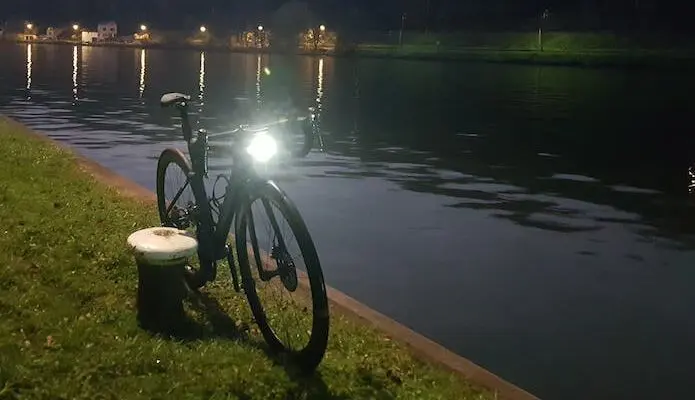
For those who commute by bike early in the morning or return late in the evening, or for those who ride long distances and necessarily spend some time on the road at night, good lighting is essential, especially in the countryside. We tested the Specialized Flux 1250 for bike commuting, evening training, and even mountain biking in the woods, a high-end front light that boasts excellent battery life.
By Guillaume Judas – Photos: DR
Due to the curfew, we entrusted the Specialized Flux 1250 front light to Kevin Le Cunff, a former professional cyclist selected for the upcoming Paralympic Games in Tokyo (in category C5). As such, the athlete from the Paris region has a double exemption to ride outdoors during the restriction period, both for commuting to work and for evening training. He therefore extensively tested this quality light for three months, on his road, time trial, and mountain bikes, in all temperatures and all weather conditions.
The test was facilitated by the excellent mounting brackets: the first adapts to handlebars with diameters of 22.2, 25.4, and 31.8 mm and can be positioned in different ways to integrate well with the cockpit setup (with cables, GPS mount, etc.), and the second is used as a GoPro-type action camera mount, which allows the light to be mounted on a time trial handlebar, for example. The Flux is perfectly fixed to the mount, to the point of being very difficult to detach when recharging. Note that an additional helmet mount is also provided.
Seven lighting modes
The Flux 1250 has seven lighting modes at different intensities, including three steady and four flashing, and from 1250 to 60 lumens, with two lights. For steady modes, three intensities are available: 1250, 600, and 300 lumens. The maximum power is too strong for road riding, in case of poor orientation on the handlebars. It can even dazzle motorists. However, it proves formidable for mountain biking in pitch darkness. The intermediate power (600 lumens) was the most used by our tester, as a good part of his rides were on unlit country roads. This intensity is sufficient to ride safely even in dark areas, while remaining perfectly visible. Finally, the minimum intensity saves battery and allows you to get home if you forgot to recharge it. But in terms of lighting, this mode is rather reserved for dusk when there is still some light.
Flashing modes are primarily used to ensure good visibility and extend battery life. With both lights flashing, it’s ideal for crossing an illuminated urban area, being perfectly noticed by other road users. The function with one steady light and one flashing light (600 lumens) is perfect for mixed routes with city and lit roads. The single steady light is powerful enough to see darker areas, while the flashing light attracts attention. Lower intensities allow you to adapt visibility to conditions while saving battery.
Note that the Flux also benefits from two “flashlight” functions that allow for up to 20 hours of battery life, but without sufficient power to be truly effective on the road. Our tester, in any case, did not see any particular interest in it for his use.
Battery life and practical aspects
The Flux 1250’s battery life is sufficient for everyday use for bike commuting or regular training. In 600 lumens mode, we observed optimal operation for approximately 3h30 in winter conditions, before seeing a decrease in intensity, but which allowed us to complete the last hour without too much difficulty.
Regarding the device’s operation, using a single button and switching between modes is not particularly practical. It is necessary to hold the button down for several seconds to change modes, and for a short moment, you find yourself without light. This is far from easy while riding, especially when transitioning from city to country, or vice versa.
The Flux 1250 meets the IPX7 waterproofing standard, which is supposed to allow it to withstand the heaviest rains. However, after a nearly two-hour ride in a downpour, we noticed that moisture had infiltrated the lights, and it took about 48 hours for it to dissipate. We do not know if a second consecutive ride in the same conditions would have altered its operation or not. The fact remains that after three months of intensive use (4 to 6 rides per week) and in all weather conditions, the Flux 1250 continues to give full satisfaction. The price of €169.90 is quite high, but this light perfectly combines lighting power, battery life, and secure mounting.
The SPECIALIZED FLUX 1250 light in brief… Rating: ***** Pros: Secure mounts, sufficient battery life for everyday use, effective even in the countryside High-intensity CREE XP-L LED – Compatibility: 22.2, 25.4, and 31.8 mm – Mount for helmet and action camera – Internal battery: Premium 3400 mAh Lithium-ion – 7 modes – Battery life: 1h30 to 20h depending on mode – Weight: 160 g – Price: €169.90 Contact: specialized.com |
=> SEE ALSO: All our Gear articles

Guillaume Judas
Share the post "Specialized Flux 1250 Front Light Review"