Share the post "The “unpinned” peloton"
By Bruno Cavelier / Text published in Cyclosport Magazine n°144, currently on newsstands – Photos: Pxhere.com, Flickr.com

In this health crisis that hit us just a year ago, amateur sport has been the fifth wheel of the carriage from the start. Of course, our sport is part of it, especially cyclosport. Nothing has been organized for several months, and even the cyclo-cross season was completely sacrificed to the great dismay of off-road enthusiasts, in total incomprehension. Because for regulars who know that local events gather at most a hundred participants divided into several races of about twenty riders at the start, all in the middle of nature, how to explain a potential danger of contamination as long as certain health protocols are respected? Unfortunately, public authorities – those who trumpet that there is almost no risk outdoors – don’t understand much about our sport… Let’s get back to cyclosport since the plowing season is now behind us.

A random calendar
Faced with this unprecedented situation (…) it is inevitable in the current situation to encounter new event cancellations in the calendar, mainly at the beginning of the season… Michèle Calvi, who is in contact with organizers to establish the event calendar for Cyclosport Magazine, was charmed by the kindness and solidarity of event managers: “organizers remain motivated although sometimes bewildered by the lack of information from sports authorities. All have sought solutions to keep their events going, often by postponing them to later dates and crossing their fingers that the health situation will improve. Very few have decided to stop. Strangely, despite the context, about ten new cyclosportives should see the light of day this year. If all goes well…“
A societal problem
However, beyond the individual frustration of each enthusiast that we are, a real societal problem arises: that of clubs. The associative sector has fallen into disrepair. Demobilization is general. It must be said – or rather repeated – that while the government has multiplied aid for businesses or professional sports, nothing has been done for amateur sports, ours; that of associations that only live through the volunteering of dedicated enthusiasts. In our clubs, while collective rides and sporting aspects are important, conviviality, assemblies, trips, teamwork around event organization are just as important. All of this now refers to the past, to memories of what we could now call the good old days, dating back to the 2019 season; already… This social life will take time to rebuild, because it will be long for those disappointed by a failing federal system to regain motivation, or for new volunteers to be ready to offer their time to keep our sport alive voluntarily. But since cyclists are not made to go in circles within a defined radius or to live from confinement to deconfinement, the “no-bib” peloton is organizing itself.
Back to the future
The oldest among us have experienced this: village races organized by festival committees for local festivals or other events. Alain Guinle, president of the Ufolep 65 committee, refreshes our memory: “I remember my first race; it was an ‘unlicensed’ race where we all started together on a circuit around the village. Anyone could enter as long as they had a bike, and at the start you’d find the local hotshots – licensed, of course – because there were prizes and lots. At that time, the festival committee organized it like any other event on its village festival program: ball, fishing competition, pétanque, and of course, a cycling race… We were far from prefectural authorizations. In the 80s, it was like that in the Landes department. There was at least one ‘unlicensed’ race every weekend, before the FSGT gradually structured this system.”
Of course, this is impossible today; but only to a certain extent…
“It’s a race. We ride in a peloton like in a race, same efforts, same pace. We don’t need a bib…”
Sunday morning race
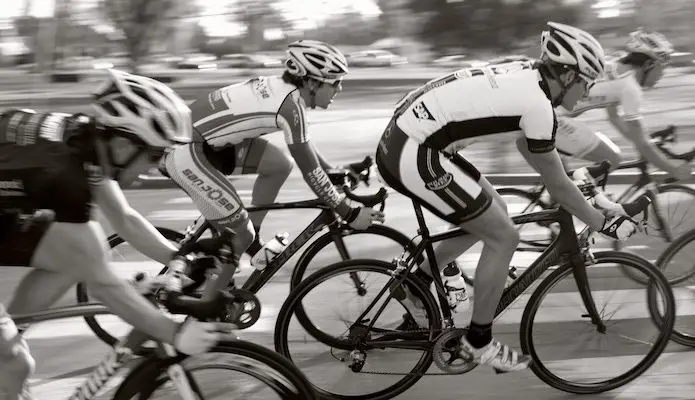
In the current context, clubs or various committees have a kind of Rubik’s cube in their hands that will take them an eternity to restore each face to its color; but not cyclists. Spontaneously, pelotons are organizing themselves. In fact, they had started doing so long before this crisis, which only reinforces the phenomenon. The notion of a club ride has now disappeared, giving way to meet-ups where everyone can go, before riding in a pack and trying as best they can to keep up with the strong riders who cross villages at an average of 40km/h. Even better, there are more or less official circuits that allow for unofficial races. While those of Longchamp or Vincennes are the best known in Paris, there are others in every major city, such as the Lavoir circuit in Marseille, where real “Grand Prix” races are organized on Sunday mornings, announced as events on Facebook. In Marseille, there is also the Obi peloton – which is not a club but nevertheless offers magnificent OBI-branded outfits – about which a regular cyclist who prefers to remain anonymous tells us: “It’s a race. We ride in a peloton like in a race, same efforts, same pace. We don’t need a bib…”
=> SEE ALSO: All our CQFD articles
Share the post "The “unpinned” peloton"