Share the post "McDavid Knee Brace Review"
To treat a patellar pathology, we tested a knee brace recommended by our osteopath, in this case the McDavid knee brace, which proved effective and comfortable for continuing sports activity despite pain.
By Jean-François Tatard – Photos: Jean-François TATARD
For the first time in 40 years, 35 of which have been spent running or cycling, I’m going to put on a knee brace. Indeed, this month the McDavid brand offered me the opportunity, through my osteopath Fabrice Bedin, to test a knee brace designed to relieve a patellar pathology and a notorious cartilage problem.
McDavid designs and markets sports medicine products. In this case, a whole host of products related to sports protection and performance for athletes, but also for all other active people. The brand’s history began in 1969 when Dr. Robert F. McDavid Jr., the company’s namesake and emeritus founder, created the first knee protection brace widely used in football. After a successful start and a period of fabulous growth, a company was formed under the name McDavid Knee Guard Inc. in 1980.
Today, McDavid products are at the top of the recommendation list for professional athletes, sports medicine professionals, and athletic trainers. From back or lumbar braces, to ankle braces, to patented compression shorts specifically designed for groin pain, McDavid products meet the specific needs of professional athletes – and others – in a wide variety of sports.
A global storytelling
McDavid also has a storytelling that is told worldwide: from its headquarters in California to its subsidiaries in Canada, Japan, and Europe, to its global distribution center. Its objective remains to support our sports practice in complete safety and to perpetuate its legacy with products at the forefront of what is best in terms of support and relief for bone, muscle, ligament, or tendon pathologies. And which inspire confidence and help athletes of all levels maintain their abilities and, even better: continue to progress while protecting themselves from injuries and wear and tear.
Focus on the knee
Constantly stressed, the knee is the site of many traumas, such as sprains, patellofemoral syndrome, or osteoarthritis. In case of weakness or injury, wearing a knee brace can help reduce pain and relieve the joint. My friend, Fabrice Bedin, the osteopath for all the local trailers, and also a teacher at the Paris School of Osteopathy, presented me with different types of knee braces and their indications, to help me choose the model best suited to my particular problem.
Anatomy lesson
The knee is the intermediate joint of the leg that supports the weight of our body, and plays an essential role in our mobility and stability. Indeed, it allows many movements such as flexion, extension, and rotation, and is particularly stressed throughout our lives. The knee is thus composed of three bones, the patella, the tibia, and the femur, connected to each other by three joints (femoropatellar and internal and external femorotibial), four ligaments (internal and external ligaments, anterior and posterior cruciate ligaments), and tendons. Other anatomical elements also participate in its function, such as synovial fluid, which acts as a true lubricant, and the meniscus, a small fibrocartilaginous disc that acts as a shock absorber. It is the integrity of these different parts that ensures the knee’s stability and allows it to respond to various stresses.
So in my case, what do we do?
Each knee brace has its function. Indeed, depending on the anatomical element affected, the activity or the therapeutic objective, each will have a very specific role: relieve pain, correct movements, facilitate post-traumatic healing, protect the knee before or after an operation, promote rehabilitation, allow the resumption of sport after a period of convalescence, etc. Thus, in my case, the knee brace is a patellar knee brace. In this instance, an orthosis related to my cartilage problems. What is called chondropathy. Very common in quadragenarians who have overdone kilometers in running, large gears in cycling, and heavy loads repeatedly in weight training.
Knee chondropathy (“chondro” means cartilage and “pathy” refers to disease) corresponds to damage to the cartilage on all articular surfaces of this joint. This damage causes softening, particularly on the patella, and long-term symptoms. Knee chondropathy is often asymptomatic at an early stage. The more significant the damage, the more pain and discomfort appear, sometimes for more than a year, or even 18 months. This mainly involves joint pain during normal movements, often felt as pressure pain during knee movements against resistance. They are most often accentuated when squatting, walking downhill, descending stairs, cycling uphill, and driving (clutch, acceleration). Rest pain can occur during and especially after prolonged, quiet sitting (driving, long-haul flights, computer work).
Choosing the knee brace
McDavid’s range is very, very wide, and for each pathology, there is a different product. On Fabrice’s advice, I therefore selected the patellar knee brace (patella, meniscus, osteoarthritis). The patellar knee brace is designed to enclose the patella, prevent any lateral movement, and improve overall knee stability. These knee braces are used in cases of pain associated with patellar instabilities (anterior knee pain). They are indicated for patellofemoral syndrome, but also for lateral subluxations, patellar misalignments, chondropathies (cartilage damage), tendinitis (tendon pain), meniscectomies (meniscus removal), or even mild osteoarthritis.
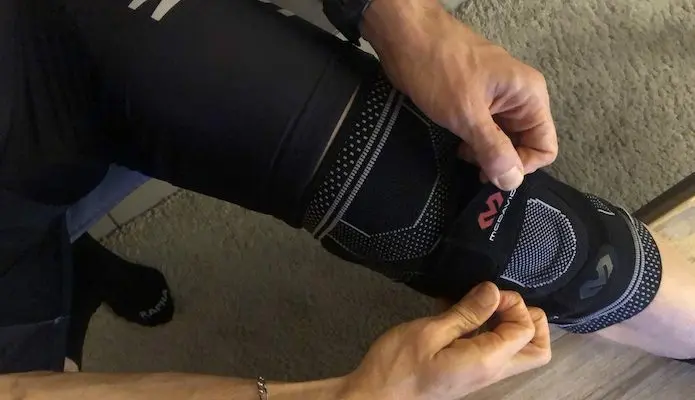
And the more severe the patellar instability, the more rigid the patellar knee brace must be, i.e., laterally reinforced. This is the case for the one I tested.Reference [5147] in the McDavid range… And in size M for the test.
A first for everything…
So this is the first time I’ve worn a knee brace. And if I hadn’t been offered the test or if my osteo hadn’t pushed a little, I must admit, I would never have put on this accessory. I was apprehensive about wearing one while cycling. And yes! You’ll never see a Tour rider with a knee brace. So it felt strange to me. In my mind, “if you’re in pain: you grit your teeth.” “If you’re in a lot of pain: you stop.” But you never cycle with a knee brace. Except that here, I admit, the knee brace is really well thought out: it’s shaped like an “X” with adjustable buttresses. And that’s a good point for placing them on the point of pain to maintain pressure to reduce discomfort. The knee brace is very comfortable to wear, the fabric is well sewn and causes no discomfort. It’s quickly forgotten while cycling. My knee injury is forgotten after a few kilometers.
My impressions
The compression is elastic. It is high quality with increased comfort. Another point, the lateral stays ensure impeccable stability and protection. The support and comfort are also perfectly adjusted. And I find the finish very sporty in its style and very neat, especially at the ends. No irritation even when sweating a lot on the indoor trainer. The gel buttress also adds a lot of comfort and protection. It is designed to be very breathable. Sweat wicks away well.
Choosing the right knee brace
I better understand the choice of this knee brace. You must choose the type of knee brace appropriate for your situation. And also the correct size. A correct and adapted orthosis will be well worn, and can thus exert its therapeutic action. To choose the knee brace model adapted to your needs, you must first know the necessary level of support and the size of your knee. To do this, simply refer to the measurement tables corresponding to each knee brace. In case of doubt, you can contact your osteopath or orthopedist. Perhaps even your pharmacist. But know that McDavid also offers knee braces adapted to all pathologies and all body types.
To conclude
McDavid knee braces are orthoses that support and relieve many knee pathologies. And the range doesn’t stop there… Whether for athletes, convalescents, or people suffering from osteoarthritis, it is important to choose the correct knee brace model, adapted to their size and symptoms. The one Fabrice Bedin recommended to me meets a very high level of demand from an enthusiast who cannot be prevented from practicing, even under penalty of sanction. This one reassures, instills confidence, and allows one not to feel guilty about continuing to run or cycle without really knowing if it is reasonable not to stop.
The MCDAVID 5147 knee brace in brief… Rating: * Pros: elastic compression, excellent increased comfort and good breathability, impeccable stability and protection, perfectly adjustable support and comfort, very sporty and very neat finish, especially at the ends. Price: €59.95 Contact: www.mcdavid.eu |
=> SEE ALSO: All our Gear articles
=> SEE ALSO: All our Coaching articles
Share the post "McDavid Knee Brace Review"