Share the post "BH Ultralight Evo 8.5 Review"
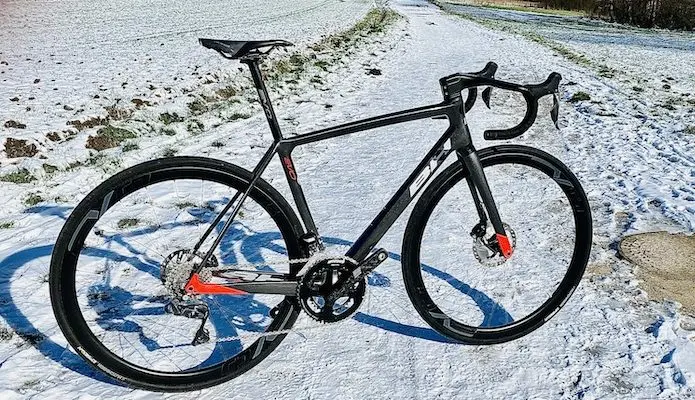
Light, stiff, and dynamic, the BH Ultralight evolves in its 2021 version with new cable integration and seatpost clamp, for a cleaner look and a more ethereal style. It retains versatile and accessible handling, and only a few adjustments would be enough to make this Ultralight Evo 8.5 the equal of the most high-end bikes.
By Guillaume Judas – Photos: @3bikes.fr / BH / DR
For several years, the Ultralight has been BH’s flagship model, with a lightweight frame with consensual shapes, owing its dynamism to its lateral stiffness and short chainstays. The disc brake version (now the only one in the catalog) has retained the same characteristics, and the 2021 livery benefits from new developments with the integration of brake hoses and derailleur electric wires into the head tube, as well as a completely integrated seatpost clamping system.
This BH Ultralight Evo is available in four versions and five colors, and it is eligible (for three out of four bikes) for the BH Unique program, which allows customization of colors and position elements from over 32,000 possible combinations.
- The Ultralight Evo 8.0 with Shimano Ultegra Di2, Vision Team 35 aluminum wheels, BH SL Compact cockpit, and Rotor crankset at €5499.
- The Ultralight Evo 8.5 in our test with Ultegra Di2, BH Evo 38 carbon wheels, a BH Evo ACR monocoque cockpit, and an FSA SLK crankset at €6299.
- The Ultralight Evo 9.0 with Shimano Dura-Ace Di2, BH Evo 50 wheels, FSA Metron 5D ACR cockpit, and FSA K-Force crankset at €8999.
- The Ultralight Evo 9.5 with Sram Red eTap AXS, Zipp 454 wheels, and FSA Metron 5D ACR cockpit at €11,999.
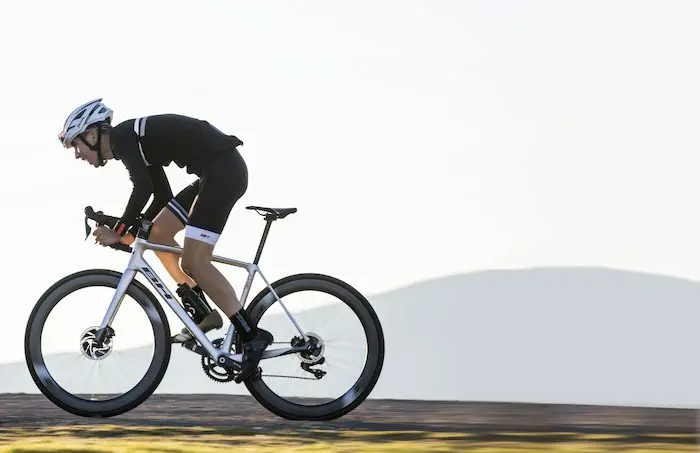
High-level carbon
For manufacturing, BH uses Japanese Toray T1100G carbon fibers, assembled with an exclusive BH molding technology called HCIM-Hollow Core, whose purpose is to reinforce specific areas with stronger fibers while eliminating structural imperfections inside and outside the tubes. A sophisticated design that allows the Spanish brand to integrate not only the cables at the cockpit and head tube (thanks to the ACR steering system), but also to offer a completely new seat clamp also integrated into the frame at the junction between the seat and top tubes, all without gaining weight compared to the previous version.
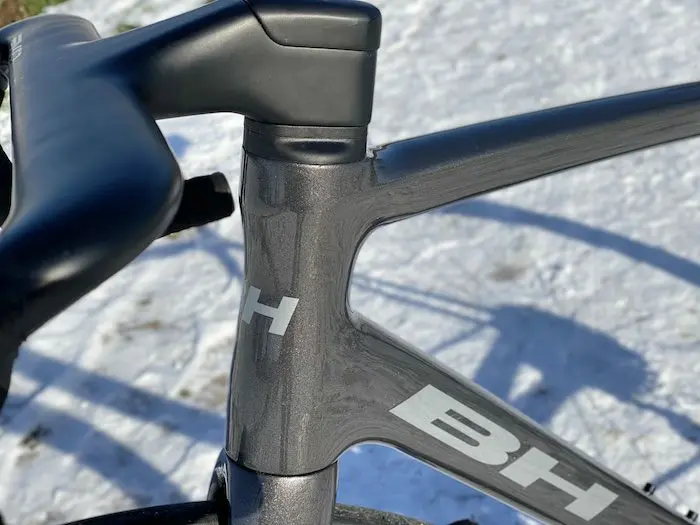
It is mainly this integration that allows the Ultralight to improve aerodynamically, as the frame retains its imposing and square-shaped down tube approaching the bottom bracket, which itself is very wide and still to the BB386 Evo standard, to promote lateral stiffness.
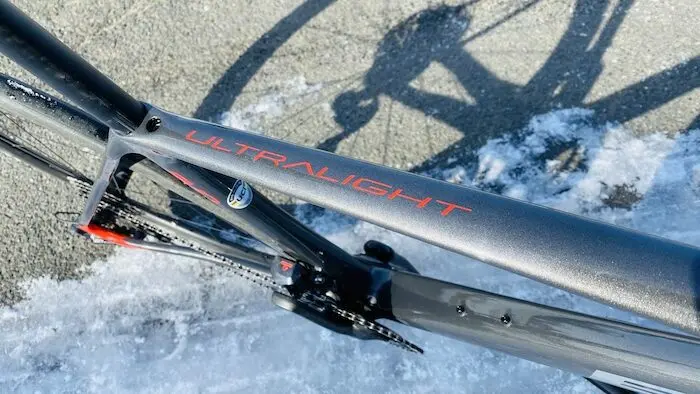
At the rear, there are still quite high and especially very short chainstays, particularly for a disc brake bike, since the rear spacing is limited to 402 mm, which normally favors the bike’s responsiveness. But this compactness does not prevent the frame from being compatible with tires up to 30 mm wide, which can be a good option for those looking for more comfort over long distances.
This new Ultralight Evo retains the same geometry as the previous version, still with only five sizes, a fairly long top tube and especially a head tube that goes from 120 to 150 mm from SM to MD, then from 150 to 185 mm from MD to LA. On XS and SM sizes, the straightened seat tube, zero-setback seatpost, and long top tube provide a forward position. It is therefore necessary to carefully choose the right size, as the differences in position can be significant. We also note that on all sizes, the head angle generally favors steering responsiveness.
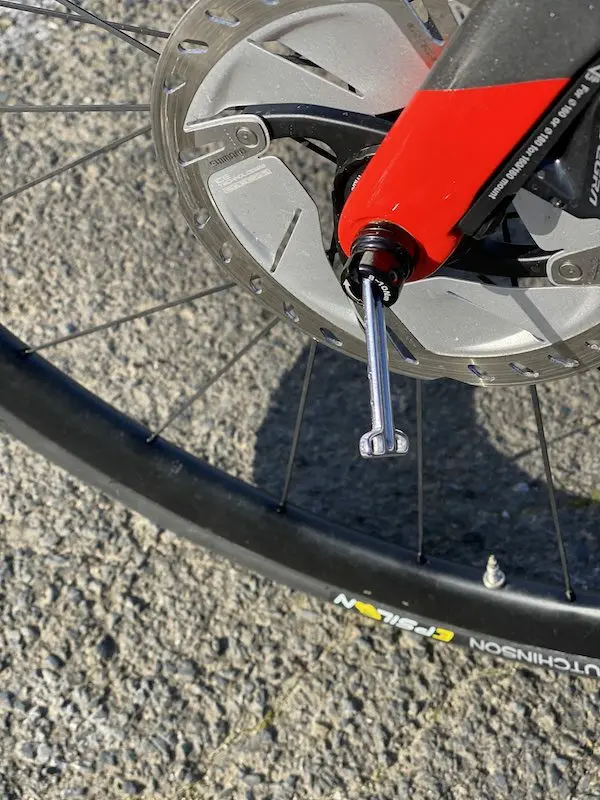
Finally, a very practical detail on this bike concerns the thru-axles, equipped with a Quick Lever clamping lever completely concealed by integrating into the axle, and which can be used without any tools.
Reliable and high-performance equipment
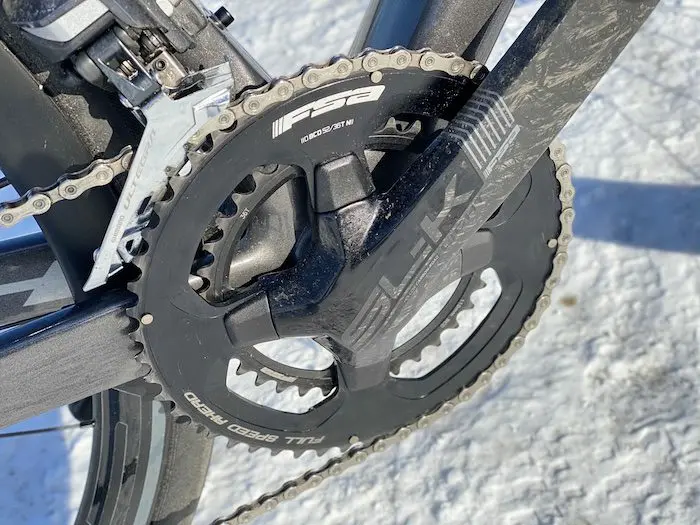
The frame alone is announced at approximately 750 g in size MD (our test size), which seems roughly consistent with the measured weight of the complete bike (7.560 kg without pedals). The Ultegra Di2 groupset is optimized here with an FSA SLK crankset, which saves about fifty grams, in addition to being directly compatible with the BB386 standard.
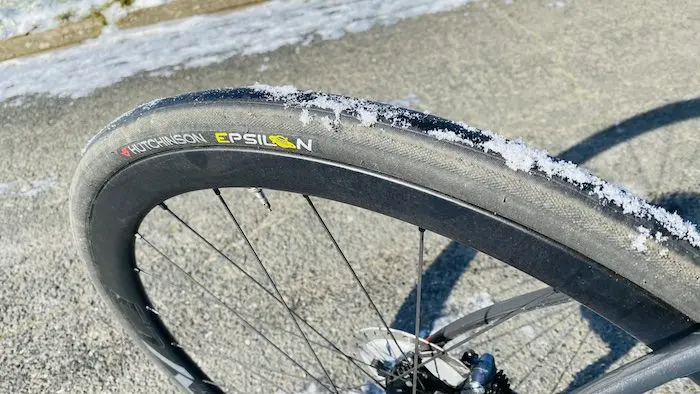
The BH Evo 38 carbon wheels are mid-range for this type of product, and stand out mainly for their versatility, with a weight of around 1500 g per pair. They are unfortunately fitted with Hutchinson Epsilon tires that are not at all in line with the bike’s level of quality, and which will need to be changed as soon as possible to improve efficiency and road feel.
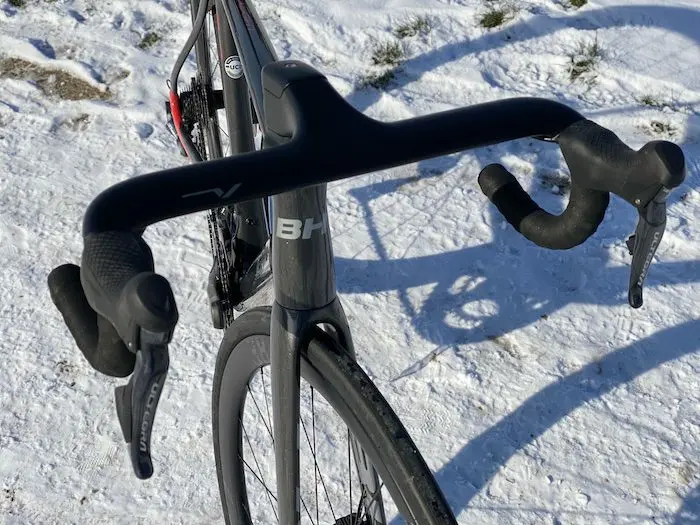
Just like the latest BH RS1, the Ultralight Evo in this 8.5 version is equipped with the Evo Monocoque ACR cockpit, with fluid shapes to cut through the wind and perfectly integrate the cabling, but relatively traditional with its wide, square top section and round grip at the bottom. It is an ergonomic success.
The equipment is completed by a short Prologo Dimension saddle (supposed to favor an “aggressive” position on the bike with hands in the drops) mounted on a BH Evo seatpost with a 27.2 mm diameter and no setback.
Aside from the tires, the BH Ultralight Evo 8.5 doesn’t have many flaws and is rather focused on versatility. More upscale wheels could undoubtedly give it a sharper temperament, or a bit more inertia on the flats (depending on needs). Given the equipment, a weight around 7.2 kg seems reasonable for the two highest-end versions of the collection.
A family resemblance
Several hundred kilometers with the Ultralight were not enough to highlight a fundamentally different behavior from its predecessor (rim-brake). The Ultralight Evo 8.5 with disc brakes is certainly a bit heavier, but retains a character that does not betray its lineage, except perhaps at low speeds and when chaining winding turns. In these conditions, the wheels lack a bit of stiffness, and above all the tires lack efficiency while being difficult to grasp in terms of grip and responsiveness. But the bike remains playful, bouncy, responsive, and quite lively in changes of pace.
These same wheels also struggle a bit on long straightaways, but they at least have the advantage of not offering too much wind resistance in the winter gusts. Let’s say that by adopting a good cruising speed, without very muscular accelerations and without chasing the clock, they prove to be completely neutral and do not distort the bike.
A test with higher-end tires already changes the game in terms of road feel and responsiveness. Another with deep-section wheels demonstrates the interesting potential of the Ultralight on flatter courses, even if it is not a pure aero bike to begin with.
Back in its original configuration, we appreciate its accessible side and the fact that it is comfortable on many profiles. We can certainly feel significant lateral stiffness and the impression that it transmits a good part of the energy we put into it to the road, but the thinner and more “reptilian” upper part of the frame allows it not to be totally locked and only intended for the most athletic riders.
The BH is designed to transmit the cyclist’s energy without any loss. But it remains a “lively” and reactive bike, and above all accessible to a wide range of users.
In terms of comfort, the round seatpost offers a bit of flex, and the Prologo saddle provides excellent support and a firm, sporty position, but without causing pain. The cockpit also deserves an excellent mention, thanks to the ergonomics we appreciated. The clamping system is quite simple, but it is necessary to tighten firmly, at the risk of the handlebar turning while riding. The remark also applies to the seatpost, which we had difficulty locking during the first ride.
The gear range is versatile with 52-36 tooth chainrings and an 11-30 cassette. Such a spread allows exploring new terrains and it will not be necessary to change anything on the bike to go on vacation, for example. The 36/30 already offers many possibilities in terms of gradients and elevation, but obviously the cassette can prove a bit uncomfortable on rolling terrain with a gap in the range and a significant difference between the 15 and 17 teeth, cogs very often used when riding a bit above 30 km/h average.
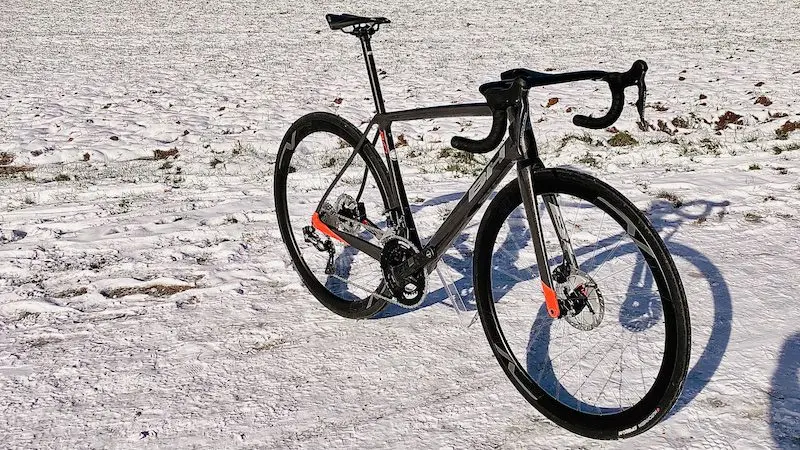
At €6299, the BH Ultralight Evo 8.5 is not particularly cheap, and is still perfectible in terms of rolling gear. However, if we compare it to other competing models of an equivalent price and with disc braking, we feel that it is rather well placed in terms of weight. And above all, like its predecessor, it continues to give the illusion of being lighter than it actually is, thanks to its handling, resulting from a clever blend of stiffness, comfort, and accessibility. This Ultralight Evo therefore has a certain potential for evolution, to make it as high-performing and sophisticated as a professional racer’s bike. This tested bike is perhaps the best offer in the Ultralight range, in terms of value for money and performance.
The BH ULTRALIGHT EVO 8.5 in brief… Rating: ***** Pros: integration, light and dynamic handling, finish Frame: Ultralight Evo Disc ACR Carbon Monocoque – Fork: Ultralight Evo Disc, Integrated Tapered Full Carbon 1.5″ – Cockpit: BH EVO Monocoque ACR – Brakes: Shimano Ultegra hydraulic – Front Derailleur: Shimano Ultegra Di2 11 sp. – Rear Derailleur: Shimano Ultegra Di2 11 sp. – Levers: Shimano Ultegra hydraulic Di2 – Cassette: Shimano Ultegra 11-30 – Chain: FSA TH-CN1102 – Crankset: FSA SLK 52/36 – Wheels: BH EVO 38 Disc V3 – Tires: Hutchinson Epsilon 700×25 – Saddle: Selle Prologo Dimension – Seatpost: BH EVO 27.2 – Weight: 7.560 kg in size MD without pedals – Number of sizes: 5 – Price: €6299 Contact: www.bhbikes.com |
=> SEE ALSO: All our Gear articles
Share the post "BH Ultralight Evo 8.5 Review"