Share the post "Polar H10 Heart Rate Sensor Review"
Among the various heart rate sensors available on the market, not all offer the same features or accuracy. Compatible with all devices and activities (including swimming), comfortable, and above all very accurate, the Polar H10 chest strap stands out from the competition, as we were able to verify after a hundred hours of testing.
By Guillaume Judas – Photos: @3bikes.fr / Polar / DR
Polar was a pioneer in heart rate measurement during exercise as early as the mid-1980s, with the first Sport Tester (a watch connected to a chest strap to capture heart rate) which launched a true revolution in training. From that time on, it became possible to monitor heart rate during exercise, in order to optimize the time spent in certain intensity zones, for faster and more targeted progress. Heart rate monitoring is also very useful for managing energy intake, limiting deviations related to dehydration, anticipating an illness or heart problem, or following doctors’ instructions based on age or medical history.
This was a first step towards so-called scientific training, long before the advent of power meters. By extending its technology to more affordable products in subsequent years, the Finnish brand remained a leader in its field at least until the late 2000s. It took the emergence of new players in the market, the launch of multifunction bike computers/GPS devices, and various training tracking applications (like Strava) for Polar to lose some of its luster in the eyes of connected athletes and cyclists. Because Polar lagged behind in terms of compatibility for a long time, with the inability to transfer training data to the Mac OS operating system for a while, for example, or the absence of the ANT+ communication protocol which allows devices from various origins to be linked together.
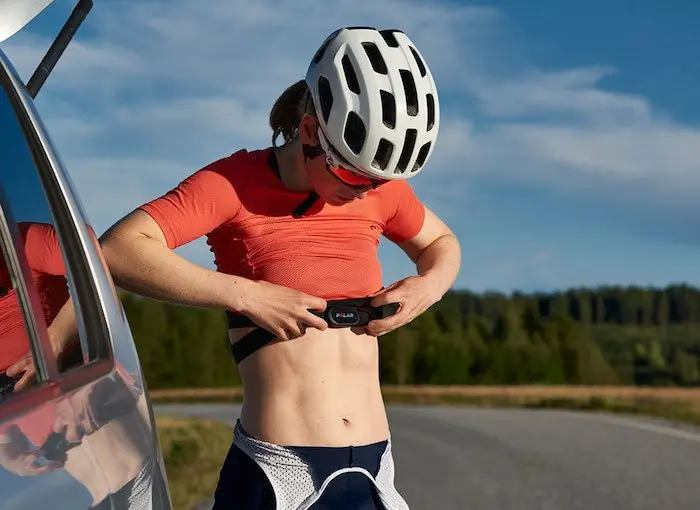
But all of this is now ancient history with the new generations of heart rate sensors, of which the H10 strap is the top-of-the-range model. Equipped with dual Bluetooth communication and ANT+ communication, it is compatible with all bike computers/GPS devices on the market (Polar, Garmin, Wahoo, Bryton, etc.) or all smartwatches, as well as all types of smartphones and, of course, training and/or indoor trainer applications like Zwift, for example. The H10 can also be connected to two devices simultaneously. Thanks to 5 kHz transmission, it can also be used in water, a very interesting feature for swimmers and triathletes. Finally, when paired with the Polar Beat application, the strap is capable of recording a training session on its own, without the need to carry any device. To do this, simply start the recording when you leave, leave your phone at home, and validate the session upon return so that all heart rate data is transferred to the application.
Note that this high-performance heart rate sensor is also available in an H9 version, with the same features except for recording a session without a device, and with a strap that is slightly less effective in terms of support.
Unrivaled accuracy and reliability
But it wasn’t on this subject that we were expecting the Polar H10 to shine. Given its higher price than the competition (around €90) and compatibility already found on straps sold for €35 to €70 (Geonaute, Wahoo, Garmin, etc.), it is the accuracy of the values that seems most important to us here, whether communicated via ANT+ to a Garmin bike computer, or via Bluetooth to the computer for Zwift.
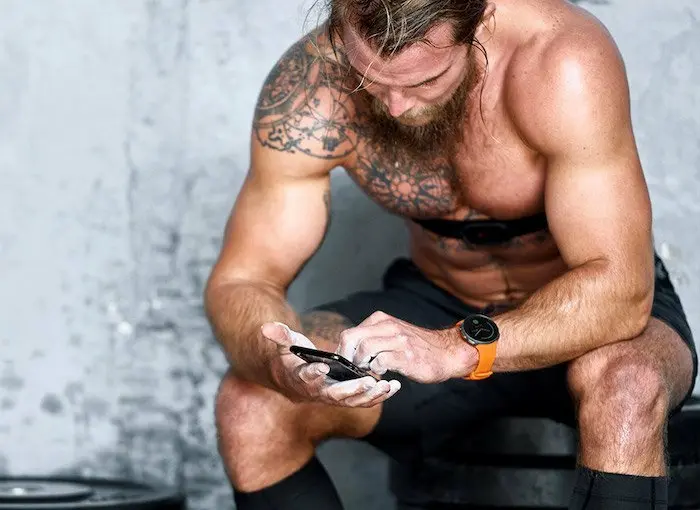
The Polar H10 uses an electrocardiogram, or ECG, to measure heart rate. Polar is capable of measuring RR, which is the precise interval between beats, a feature that not only offers more accuracy but also allows for measuring fatigue levels through an orthostatic test (with a compatible Polar device). This ECG system works by decoding the heart’s electrical impulses, unlike devices that use optical technology, such as wrist-worn watches, which measure blood flow. In this area, Polar undoubtedly has more experience than the competition, as we observed in the field, after riding with several straps.
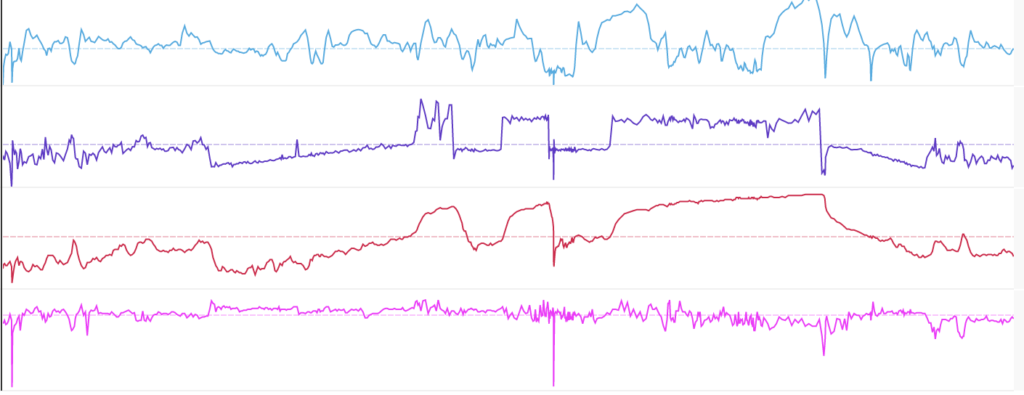
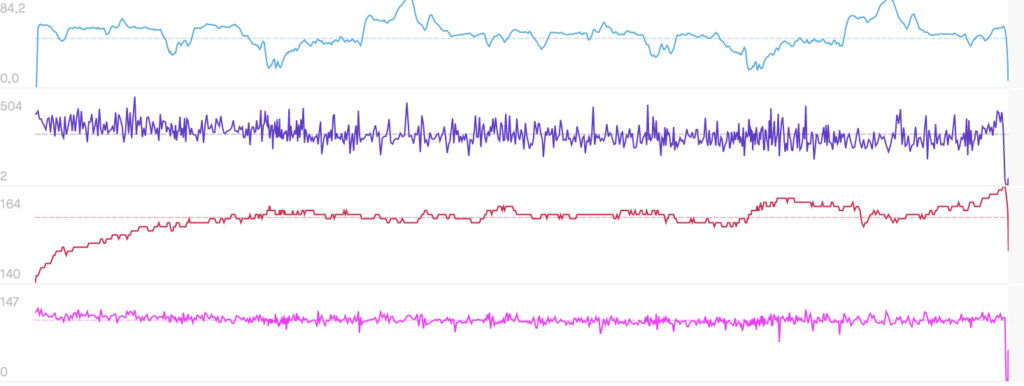
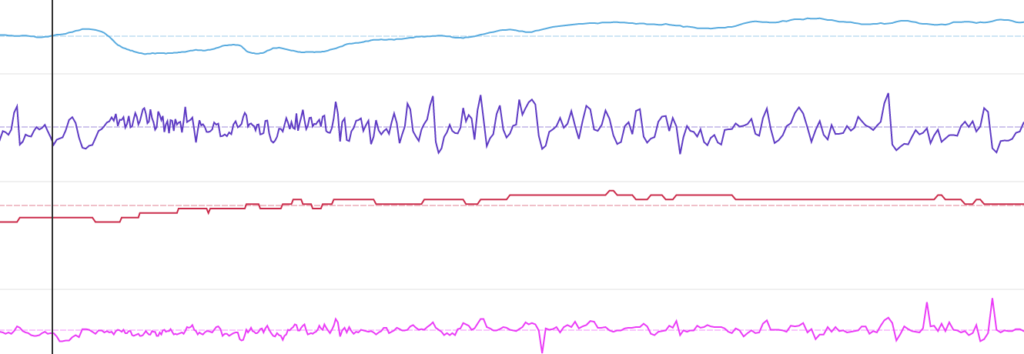
Of course, this precision may seem secondary to many practitioners, as many even ride without heart rate monitoring and solely by feel. However, when one takes the step of using a heart rate sensor, whether for the quality of training or for health monitoring, it seems important to do so under good conditions and with a device that can be relied upon. The Polar H10 strap therefore seems to us to be the most reliable and accurate on the market today.
Top comfort and support
Here again, all of Polar’s experience is reflected in the design of the strap, which is worn without discomfort and stays perfectly in place. Available in two sizes, the strap is of course adjustable in length. Be careful, however, when choosing the correct length, because with a chest circumference of 90 cm, we had to adjust the strap to its maximum length in size XS-S.
The non-stretchable part of the strap (with the sensors) measures 40 cm. The softer part has small silicone nubs that ensure excellent support without the need to overtighten. This is the first strap we’ve used without needing to readjust it on the chest once dressed. And while riding, you completely forget about it, even if the main unit that clips onto two buttons in the middle of the pectorals is a little thicker than average. The strap’s closure system is firm and clear. We just have some reservations about its thinness, and we wonder about its long-term reliability.
Perfectly placed on the chest, the Polar H10 does not slip during exercise (as is sometimes the case with a Geonaute or a Wahoo), and is absolutely not felt. In a hundred hours of use, it has not caused any marks or irritation on the skin, as is the case for us with a Garmin HRM Dual strap.
| The Polar H10 strap in different versions |
Finally, in terms of battery life, the Polar H10 strap is rated for 400 hours with Bluetooth transmission, meaning the battery life (CR 2025, whereas competing products use a CR 2032) is equivalent to the competition, except for Garmin, which is a little more economical.
While Polar is only catching up in terms of compatibility and features, and even if some competing models sold at an equivalent price do better by measuring running cadence, vertical oscillation, or stride length, for example (like the Garmin HRM-Run), the Polar H10 heart rate sensor delivers the essentials. Whether it’s for training monitoring, precise statistics, or health monitoring, Polar reclaims leadership in heart rate measurement with this very high-end H10 sensor, which is well worth its selling price.
| The Polar H10 heart rate sensor in brief… Rating: * Pros: accuracy, compatibility, comfort HR measurement method: ECG – Battery life: 400 h – Water resistance: 30 m – Strap: Polar Pro Strap – Compatibility: ANT+, Bluetooth, 5 kHz transmission (Gymlink), all third-party devices and applications – Weight: 60 g – Sizes: XS/S and M/XXL – Price: €89.90 Contact: Polar.com |
=> SEE ALSO: All our Gear articles
Share the post "Polar H10 Heart Rate Sensor Review"