Share the post "In-Depth Review of the Shimano Ultegra R8020 Disc Groupset"
Introduced just over three years ago (in late summer 2017), the Shimano Ultegra groupset with cable-actuated derailleurs is one of the most reliable options among mid- to high-end bicycle drivetrain components. We were able to conduct a long-term test of the disc-brake version, which is available on many bikes in manufacturers’ 2021 lineups. Here’s our verdict.
By Guillaume Judas – Photos: @3bikes.fr / DR
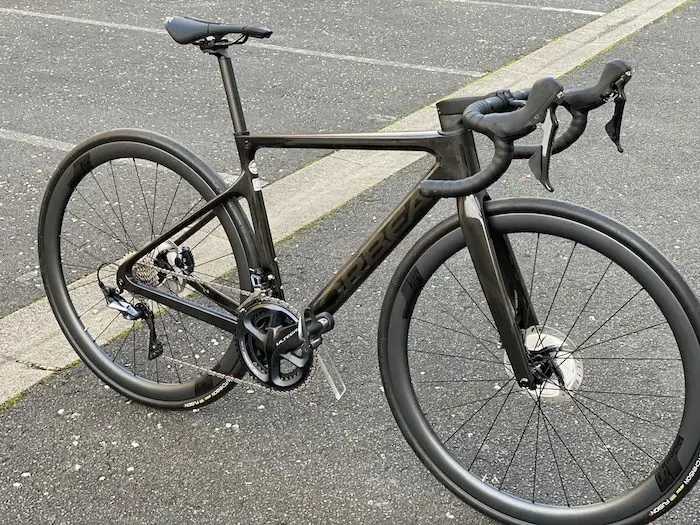
For nearly 40 years (formerly known as Shimano 600), the Shimano Ultegra groupset has been one of the jewels in Shimano’s crown, positioned in the mid-to-high-end segment just below Dura-Ace and above 105. Over the course of its evolution—the latest update dating back to late 2017—it has adopted the features and functionality of Dura-Ace, though with slightly heavier and somewhat less durable materials. In terms of performance—whether in braking or the smoothness and precision of shifting—it has often come very close to Dura-Ace, which explains its popularity among many racers and recreational cyclists. It is typically found on many bikes in a price range from €2,500 to just over €5,000, as is still the case in 2021. The latest version is no exception to the rule, regardless of the specific model. Shimano’s latest groupset comes in four variants, each with a different code name:
- Ultegra R8000 for the rim-brake version with cable-actuated derailleurs
- Ultegra R8020 for the version with disc brakes and cable-actuated derailleurs
- Ultegra R8050 for the version with rim brakes and electronic derailleurs
- Ultegra R8070 for the version with disc brakes and electronic derailleurs
The Ultegra R8020 with disc brakes is therefore an interesting option, as it retains the operation of derailleurs with traditional cables while incorporating disc brakes, which are becoming increasingly common among bike manufacturers. As a result, this version maintains a relatively affordable official price of around €1,200 (depending on options and various promotions).
Increased Weight
On our test model, mounted on an Orbea Orca OMR M25 Team bike, the Ultegra groupset weighs in at nearly 2,800 g, which can be considered quite heavy. By way of comparison, that’s nearly 300 g more than the R8000 with rim brakes, or 640 g more than the Dura-Ace Di2 with rim brakes. Compared to other groupsets with disc brakes, it’s 300 g heavier than a SRAM Red AXS, a Campagnolo Super Record, or a Shimano Dura-Ace, but weighs about the same as a SRAM Force AXS or a Campagnolo Chorus, while being less expensive.
For some, weight is a secondary consideration, and it’s clear that it doesn’t affect performance here. Nevertheless, this is also why, with this category of groupset, it’s nearly impossible to get below 8 kg for a complete bike with disc brakes, and you have to spend significantly more to compete with a rim-brake bike (at least €10,000 to have any hope of reaching 7 kg).
Unique ergonomics
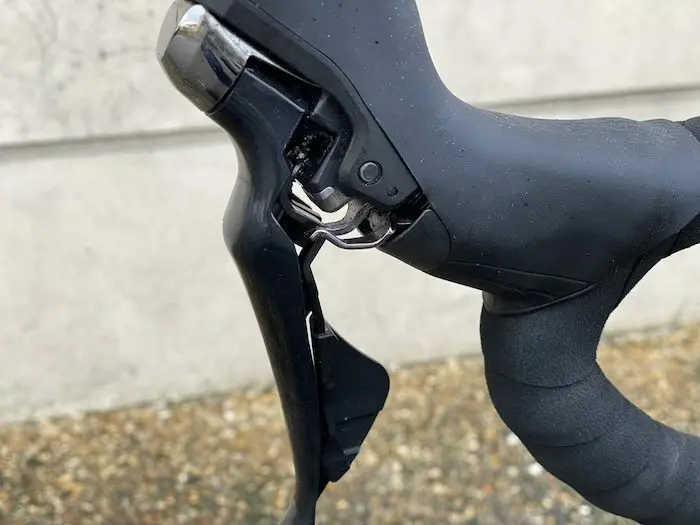
Another criticism that can be leveled against hydraulic disc brakes concerns the shape and ergonomics of the shift levers, which are quite bulky here due to the oil reservoir located on top of the levers. While the integration is particularly well-executed on the Di2 levers (Dura-Ace and Ultegra) thanks to the absence of a shifting mechanism, the non-Di2 versions are very bulky, in addition to being heavy. This weight directly above the front wheel slightly detracts from the smooth, light feel of the steering while riding.
On the other hand, on the mechanical Ultegra shifters, certain parts of the mechanism aren’t covered by the brake caliper, which gives it a somewhat cheap finish and makes it uncomfortable when you grip the levers firmly.
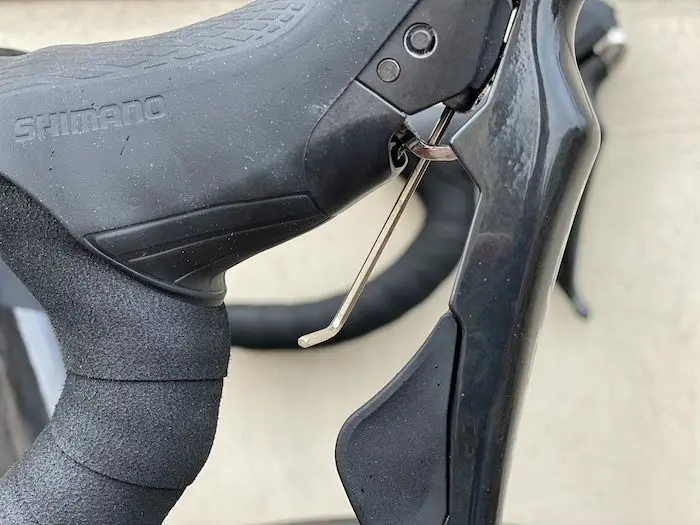
Fortunately, these shifters—which are, after all, the main point of contact between the rider and the drivetrain—are particularly easy to use, whether for braking or shifting gears. The shape of the brake lever provides a good grip for braking with your hands on the shifters. The reach is adjustable via a small screw located beneath the mechanism and accessible with a 2 mm Allen wrench, allowing you to adjust the distance between the lever and the handlebars for braking with your hands in the lower position. This is convenient for those with small hands or depending on the shape of the handlebars.
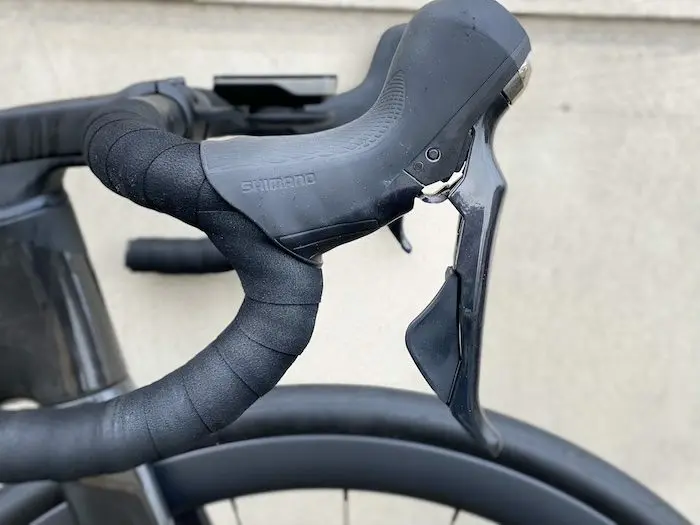
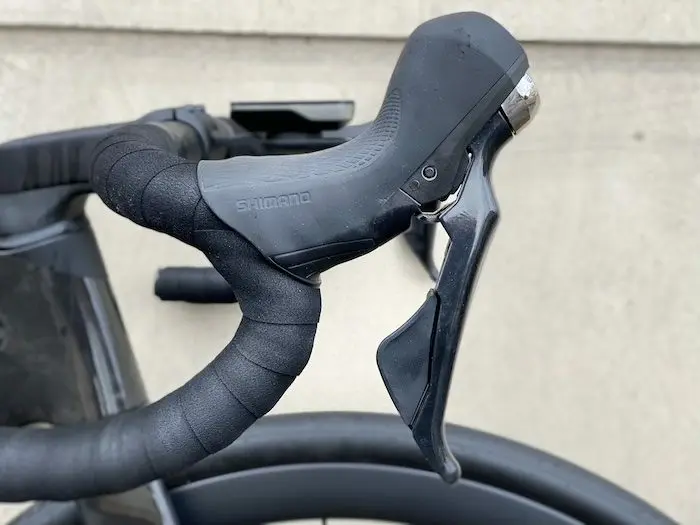
To shift gears, moving the main lever significantly inward allows you to shift up to three cogs at a time on the cassette, whereas the smaller lever only allows you to shift down one at a time. In either direction, the travel required to operate the derailleurs is much greater than on Di2 shifters, so it’s not possible to shift gears in rapid succession. But you get the hang of it very quickly, especially since the drivetrain operates very smoothly, thanks to the low-friction SP41 cables and housings. In the case of the Orbea Orca, this smooth operation is all the more remarkable given that the derailleur housings run under the stem and inside the head tube before routing entirely internally through the frame, with a particularly tight routing pattern.
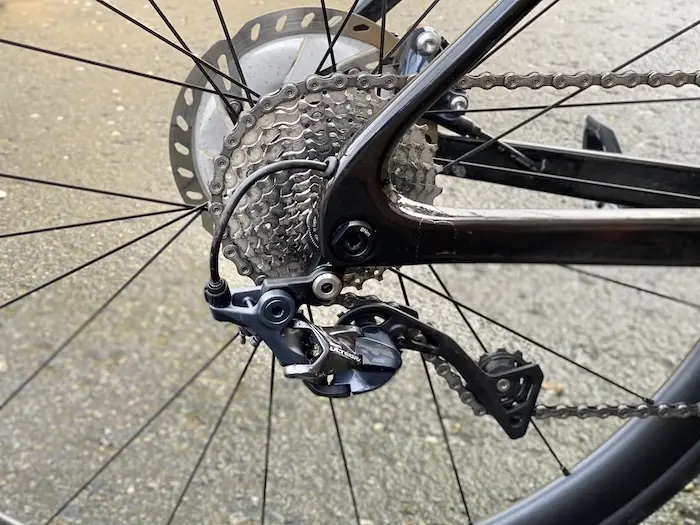
Precise shifting
In addition to the smooth operation of the derailleurs, we commend their precision and the near absence of unwanted noise. At the rear, despite wheel changes and mounting the bike at least twice a week on a connected indoor trainer—which requires removing the rear wheel—we didn’t have to make any adjustments over nearly 4,500 km. The system operates precisely and quietly under all circumstances, except with an extreme 53/30 gear combination—that is, the largest chainring with the smallest sprocket on the cassette. Note that the groupset on our test bike features a long-cage derailleur (GS) that accommodates cassettes with a largest sprocket of up to 34 teeth.
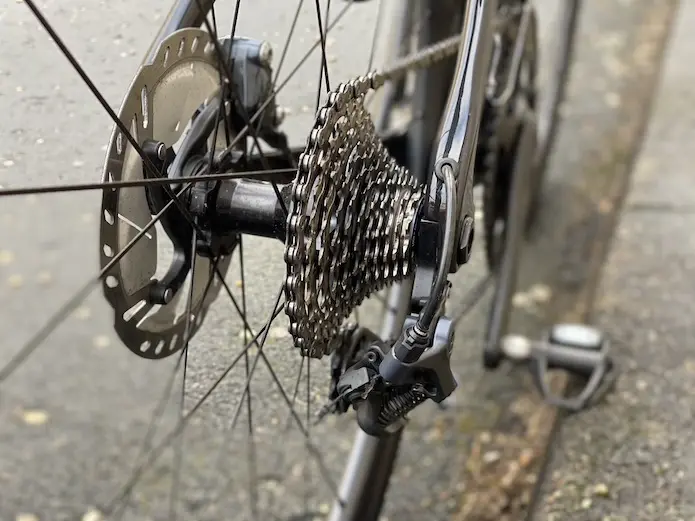
The same praise applies to the front derailleur, which even features an intermediate notch to reposition the fork in case of frequent chain crossings. Our only regret is that this notch is slightly less firm than during a standard gear shift, which sometimes makes it hard to feel—especially when wearing thick winter gloves. Chainring shifts are very fast and efficient with the Ultegra crankset and its highly rigid Hollowglide chainrings, which feature a ramp to facilitate the chain’s transition from one chainring to the other. However, when tested with a different crankset, the Ultegra drivetrain proved just as effective, though perhaps a tad slower when shifting from the small chainring to the large one.
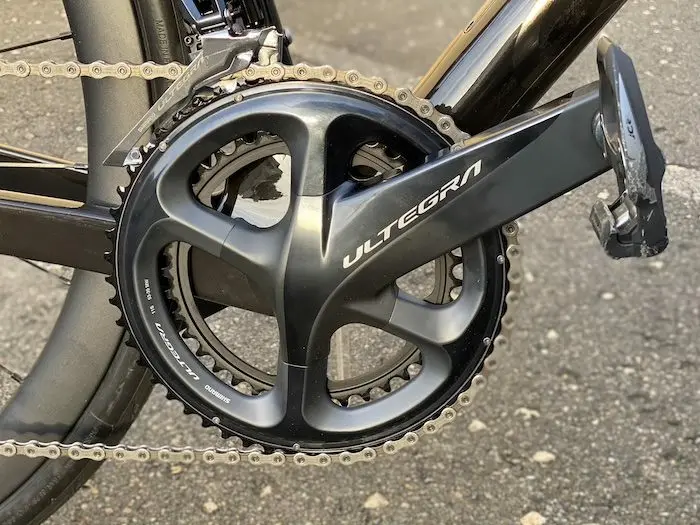
This same front derailleur has been refined and redesigned to allow more space for mounting a wider rear tire, and the section of cable protruding from the clamp now has a dedicated, neater location that reduces the risk of fraying or injury when carrying or cleaning the bike.
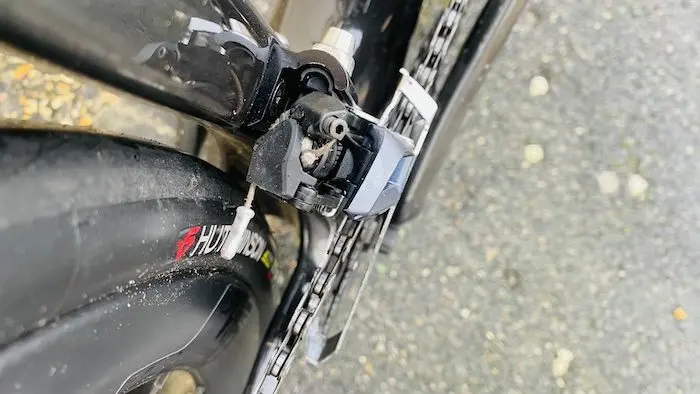
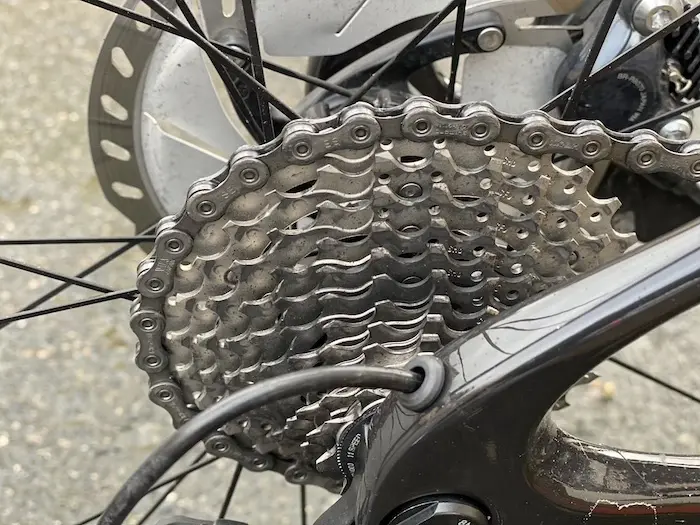
Even with a chain nearing the end of its life, we’ve noticed no decline in shifting performance. And yet it’s been through it all—rain, mud, salt, and sand—the typical debris encountered on winter roads. Still, it’s best to follow the maintenance intervals for this wear-and-tear part (about 4,500 km in winter and a maximum of 6,000 km in summer) and replace it before it causes significant damage to the cassette and chainring teeth.
=> SEE ALSO: Buy Shimano Ultegra components on sale
Very powerful braking
Unsurprisingly, the hydraulic disc brakes are very powerful, regardless of the conditions. Here, Orbea has opted for a bike setup with two 160-mm rotors, whereas the standard is typically 160 mm in the front and 140 mm in the rear. Some riders even prefer to install two 140 mm rotors—which are more prone to overheating on long descents and, consequently, to warping—to save about 20 grams per rotor.
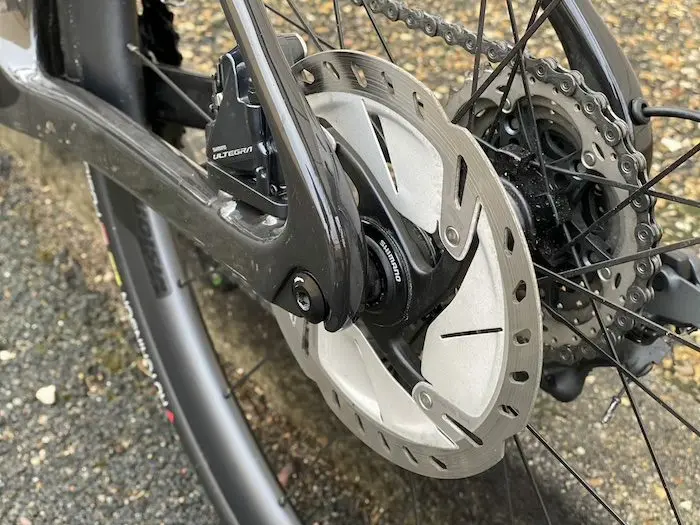
There is still much debate about whether or not it’s worthwhile to have such powerful braking on a road bike, given that many experienced riders already don’t fully utilize the potential of their rim brakes. No matter how powerful the braking may be, its effectiveness on a road bike depends on several factors, particularly the contact with the ground. A road bike has no suspension and no wide tires inflated to low pressure. To get around this issue and reassure consumers, many brands offer bikes with wide tires—as seen here with Orbea’s 30 mm tires (measured at 32 mm)! With this setup, you quickly gain confidence and a real sense of control over the bike, even on the slippery roads of November and December. Braking feels reassuring in both dry and wet conditions, and the shorter stopping distance is reassuring in the city or when encountering an unexpected obstacle.
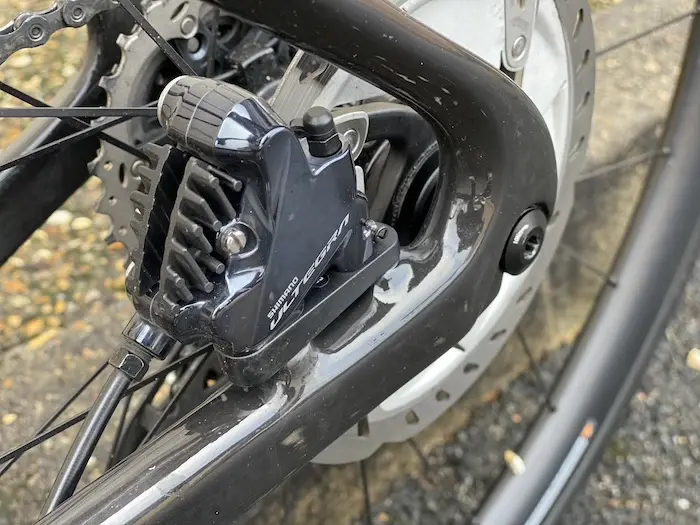
In search of a bit more responsiveness and by fitting tires better suited to sporty riding (25 mm section width, or 27 mm as actually measured on the rims), braking becomes much harder to modulate with the 160-mm rotors (especially at the rear) given our light weight. Even in dry conditions, applying even slightly too much pressure to the right lever is enough to lock up the wheel (when approaching a stop sign or traffic light, for example), and on wet roads, it’s best to apply the brakes with finesse, or you risk losing control of the bike as the rear wheel skids. So there’s no doubt about it: the Shimano Ultegra disc brakes stop the bike very effectively, no matter the conditions!
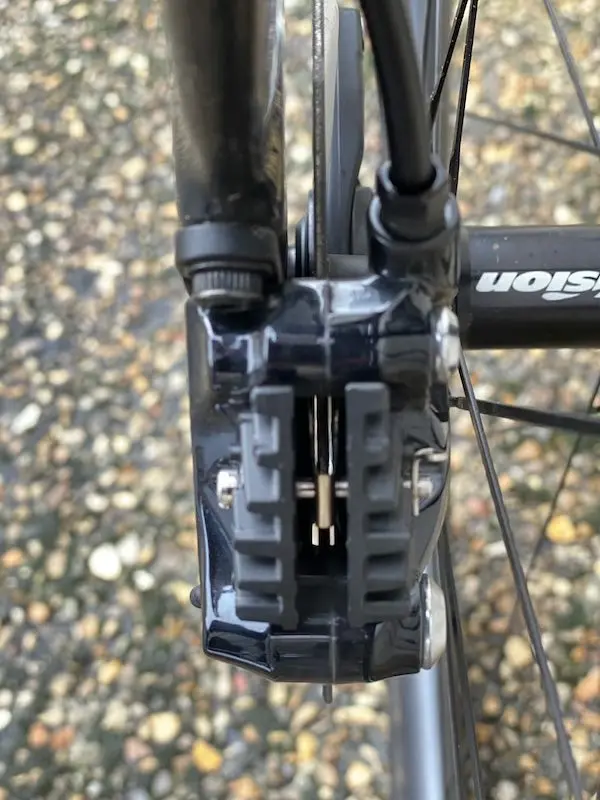
Over 4,500 km, we didn’t notice any unwanted noise in dry conditions. Things get a little worse in the rain, with the rotors emitting a high-pitched squeal when applied while wet. The noise disappears once the rain stops (even if the road remains wet). Under normal conditions, the rotors do not rub against the brake pads, despite the very narrow clearance between them. After hard braking, you may feel a slight rubbing sensation for a few seconds while the pads settle back into place, but this has no negative consequences. However, a scraping or rattling noise may persist for quite some time in heavy rain, especially when riding on a muddy country road where sand or tiny pebbles get lodged between the pads and the rotors.
Equipment manufacturers, frame builders, and mechanics are becoming increasingly proficient with this technology, ensuring excellent build quality and, above all, relatively easy adjustment of the caliper position.
It must be noted, however, that in recent years, component manufacturers, frame manufacturers, and mechanics have been getting better and better at mastering this technology, ensuring excellent build quality and, above all, relatively easy adjustment of the caliper’s position relative to the wheel for the user—as is indeed the case here with the Orbea Orca M25 Team.
What about reliability?
Over the course of our test, we observed no loss of braking travel (so no bleeding is needed in the immediate future) nor any change in the quality of shifting.
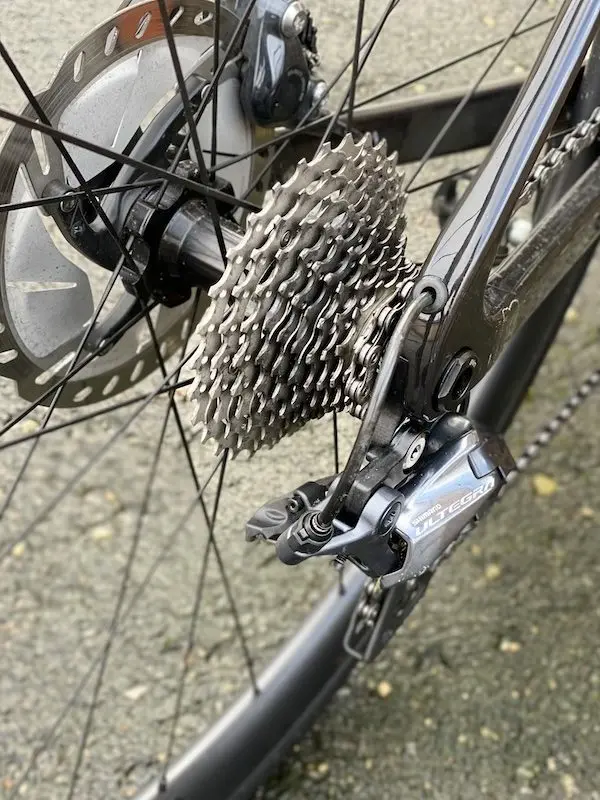
The chain will need to be replaced soon to protect the cassette teeth and extend its lifespan. Made from different materials than the Dura-Ace, the Ultegra cassette is slightly less durable, but you can expect to get nearly 30,000 km out of it—enough to wear out at least four chains. Note, however, that cassettes with a wide gear range (such as the 11-30 shown here) are more prone to wear than those with smaller gaps between each sprocket, simply because these “gaps” in the range sometimes require you to stay on the same sprocket for longer.
To explore this further, we spoke with one of our colleagues who has been riding with this groupset for three years. He explained that he has replaced his brake pads every 10,000 km, his derailleur cables and housings at 20,000 km, and his brake rotors at 40,000 km. More troubling, he began experiencing shifting problems with the left shifter at 30,000 km, having to pull the lever several times to get the derailleur to respond. The problem was temporarily resolved after applying penetrating oil to the mechanism.
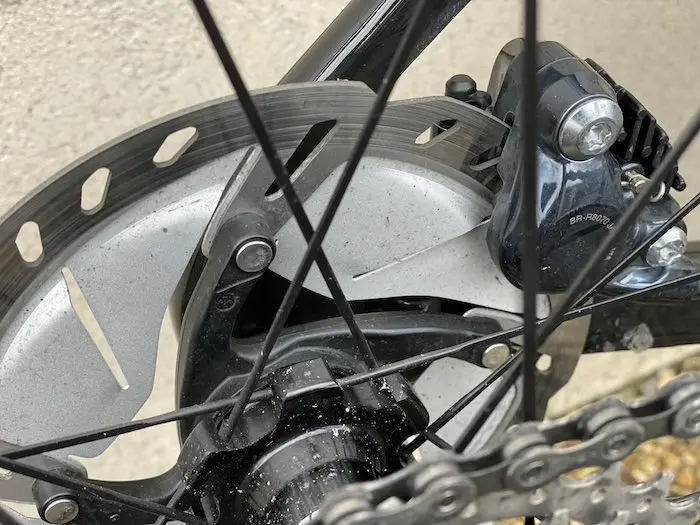
Overall, however, the mechanical Ultegra groupset is very reliable, and as far as the disc brakes are concerned, there are no issues to report as long as installation and maintenance (bleeding) are performed correctly and without tampering with the bleed screw, which could potentially cause fluid leaks.
What’s the practical difference compared to top-of-the-line groupsets?
Between an Ultegra R8020 groupset with disc brakes and cable-actuated derailleurs and a top-of-the-line groupset (also with disc brakes), the main difference is… about 300 g. But the price also triples just for this component alone. Obviously, we can also factor in the difference in comfort offered by electronic shifters, as well as the quality of certain bearings (on the bottom bracket and rear derailleur) and the durability of certain components like shift levers or derailleurs, which tend to develop less play over time in high-end models. If there is a difference in quality, it isn’t huge.
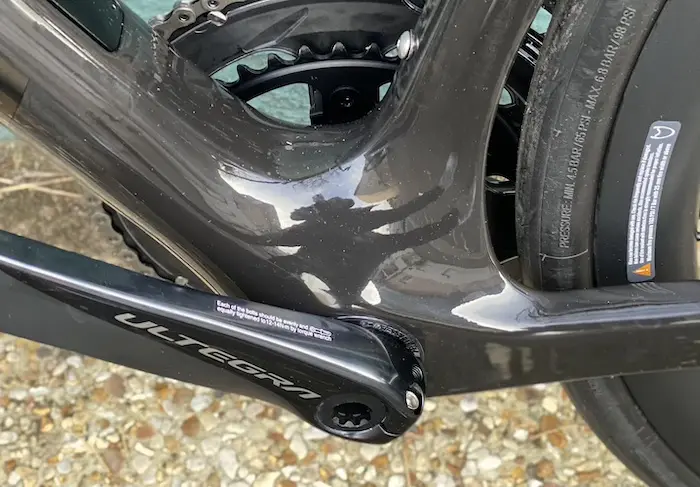
In terms of handling and performance on the road, the slightly heavy shift levers on the handlebars are somewhat noticeable and make steering feel a bit heavier. But otherwise, braking and shifting are just as smooth and precise as on higher-end groupsets. In any case, it’s impossible to blame the groupset—and by extension, the bike’s price—for any lack of performance. Choosing a groupset like the Ultegra R8020 is therefore first and foremost a rational decision, whether on a complete bike or as an aftermarket upgrade. Although nearing the end of its product cycle, the Ultegra remains a safe bet, and its value for money is spot on.
| The SHIMANO ULTEGRA R8020 DISC groupset at a glance… Rating: ***** Pros: value for money, performance, smooth shifting, reliability Approximate weights and prices of components: Combined shifters + brakes + rotors: 1,144 g / €760 Cranks available in 165/170/172.5/175 mm. Derailleur available with medium or long cage. Chainrings available in 53-39/52-36/50-34/46-36. 11-speed cassette available in 11-25/11-28/11-30/12-25/14-28. Aero brake and shifter options available. Levers available for smaller hands. Contact: bike.shimano.com |
=> SEE ALSO: All our Gear articles
Share the post "In-Depth Review of the Shimano Ultegra R8020 Disc Groupset"