Share the post "5 Indoor Trainer Workouts to Build Strength"
Current conditions are ideal for enjoying indoor trainer riding and training in a perfectly targeted way. We offer 5 workouts designed to build your strength, so that you become more powerful and more efficient on the road.
By Sébastien Argentin – Photos: Elite / Santini
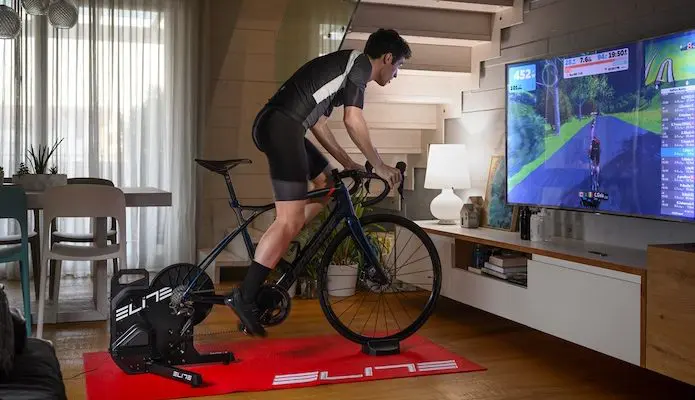
Connected platforms such as Zwift have revolutionized the way we ride indoors, making sessions more interesting and fun. The dynamics of the game and the simulation of climbs and descents, combined with suitable equipment (a realistic smart trainer, a fan…), even offer new ways to spend more time pedaling indoors. Riding for more than an hour on the indoor trainer is therefore no longer a real problem for maintaining or improving fitness, on a few conditions:
- By targeting your sessions and allowing yourself recovery periods (whether rest days or calmer moments in the middle of a session)
- By riding in a well-aired, ventilated space (a fan makes all the difference on the trainer)
- By staying properly hydrated before, during and after the session
- By supplementing your road training, at least for base endurance work
With these few precautions in mind, you can plan several types of indoor trainer workouts. Zwift offers its own training programs, but most of them focus simply on developing FTP (Functional Threshold Power, the maximum average power you can hold for an hour). Now, we know that the skills needed to progress on the road are a little more complex.
We therefore offer 5 typical workouts to build muscular strength, but targeting intensities that will also help you work on your FTP.
General Notes
Base target => trained cyclist, training at least 4–5 hours a week or more, with a MAP (maximal aerobic power) in the range of 4.5 to 6 W/kg.
=> SEE ALSO: a MAP test on Zwift
Adaptability => reduce the workload of the proposed session so it fits everyone’s level.
Progression => do the same session a second time, taking into account the work already done and slightly increasing the load or difficulty.
A flat course, with little or no change in gradient, is ideal for focusing on and following the instructions for each exercise. On Zwift, a route like Tik Tok in Watopia is particularly well suited.
To help you set the right intensity level, we use the ESIE scale.
The Subjective Effort Intensity Scale, based on the scale of ESIE, Grappe et al. 1999
|
Session 1 – Around Gimenez… – 1h25’
- 15′ progressive warm-up: start around 80–85 rpm (revolutions per minute) and gradually lower cadence to 70–75 rpm.
- 25′ split into 5x(4′ at I2/I2+ followed by 1′ at I4). The 4′ should ideally be done in a gear that keeps you at 50–60 rpm, i.e. 53×12-11 for a trained cyclist, and then keep that same gear for the 1′ at I4 (cadence should rise to around 75–80 rpm).
- 10′ active recovery, ideally close to 2 W/kg, but always with a cadence of around 50–60 rpm.
- 25′ split into 5x (4′ at I2/I2+ followed by 1′ at I4) Same as above!
- 10′ easy, gradually returning to a more traditional cadence, around 85–90–95 rpm.
Adaptability => You can start more easily with 2 blocks of 15′ or 20′ depending on your level.
Progression => Replace the 2 blocks of 25′ with 2 blocks of 30–35′, or with 1 block of 40′ plus 1 block of 20′.
Session 2 – Big-Gear Rhythm – 1h20’
- 20′ progressive warm-up: start with 5′ easy, breathing fully comfortable, with a cadence that gradually increases as muscle coordination develops, then continue with 8′ near I2, followed by 2′ near I3, and finally 5′ easy with a maximum acceleration of 5–6″ placed by feel. For cadence, start around 80–85 rpm during the first 5 minutes, then gradually lower it toward 70–75 rpm by the end of the warm-up.
- 12′ split into 6x (1′45″ at I2+ followed by 15″ at I5+/I6, ideally with a peak at around 150% of MAP). The base gear should be 53×12-11 to stay around 50 rpm during the 1′45″.
- 16′ active recovery, ideally close to 2 W/kg, but always with a cadence of around 50–60 rpm.
- 12′ split into 6x (1′45″ at I2+ followed by 15″ at I5+/I6, ideally with a peak at around 150% of MAP). The base gear should be 53×12-11 to stay around 50 rpm during the 1′45″.
- 10′ to continue at around 50–60 rpm at an intensity close to I2
- 10′ easy, gradually returning to a more traditional cadence, around 85–90–95 rpm
Adaptability => You can start more easily with 2 blocks of 8 or 10′ depending on your level. You can also skip the 10′ of I2 work between the last set and the final recovery.
Progression => Replace the 2 blocks of 12′ with 2 blocks of 16′, then possibly with 1 block of 20–24′.
Session 3 – Maximal Strength – 1h20’
- 10′ progressive warm-up: start around 80–85 rpm and gradually lower cadence to 70–75 rpm.
- 15’ in 53×12-11 at I2: with a 5–6″ acceleration at t=3’, 6’, 9’ and 12’.
- 5×10″ sprints in 53×12-11, all-out, seated, starting each exercise with a cadence around 40–50 rpm. Take a 1′50″ recovery after each sprint, around 2 W/kg with free cadence.
- 15′ active recovery, ideally close to 2 W/kg, but always with a cadence of around 50–60 rpm. Power may rise slightly during these 15′… but never exceeding 2.5 W/kg.
- 5×10″ sprints in 53×12-11, all-out, seated, starting each exercise with a cadence around 40–50 rpm. Take a 1′50″ recovery after each sprint, around 2 W/kg with free cadence.
- 10’ to continue at around 50–60 rpm at an intensity close to I2.
- 10′ easy, gradually returning to a more traditional cadence, around 85–90–95 rpm.
Adaptability => You can start more easily with 2 blocks of 3 or 4 sprints depending on your level.
Progression => Replace the 2 blocks of 5 sprints with 2 blocks of 6 or 7 sprints. Otherwise, feel free to play with rest time, for example taking 1′20″ instead of 1′50″ between sprints.
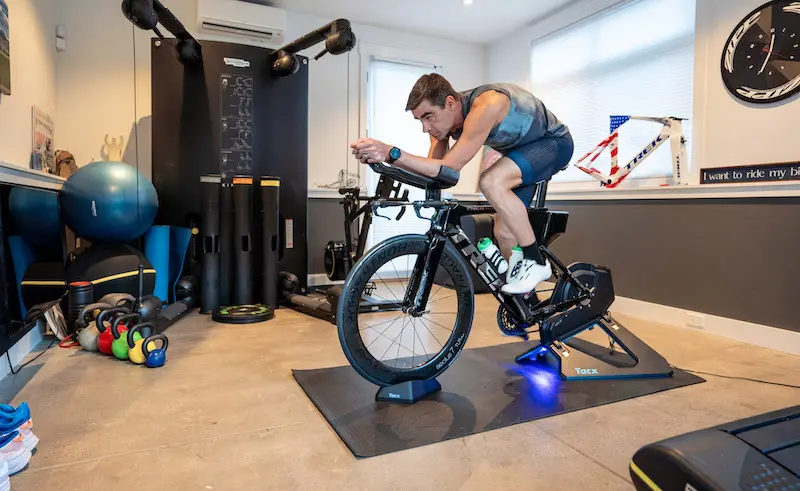
Session 4 – Force Endurance – 1h20
- 10′ progressive warm-up: start around 80–85 rpm and gradually lower cadence to 70–75 rpm.
- 1h at 95% FTP in 53×12-11, aiming for an average cadence of around 55–60 rpm. Take care to estimate the target power correctly, and not to go too far above it at the start. In particular, minimize the gradual drop in power that tends to set in => consistency, effort management and target power! Muscular drift, as well as cardiorespiratory drift, should gradually appear and start to be bothersome in the second half of the exercise… For Zwifters, choose a flat route such as Tik Tok to achieve this optimal consistency.
- 10′ easy, gradually returning to a more traditional cadence, around 85–90–95 rpm.
Adaptability => You can start more easily with 20, 30 or 40′ depending on your level.
Progression => Repeat the same session, aiming to slightly increase the average power you held the first time.
Session 5 – Strength/Velocity – 1h20’
- 10′ progressive warm-up: start around 80–85 rpm and gradually lower cadence to 70–75 rpm.
- 24′ split into (2′ at 100–105 rpm at I2, followed by 6′ near 50–55 rpm in the low I3 zone).
- 12′ active recovery at a cadence of around 60–70 rpm.
- 24′ split into (2′ at 100–105 rpm at I2, followed by 6′ near 50–55 rpm in the low I3 zone).
- 10′ easy, gradually returning to a more traditional cadence, around 85–90–95 rpm.
Adaptability => You can start more easily with 2 blocks of 18′ (2′ + 4′) or 2 blocks of 21′ (2′ + 5′). You can also do just one block.
Progression => Replace the 2 blocks of 24′ (2′ + 6′) with 2 blocks of 27′ (2′ + 7′) or 2 blocks of 30′ (2′ + 8′). You can also do a single block of 40′, 48′ or even 56′ (2′ + 6′).
Tips
Do no more than two strength sessions a week, alternate them with easier sessions, and above all don’t neglect base endurance training, ideally with at least one long weekend ride of around a hundred kilometers. Ideally, drink an energy drink during sessions, and rehydrate properly afterward. To speed up recovery, do gentle stretching after the session if you feel the need.
=> SEE ALSO: All our Coaching articles
Share the post "5 Indoor Trainer Workouts to Build Strength"