Share the post "Choosing the Right Crank Length"
Every component maker offers cranksets with different crank lengths, but at the same time most bikes are sold complete with components chosen by the brands. Yet, whatever your size, crank length really matters to how you pedal. Should you go for longer cranks, shorter ones, or stick with the standard offering?
By Guillaume Judas – Photos: Scott-Sports, Pixabay.com
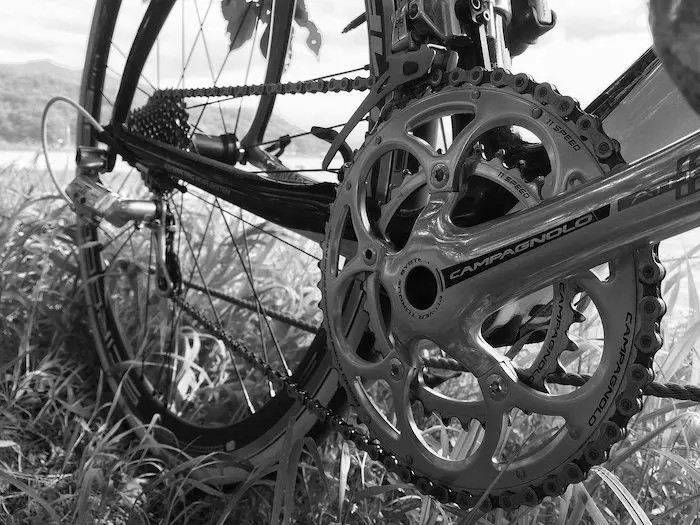
Shimano, SRAM, and Campagnolo offer their crankset models with different crank lengths and different chainring combinations. The same goes for specialist crankset makers such as Rotor, Stronglight, Praxis, and all power meter manufacturers. A few years ago, Look even offered an interesting solution with its Zed 2 crankset, which could be set to three lengths (170, 172.5, and 175 mm) by repositioning an insert. These three lengths are the most common, but depending on the crankset model, you can also find cranks from 165 to 180 mm.
However, on most production bikes, you do not really get to choose your crank length. Set by the brands’ internal statistics, crank lengths depend on bike size, just like stem length, handlebar or saddle width, or even gearing. All of this without taking into account the individual body characteristics of each rider, your flexibility, your riding style, your experience, or your habits.
We also know that a good position is essential for efficiency, comfort, and performance on the bike. And often it comes down to a millimeter or two, so the body can give its best, with a bike that acts as a true extension of the body.
On a production bike, a cyclist who knows what they want, or who has gone through a thorough bike fit, often has to negotiate with the bike shop to swap the position-related components, so they can ride the ideal bike. That is the least you can expect from a bike costing 5,000, 7,000, or even over 10,000 €. But it is obviously much harder with online sales, where bikes are standardized as much as possible. And when modifications are possible, they often cost extra. That leaves the options of choosing a custom build, or buying an extra crankset in the right size.
=> SEE ALSO: Finding a crankset with the right crank length
How is crank length determined?
For bike brands, crank length is determined by bike size. On XS and S bikes you often find 170 mm cranks, on M and L 172.5 mm, and on XL 175 mm.
But to be a bit more precise, you should look at inseam length, or rather at the ratio between leg length and total height. Two people who are both 1.75 m tall, for example, can have very different builds, with short legs and a long torso on one side, and long legs and a short torso on the other. A more precise formula for finding the right crank length could be inseam length multiplied by a coefficient of 0.216. However, we can see that this does not work at the extremes: it would call for 150 mm cranks for someone with a 70 cm inseam (which can be the case for small-framed women), and 190 mm cranks for someone with a 90 cm inseam. In both cases, those crank sizes do not exist.
Other factors must also be considered, such as the cyclist’s joint and muscle flexibility, the position they naturally adopt in the saddle, and of course their habits.
The lever arm
Even if we only consider the three most common crank lengths (170, 172.5, and 175 mm), these differences of a few millimeters are not negligible in terms of position and feel. Between 170 and 175 mm, the difference is not visible to the eye once the crankset is mounted on the bike. Yet with every pedal revolution, the length of the circle described by the pedal’s movement (the distance between two extreme points) varies by 1 cm between these two crank lengths. In terms of circumference, the difference is 3.14 cm (109.9 cm – 106.76 cm). In terms of muscles, joints, and tendons, it is easy to understand that this difference affects the range of motion, all the more so because it is repeated thousands of times per ride.
In theory, then, longer cranks increase the circumference of the circle, and therefore the lever arm. With the same muscle force, a longer lever arm gives more force to the drivetrain, and therefore makes it easier to push a big gear. But this must still be weighed against power, which is force multiplied by rotational speed. If a larger circle comes with a slower pedaling speed because of the range of motion needed, there is no benefit to fitting cranks that are too long.
Some studies have even shown that for the same athlete, crank lengths from 160 to 190 mm do not change power output, which is determined first and foremost by the rider’s general physical capacities. Nevertheless, once again, the muscular, joint, and tendon stresses of a movement that is too wide for the inseam length must not be overlooked. These stresses can sometimes cause serious injuries, in addition to the usual muscle soreness when switching to a movement that has become almost automatic.
As for position, changing cranks in either direction must be accompanied by a change in saddle height, in the same proportion as the change in crank length, so as to keep the same leg extension when the leg is “extended.” For example, if you go from 172.5 to 170, you need to raise the saddle by 2.5 mm.
=> SEE ALSO: Finding a crankset with the right crank length
The theoretical advantages of shorter cranks
Let’s start with an aspect that is sometimes overlooked but can become important when your riding is serious, whether on the road or off-road: shorter cranks are less likely to touch the ground, whether in corners (while pedaling) or when clearing obstacles (rocks, roots, branches) and riding off-camber sections in mountain biking, cyclocross, or gravel. On time trial or triathlon bikes, shorter cranks allow manufacturers to lower the bottom bracket, which lowers the center of gravity of the bike and rider for better aerodynamics and stability.
The other benefit of shorter cranks concerns the low, advanced aerodynamic position on the front end. Crank length changes the angle between the hip and the torso. With long cranks, the angle is more closed, which can limit your ability to lower yourself forward and puts a lot of strain on the hip joint, sometimes with associated pain.
This is also a trend seen among very high-level racers, who adopt very aggressive positions. Alejandro Valverde, for example, switched to 170 mm cranks a while ago, approaching forty, despite being 1.76 m tall.
Finally, the often-cited decisive advantage of shorter cranks is the supposed ease of “spinning the legs” more readily, and therefore raising pedaling cadence. The consequences are less fatigue over long distances, less buildup of muscle waste, and better responsiveness when accelerating.
Not so simple
But beyond theory, what is it really like on the road? Is it really advantageous to choose shorter cranks for road riding?
I was able to experience this very recently when a test bike arrived. I have been riding regularly for 36 years, thousands of km every year. I started at age 14 with 165 mm cranks (at 1.50 m tall at the time). When I joined the Juniors, having grown a bit (no laughing!), I moved to 170 for a year, then to 172.5 in the year I turned 18. That was the era of Armel André, an ergonomist from the automotive world who was one of the first to work on positioning software. A crank size that was somewhat high for my 1.67 m, but made possible by my flexibility and cadence at the time. I never changed again, apart from a few attempts at time trials or on mountain bikes with 175s (which made me feel like I was climbing stairs two steps at a time) or with a few test bikes delivered with 170s. That last length often bothered me, giving me the feeling that I could not extend my legs and limiting me during hard efforts.
Recently, I received a bike ordered to my specifications for a multi-week test. Despite my request, a mechanic’s error meant it arrived with 170 mm cranks. In absolute terms, that is not very serious, since I have another crankset, in 172.5, that I can fit to this bike for the duration of the test. However, that required an adapter, which took more than three weeks to arrive.
So I rode more than 1,000 km on this bike with the 170s. I could already appreciate its qualities, but without really enjoying its handling. I felt “blocked.” I struggled to accelerate out of the saddle, I felt I was mashing on false flats, and on longer climbs I could not settle into the right intensity. Riding it repeatedly did not change much. The muscular sensations were strange, and they were not confirmed on Zwift, where I rode another bike equipped with the right cranks.
Then the part finally arrived, and we were able to fit the right crankset. From the first few hundred meters, I discovered a different machine. I finally regained the right coordination out of the saddle, between the movements of the legs and those of the upper body. On the flat, I felt I could increase my cadence by “sending” the legs forward every time I wanted to accelerate. Even more surprising, I regained a perfect balance (50/50) between the power of the two legs, which was not the case with the 170s.
Moving directly from 170 to 172.5 mm cranks on a bike I had already had time to get used to, I also noticed that I was pedaling with a very slightly less smooth stroke, perhaps with more pronounced dead spots at the top and bottom of the crank rotation. Still, I felt that these tiny releases of muscle pressure on each pedal stroke encouraged a “micro recovery” that I did not feel with the 170s.
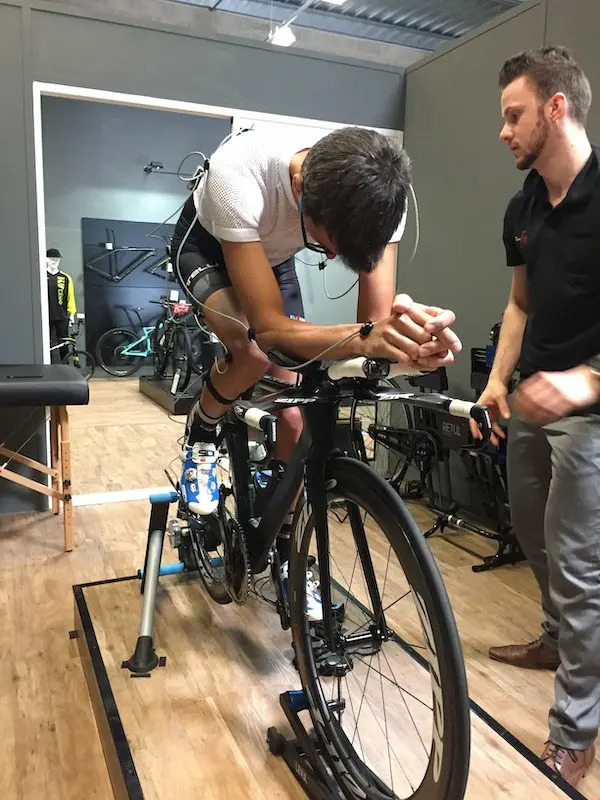
In early 2017, during the test of the Bikefitting posture analysis system, the operator noticed that my pedaling efficiency was better with 172.5 mm cranks, even though, given my size, he had naturally steered me toward 170s. The same finding came a few months later during the test of Specialized’s Retül positioning system. After hundreds of thousands of km on 172.5s, my body is so used to them that it feels a bit lost and less efficient with any other length.
=> SEE ALSO: Finding a crankset with the right crank length
Crank length is therefore a subject far more complicated than it appears, beyond theories that are all interesting in their own way. They can only be verified on the road or through a good dynamic bike fit, one that takes into account not only your body characteristics, but also your muscle characteristics and the way you ride.
=> SEE ALSO: All our gear articles
Share the post "Choosing the Right Crank Length"