Share the post "The 2021 Tour de France Route"
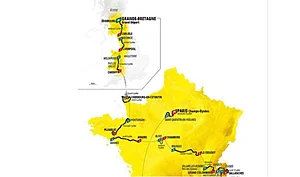
Christian Prudhomme presented the 108th edition of the Tour de France, with its Grand Départ in Brest, this evening on France 3’s Stade 2 program. A 3,383-kilometer Tour de France 2021 that blends classicism and modernity, with the return of an individual time trial in the first week and another on the eve of the finish, but also with a tricky course featuring wind, small roads, and passes recently discovered by the Grande Boucle.
Photo credit: ASO

The 2021 Tour de France will take place entirely on French roads from June 26 to July 18, highlighting the departments, as seen with the first four stages in Brittany. A total of 3,383 kilometers, 27 climbs of category 2, 1, or Hors Catégorie, six mountain stages, and two individual time trials.
Find the stages and their distances here, as well as their main difficulties:
Stage 1 (June 26): Brest – Landerneau (187 km), a stage entirely in Finistère, featuring the Monts d’Arrée, small roads, wind, and a punchy finish at the top of the Côte de la Fosse aux Loups in Landerneau (3 km at an average of 5.7%, with an initial section at 14%)

Stage 2 (June 27): Perros-Guirec – Mûr-de-Bretagne Guerlédan (182 km), a stage entirely in Côtes-d’Armor, along the Pink Granite Coast before a finish with two successive climbs of the famous Mur de Bretagne.

Stage 3 (June 28): Lorient – Pontivy (182 km), a stage entirely in Morbihan this time, which should favor a sprinter.
Stage 4 (June 29): Redon – Fougères (152 km), again with a finish that should suit a sprinter, for a stage entirely in Ille-et-Vilaine.
Stage 5 (June 30): Changé-Laval (27 km), for a first individual time trial in Mayenne, on a rolling course.
Stage 6 (July 1): Tours – Chateauroux (144 km), a short and flat stage, but very exposed to the risk of echelons in its second part.
Stage 7 (July 2): Vierzon – Le Creusot (248 km), the longest stage of the Tour in 20 years, with a very hilly second part in the Morvan, including a finish at the top of a 1 km climb at an average of 13%.

Stage 8 (July 3): Oyonnax – Le Grand Bornand (151 km), a stage that truly enters the mountains, with a finale that will see the succession of the Romme and Colombière passes before descending into Le Grand Bornand.


Stage 9 (July 4): Cluses – Tignes (145 km), with the succession of the Côte de Domancy, the Cols des Saisies, du Pré, du Cormet de Roseland, before the final climb to Tignes at 2113 m altitude.


July 5: Rest day
Stage 10 (July 6): Albertville – Valence (186 km), where the peloton will turn its back on the Alps, with a final section exposed to wind and the risk of echelons, but which should suit sprinters.
Stage 11 (July 7): Sorgues – Malaucène (199 km), with a double ascent of Mont Ventoux, the first time via Sault, before a second time via Bédoin, which will precede the finish in Malaucène after a fast and technical descent.


Stage 12 (July 8): Saint-Paul-Trois-Châteaux – Nîmes (161 km), a transition stage that should be controlled by the peloton for a sprint finish.
Stage 13 (July 9): Nimes – Carcassonne (220 km), a long transition stage, a little hillier than the day before, and which this time could favor the breakaway riders.
Stage 14 (July 10): Carcassonne – Quillan (184 km), a hilly stage, with the climbs of the Cols de Montségur (4.2 km at 8.6%), de la Croix des Morts (6.8 km at 5.8%), and finally de Saint-Louis (4.7 km at 7.4%) in the last 20 kilometers.

Stage 15 (July 11): Céret – Andorra la Vella (192 km), with the arrival in the Pyrenees via the Cols de Puymorens, Port d’Envalira (summit of the 2021 Tour), and Beixalis before descending into the Andorran capital.

July 12: Rest day
Stage 16 (July 13): Pas de la Case – Saint-Gaudens (169 km), a stage in the heart of the Pyrenees, but more hilly than truly mountainous.
Stage 17 (July 14): Muret – Saint-Lary-Soulan (178 km), with a succession of three difficult passes in the last 50 kilometers. Peyresourdes, Val Louron Azet, and the very long Col du Portet above Saint-Lary should cause significant damage.


Stage 18 (July 15): Pau – Luz Ardiden (130 km), the last stage of the Pyrenees will offer riders the dreaded succession of the Col du Tourmalet and the climb to Luz Ardiden.


Stage 19 (July 16): Mourenx – Libourne (203 km), the Landes stage, flat and fast, which will favor a mass sprint.
Stage 20 (July 17): Libourne – Saint-Emilion (31 km), the return of a flat time trial on the eve of the final finish, which should determine the final general classification.
Stage 21 (July 16): Chatou – Paris (112 km), with the traditional parade of riders before the finish on the Champs-Elysées, which should not escape a sprinter.
=> SEE ALSO: All our Mag articles
Share the post "The 2021 Tour de France Route"