Share the post "Review of the Orbea Ordu M10iLTD"
With a redesigned frame, the use of high-stiffness carbon fiber, and a focus on practical adjustability, the new Orbea Ordu stands out as one of the top triathlon bikes, with a lightweight frame, improved handling, and high-performance aerodynamics. It’s a bike designed to ride fast and for long distances, which we had the chance to test for a few weeks.
By Guillaume Judas – Photos: @3bikes.fr

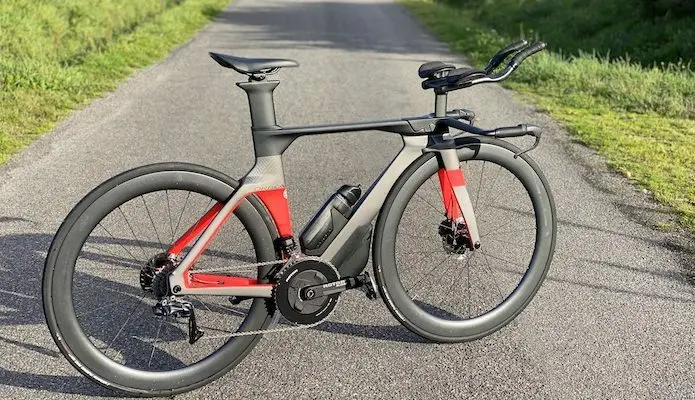
The new Ordu has undergone a major redesign compared to its predecessor in the Basque brand Orbea’s lineup. And while it serves the same purpose within the lineup—namely, meeting the needs of triathletes and cyclists who compete in time trials— its design has this time been developed with the triathlon in mind, featuring the seamless integration of components such as the water bottle and transport box, in addition to the Di2 cables and brake hoses made possible by the adoption of disc brakes. The tubes (shapes and dimensions), the seatpost, and the entire handlebar assembly were designed after more than 2,500 hours of calculations to determine their most efficient contours. Even more than this new profile—which aims to significantly reduce aerodynamic drag (-11.5% compared to the previous Ordu, according to the brand, equating to a 41-second time savings over the 180 km of an Ironman)— it is above all in terms of ease of position adjustment that the new Ordu stands out, as no such machine can achieve lasting efficiency without a riding position meticulously fine-tuned down to the smallest detail.

Thus, the handlebar assembly can be adjusted for height and reach quite easily by turning a few sturdy, easily accessible screws. The base of the airplane-wing-shaped handlebars can be flipped over to raise the height of the grips and brake levers. A central bar allows for quick adjustment of the armrests’ height, and a set of small shims allows for adjustment of their angle. Their spacing is also adjustable. Finally, the reach of the extensions can also be adjusted with a single turn of a wrench. Aside from the handlebar base, all adjustments related to the triathlete’s riding position can be made in less than 10 minutes.


As for the seatpost, the seatpost clamp can be set to three positions, providing a total adjustment range of 8 cm in setback, in addition to the range allowed by the saddle frame. For height adjustment, a screw—operated with a 5 mm Allen wrench and securing a tangential pad—is hidden under a rubber gasket at the junction with the frame. It’s reliable and sturdy, unlike some competing designs where the screws get stripped or damaged after just a few adjustments.


Weight Reduction and Improved Handling
To make the new Ordu highly appealing, Orbea has also worked on the frame’s weight, using the shapes and edges of the tubes to optimize the lamination process with the best carbon fibers available from the Spanish manufacturer—namely, OMX carbon—as found on the latest top-of-the-line Orca. The brand thus announces a frame weighing 1,130 g and a fork weighing 440 g, which is particularly impressive for a bike designed for solo riding. Available in four sizes, the Ordu features stiffness that scales with each size thanks to the use of different carbon layups, ensuring consistent handling for riders of all sizes.

Including the wheels, the complete setup (including the handlebar and stem), the storage box (or Toolbox), and the dedicated bottle cage and water bottle, this weight savings is relative, as the bike still weighs 8.6 kg without pedals in size XS—a size better suited for flat terrain or moderately rolling routes than for steep climbs.
Nevertheless, effort was made during the design process to improve this bike’s handling and stability on descents or winding sections, in order to provide the rider with greater confidence and safety. On the new Ordu, Orbea has therefore increased the front end’s reach (with a longer top tube, offset by a shorter stem), while maintaining a 72° head angle for a good balance between responsiveness and front-end stability (at least compared to other small-sized bikes). This modification makes the bike easier to handle and provides precision in cornering. To promote stability at high speeds, the bottom bracket has also been lowered slightly to lower the center of gravity.


A set-back bottom bracket
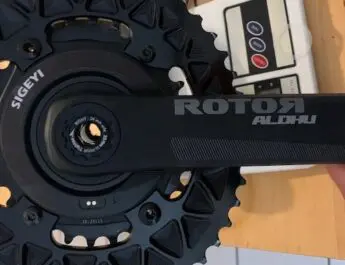
The Ordu is available as a frame kit (€3,499) and in three complete versions, ranging from €4,699 for the M20LTD (with Shimano Ultegra) to €8,999 for the model tested here, featuring Shimano Dura-Ace Di2 derailleurs and brakes, a Rotor ALDHU crankset, Vision 55 SC Disc Carbon TLR wheels, and Vittoria Rubino Pro tires. But it’s the €6,999 M20iLTD version that we find most appealing in terms of value for money, especially since the only difference from the top-of-the-line model is the Shimano Ultegra Di2 derailleurs.

For a bike priced at nearly €9,000, the drivetrain (wheels and tires) clearly falls short in this case, with wheels—and especially tires—that aren’t quite up to the bike’s standard. Reliable and stiff, the Vision 55 SC wheels are a bit heavy (nearly 1,700 g per pair) but, more importantly, are let down by tires that, while solid and reassuring in wet cornering, frankly lack performance regardless of the conditions.
This choice is all the more regrettable given that the MyO program available for the Ordu (customization of the paint job and certain components) is more limited than on the Orca, for example, and does not allow for changes to the tire setup.
Although it comes with a specific bottle cage and water bottle designed in conjunction with the frame to minimize aerodynamic drag (the bottle will soon be available as a spare part on the Orbea website in case it needs to be replaced), the Ordu can, of course, accommodate more traditional accessories. As for the Toolbox mounted under the down tube—which is very handy for carrying repair gear (inner tubes and CO₂ cartridges, for example, or even a lightweight windbreaker) and offers a definite advantage in terms of aerodynamics— it can be removed to make the bike compliant with UCI-regulated competitions.

The Almost Fatal Weapon
As for the riding position, it took us a few rides to fine-tune certain adjustments, as we lacked recent experience in this area. Adjusting the cockpit setup is very simple, and while it took us three tries to find the right height and spacing for the armrests and handlebar extensions, each adjustment was a breeze. The same goes for the saddle, although in that case it took us longer to find the exact height down to the millimeter because of the significant forward reach of the saddle nose relative to the bottom bracket axis—due to the frame’s architecture and the aerodynamic position. But it’s safe to say that Orbea fully delivers on its promises with the Ordu when it comes to practical features.

Compared to the position of the armrests, the base of the handlebars is relatively low, which requires a two-step adjustment. First, when standing on the pedals, with a lot of weight on the front wheel, you need to perfectly coordinate every movement with the perceived heaviness of the steering. Second, in terms of handling, because this very low position also requires tilting your neck forward to see clearly around you. This feeling of discomfort quickly disappears once you settle into the aerobars, a position better suited for long-distance races like Ironman or 70.3 events. With your arms relatively high but well forward and in line with your shoulders, you can tuck your head in without feeling like you’re losing control of the bike at the slightest change in direction. With a little practice, many turns can be taken in an aerodynamic position without feeling the slightest instability in the steering. The steering then feels lighter, and the Ordu less clunky than many bikes of the same type.

If safety is a concern, however, be careful with disc brakes on a bike like this on wet surfaces. The forward riding position takes weight off the rear wheel, and even slight pressure on the brakes is enough to lock the wheel and risk a skid. Fortunately, the Vittoria tires provide good grip, and they’re also quite durable and resistant to cuts. Nevertheless, they remain mid-range tires—not very comfortable or responsive, lacking flexibility, and with a rubbery road feel that doesn’t quite match the overall quality of this bike.
They don’t add much in terms of comfort—an area where the Ordu already struggles due to its very high stiffness. The frame itself doesn’t do much to filter out road imperfections, as evidenced by the splashes that come out of the water bottle cap at the start of every ride, and its very stiff handlebar setup doesn’t offer much in the way of comfort either. But comfort is first and foremost a matter of riding position, and even if it gets a bit bumpy over potholes or manhole covers on the road, the Ordu remains well-suited for long rides because it feels so comfortable behind the handlebars.

The Ordu is also very stiff laterally, so it takes some time to get used to handling it on inclines. If you use too high a gear ratio, you’ll quickly feel the bike’s stiffness and gradually lose speed. And when riding out of the saddle, you have to handle it with care to maintain good coordination between your upper and lower body—again, to avoid getting overwhelmed by the slope. Fortunately, the very well-designed cockpit doesn’t restrict knee movement when you stand on the pedals. The dual derailleur shifters, located at the ends of the handlebar extensions and near the brake levers, are extremely easy to use regardless of hand position, thanks to the Synchro-shift function, which allows you to use the gears like a sequential gearbox.
It’s on long stretches with no intersections and no changes in gradient that the bike is obviously most enjoyable.
It’s on long stretches without intersections or changes in gradient that the bike is obviously most enjoyable. You get into position and shift into gear. The Ordu makes it easy to pick up speed—and, more importantly, to maintain it. No matter the wind angle, as long as it’s moderate, the bike is faster than any road bike. In a headwind, you can easily ride 2 or 3 km/h faster than on a traditional bike, feeling much more aerodynamic and with more support in your back and lower back thanks to the support provided by the armrests and handlebar extensions. With a tailwind, the benefit is even greater, especially when you can exceed 50 km/h. At that speed, the aerodynamic advantage is more than obvious, and can be further optimized by wearing a cycling suit and using taller, higher-performance wheels. A gain of two or three kilometers per hour has been observed in the average speed of typical training rides compared to a conventional bike, while maintaining the same perceived level of difficulty. This time savings could be even greater in a competitive setting, provided safety conditions are met, since the Ordu is trickier to handle during accelerations and in traffic than a road bike.

The Ordu is therefore a bike that requires some skill to ride in high winds. With its wide tubes and prominent Toolbox, it creates significant wind resistance that can cause you to veer off course. In strong gusts, it’s quite difficult to control but never becomes unmanageable. And although it’s particularly demanding in these conditions, you still notice its impressive efficiency when you glance at the speedometer.
After riding nearly 800 km on this bike, we can’t help but be impressed by its performance and all the details designed to optimize riding position and overall handling. Like any bike of this type, it takes some getting used to and isn’t as versatile as a road bike in normal traffic conditions. But once the road clears, what a blast!
| ORBEA ORDU M10iLTD |
| Rating: ***** Pros: Stiffness, efficiency, practical features for position adjustments, feels secure at high speeds Frame: Orbea Ordu Carbon OMX Disc – Fork: Orbea Ordu OMX ICR fork – Handlebars: Orbea Ordu OMX/Vision TFA Carbon Aero Clip Extensions – Brakes: Shimano Dura-Ace R9170 hydraulic 160/140 mm – Front derailleur: Shimano Dura-Ace R9150 Di2 11-speed – Rear derailleur: Shimano Dura-Ace R9150 Di2 11-speed – Shifters: Shimano Dura-Ace R9180 hydraulic – Cassette: Shimano Dura-Ace 11-28 – Chain: Shimano Dura-Ace 11-speed – Crankset: Rotor Aldhu 52/36 (optional power meter) – Wheels: Vision 55 SC Disc – Tires: Vittoria Rubino Pro 700×25 – Saddle: Fizik Argo Vento R5 – Seatpost: Orbea Ordu OMX – Weight: 8.6 kg in size XS without pedals – Sizes available: 4 – Two colors – Free color customization with MyO – Price: €8,999 – Frame kit: €3,499 |
| Contact: www.orbea.com |
=> SEE ALSO: All our Gear articles
Share the post "Review of the Orbea Ordu M10iLTD"