Share the post "Specialized S-Works Aethos Review"
It’s the surprise of the autumn from Specialized: the Aethos shakes up the norms established in recent years in terms of weight, accessibility, and comfort. It thus meets the expectations of many riders who don’t necessarily identify with bikes primarily designed for professional racers. The S-Works version is very high-end, as we observed during this first test.
By Guillaume Judas – Photos: Pauline Ballet / @paulineballet

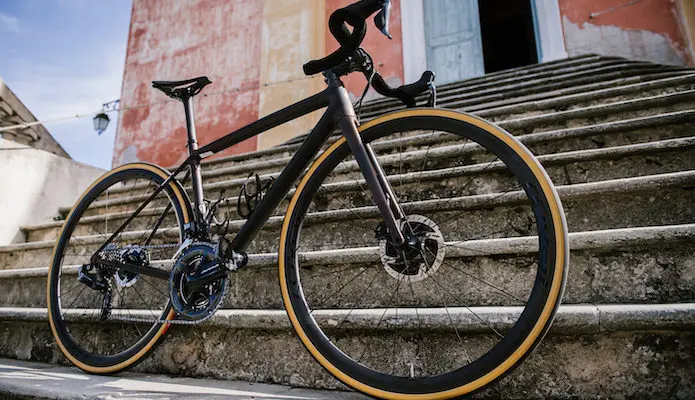
Once again, the release of a Specialized bike stirs up the cyclosphere, whether on forums or social media. Three months after the presentation of the Tarmac SL7, already almost impossible to find in stores due to its success for the 2021 range, the American brand takes everyone by surprise with a bike of simple and refined appearance. On the Aethos, there are no oversized and aerodynamic tubes, no integrated brake hoses, and it even returns to a traditional seatpost clamp and a bottom bracket with external bearings. With a very classic profile for a sporty road bike that strongly resembles some carbon frames from the mid-2000s, the Aethos disrupts Specialized’s sometimes perceived as particularly aggressive marketing discourse in recent years, especially in the areas of stiffness and aerodynamic drag.

It is in terms of lightness, however, that the Aethos stands out, and quite significantly. Specialized is known as one of the pioneers of disc braking, with a 2021 range that no longer includes any rim-brake bikes. The primary criticism against this technology concerns an inevitable weight gain (between 500 g and 1 kg depending on the bike’s range level). The design of a very lightweight disc bike is therefore a coherent strategy in line with riders’ expectations, and the result lives up to the announcements made in this regard: our test Aethos with Shimano Dura-Ace Di2 in size 52 weighs exactly 6.440 kg complete with pedals and bottle cages, or 6.130 kg when compared to other bikes sold on the market.

The brand’s other objective with the Aethos is to make the bike more physically approachable than models designed for professional racers and those seeking pure performance. A bike that is forgiving in its handling, less demanding to use than a Tarmac SL7 for the average cyclist, but which remains safe and, above all, robust. In its highest-end and lightest S-Works version, the Aethos is not assembled with any exotic or artisanal components, and it is guaranteed to support a rider weighing up to 125 kg. An easy and reassuring bike, but not accessible to all budgets, as you’ll need to pay €11,799 to get the model tested here.

A super light frame
The Aethos S-Works is, above all, an extremely lightweight frame, announced at 588 g bare, which is about 230 g less than the Tarmac SL7 S-Works, or 50 g less than a Factor O2 VAM, 80 g less than a Canyon Ultimate CF Evo, and 130 g less than a Trek Emonda SLR 9. It is lighter than any rim-brake chassis presented so far, even though we are talking about a frame kit designed exclusively for disc braking (with the resistance in key areas that this implies). The fork, meanwhile, weighs around 300 g.
This featherlight weight was achieved through supercomputers and billions of simulations, taking into account advancements in carbon fibers, particularly the Fact 12r nomenclature already used on the Tarmac SL7 for its stiffness and lightness qualities. By deliberately setting aside an architecture designed for better air penetration and focusing on the best balance between weight, strength, and comfort, the American brand’s engineers opted for almost round tubes, with elliptical shapes in certain areas, such as around the head tube or bottom bracket shell, without adding more material than necessary. This construction allows the Aethos frame (non S-Works) with less high-end Fact 10r carbon fibers to be announced at 680 g, barely 100 g more than the S-Works. Note that, whether as a complete bike or a frame kit, the Aethos is only compatible with electronic drivetrains, wired or wireless.

The six frame sizes offered (compared to seven for a Tarmac, as the 44 is not available here) are designed independently of each other in terms of tube diameter, which allows Specialized to promise the same bike behavior, regardless of the rider’s size.

Around the frame, effort is also made on components such as the seat clamp or the headset expander to shave grams where possible, but without compromising reliability or maintenance. The Aethos can support a cyclist up to 125 kg, and the brand is definitively abandoning Press Fit bottom bracket bearings in favor of external bearings, which are slightly heavier but prevent many creaks during use.
In terms of equipment, the two groups offered (Shimano Dura-Ace Di2 and Sram Red eTap AXS) in this S-Works version at €11,799 are of roughly equivalent weight, around 2500 g. In both cases, with 11 or 12 speeds, these are luxurious, reliable, and proven drivetrains. Given the bike’s range level, the Aethos S-Works comes standard with a power meter. The Specialized-branded 4iiii model on our Dura-Ace test bike adds approximately 25 g to the complete group.
Stem, handlebars, and Power saddle are from the S-Works range of the American manufacturer, and are also extensively proven. They are reliable, lightweight, well-finished, ergonomic, and comfortable to use, even on long rides. The Alpinist seatpost from sister brand Roval is announced at 136 g, while remaining practical for setback and saddle tilt adjustments. As for the Roval Alpinist CLX wheels, we had already had the opportunity to test them during the Tarmac SL7 test and compare them with the Rapide CLX. These are very lightweight (1258 g per pair) and versatile tubed wheels, but also stiff enough to be effective on all terrains without flexing. They are fitted with Turbo Cotton tires, also very high-end even if not necessarily the lightest on the market. In any case, they perfectly suit the overall behavior of the Aethos. Finally, let’s specify that the new 274 g Roval Alpinist cockpit is reserved for the limited edition of the Aethos, the S-Works Founder’s Edition.
The Aethos S-Works, as a complete bike at 6.1 kg, thus features a homogeneous and coherent build, but there is no doubt that the frame kit can be the basis for more extreme builds, which could even break some records, as you can see below. Specialized challenges preconceived notions with the Aethos and offers disc braking new horizons in the realm of lightness.
In another dimension
By weighing the Aethos S-Works, one can easily measure the difference compared to a mid-range disc bike, and even recent aero models. The weight is astonishing, and it comes with almost unparalleled handling and liveliness. When standing on the pedals to launch the machine, you feel the docility and freedom of the steering, without, however, suffering from a lack of stiffness or firmness in the cockpit. With the proposed setup, it is possible to lean on the handlebars without fear, gripping the brake levers. We are far from some lightweight setups with extremely flexible (and fragile) components that we remember.
The weight is astonishing and it comes with almost unparalleled handling and liveliness.
The first few hectometers demonstrate the bike’s excellent rolling qualities, even if it obviously lacks a bit of inertia compared to models more geared towards competition. It seems to roll without friction, and without any sound other than the hiss of the tires on the road. The supports are firm, with handlebars that remain well in phase with the behavior of the head tube, and a saddle that supports the rider’s weight without sagging. Nevertheless, contact with the road remains muted, but without softness. The bike is comfortable and compliant but never vague, with wheels that always follow the same line, regardless of the demands. Of course, the Turbo Cotton tires contribute to this overall comfort and silky road feel, even if they are inflated here to 7 bar. But they are not the only ones on the market to offer these characteristics.

The rolling roads of Cap Corse show that it is not necessary to excessively shift gears to appreciate the Aethos. You can ride with torque on the pedals without hitting the lateral stiffness of the frame. It seems to slightly accompany the rotational movements of the crankset without the entire bike coming apart. The new Specialized is an easy bike to handle and ride. A very appreciable behavior during group rides where you never feel overwhelmed by the bike, and even more so at the end of a ride when fatigue sets in. The brand talks about pleasure with the Aethos. A new dimension of cycling that has not always been taken into account by manufacturers until now, and which here reminds us of a behavior close to the high-end steel bikes of the last century, but much lighter.

It’s when tackling the mountains, and regardless of the slope’s direction, that one truly understands the Aethos’s raison d’être. Let’s be clear: a bike a kilo lighter won’t radically change your performance, especially if you have a good appetite. However, in terms of pleasure and sensations, it’s a completely different story. There’s that easy aspect, which allows for some gearing errors and lets you ride within a wider pedaling cadence range than with a very stiff bike. If you feel yourself struggling on a gradient for a few dozen meters or when taking a tight corner, the bike easily relaunches out of the saddle, offering just enough elasticity to allow you to use your own weight to propel the pedal. An ephemeral, yet airy sensation that gives you the impression of being able to tackle any slope. On the rough roads of Balagne, the bike’s comfort and traction are also assets because it doesn’t bounce on potholes or gravel, and it allows you to become one with the asphalt. Finally, this lightness provides a feeling of responsiveness that makes you want to frequently change pace, which can quickly tire your opponents or riding companions.

Although offered in one size less than the Tarmac SL7, the Aethos benefits from almost the same geometry, with the only differences being a slightly higher sloping top tube and a slightly taller head tube to compensate for the absence of a stem designed for cable integration. It thus retains the legendary Specialized handling, even here in size 52. In tight corner sequences, the bike is playful and very precise. It inspires confidence when leaning into turns, and even proves much less radical than a stiffer bike. On the winding roads of Corsica, it feels like it can forgive some trajectory errors on tightening corners, and its relative flexibility allows it to perfectly hug the terrain while leaning into the tire’s shoulder. It’s only at high speeds and on fast curves that it feels less stable than the SL7. With the 33mm deep Alpinist CLX wheels, it is even sensitive to crosswinds that can be found on mountainsides and when descending at full speed. In short, the Aethos is best appreciated at a more reasonable pace than that of a pro.


Moreover, several kilometers at a good pace on a false flat descent still show some limitations of the Aethos. The bike doesn’t sag when you push the gear, but seems to lack breath above 40 km/h. It is clearly less efficient than the SL7 in this area. A few successive sprints on an uphill false flat road show a behavior that will again limit competitors: during energetic accelerations or power efforts (beyond 600-700 watts), the Aethos lacks lateral firmness and seems to dissipate some watts at the decisive moment. But this exclusive machine, which is also prohibited as such from official competitions due to its weight being under 6.8 kg, is not made for that.

A bike for whom?
Like Porsche in the automotive world, Specialized once again delivers an almost flawless product, even if the price may seem excessive and excellence in one area is not necessarily what everyone is looking for. While it’s important to remember that the buyer of a 911 is not always the buyer of a Cayenne, the same applies to the Aethos compared to a Tarmac or a Roubaix.
Light, lively, nimble, comfortable, and easy to use even for riders of modest ability, the Aethos offers unparalleled pleasure to date, sometimes at the expense of pure performance, but only when it needs to be pushed to its limits. It is therefore primarily aimed at KOM hunters and cycling epicureans who don’t always want to keep an eye on their bike computer, while ensuring they aren’t crippled with aches and pains the day after their Sunday ride. With the Aethos, Specialized has thus succeeded in offering a different but complementary machine to the Tarmac SL7, which in a way fills a gap in the range by pushing the characteristics of the old SL6 even further.

As for the very high price, it is not solely due to Specialized with this S-Works model, considering the level of the range and the value of the components, the technologies used, and even the presence of a power meter.
| SPECIALIZED AETHOS S-WORKS |
| Rating: * Pros: Lightness, comfort, accessibility, responsiveness Frame: Aethos S-Works, Fact 12 R carbon – Fork: Specialized Fact Carbon Disc (thru-axle) – Handlebar: S-Works compact – Stem: S-Works – Brakes: Shimano Dura-Ace R9170 hydraulic 160/140 mm – Front Derailleur: Shimano Dura-Ace R9150 Di2 11 sp. – Rear Derailleur: Shimano Dura-Ace R9150 Di2 11 sp. – Levers: Shimano Dura-Ace R9170 hydraulic Di2 – Cassette: Shimano Dura-Ace 11-30 – Chain: Shimano Dura-Ace 11-speed – Crankset: Shimano Dura-Ace 52/36 (with 4iiii Specialized power meter) – Wheels: Roval Alpinist CLX – Tires: Turbo Cotton 700×26 – Saddle: Body Geometry S-Works Power – Seatpost: Roval Alpinist carbon – Weight: 6.130 kg in size 52 without pedals – Number of sizes: 6 – Price: €11,799 – Frame kit: €4499
|

| Contact: www.specialized.com |
=> SEE ALSO: All our Gear articles
Share the post "Specialized S-Works Aethos Review"