Share the post "What difference does a new bike make?"
You’ve been riding your bike for several years, and now you’ve just bought a new one. It’s obvious, you immediately feel differences. But beyond weight, stiffness, comfort, geometry, and ergonomics, what changes when you ride a new bike? What makes the sensations so different?
By Jean-François Tatard – Photos: Pauline Ballet, Jean-François Tatard
While for many, custom-made represents the ultimate machine, it’s not so easy to determine what best characterizes a bike. In fact, each manufacturer has its own definition of the ultimate machine. From one manufacturer to another, the geometry—that complex alchemy of each tube’s length depending on size—is different. Each manufacturer has its convictions on the matter, which can influence the handling or “ride” of the bike, more precisely a succession of reactions that you will quickly feel when switching from one machine to another. Even if you almost systematically find the same saddle height, you will be more or less forward on one bike, you will have more or less saddle angle on another, the fork will have more or less a different inclination that can influence the behavior of the front wheel. A set of behaviors not solely linked to the size or angle of the tubes, by the way. With carbon and its associated technologies, it is now possible to modify the behavior of a frame based on different layers of carbon, to stiffen or soften specific parts.
And if you rely on a bike fit to transfer your measurements from one bike to another, also consider the context in which you had it done. You may not have the same physical and physiological dispositions as at another time of the year…
A question of feeling
A new bike custom-fitted to the measurements of your previous ride is ultimately no guarantee of getting the same sensations. Each ride, even when set up identically, requires a period of adaptation. According to Dany Maffeïs, a bike mechanic and still active Elite cyclist, “a new bike requires us to be attentive to our body, to identify potential points of resistance, for example. You may have had your setup custom-made, and then experience neck pain with your hands in the drops once you start riding dynamically. It’s the same with the wrists. The saddle also sags and its shape changes over the kilometers. The texture of the covering also changes due to friction. These are parameters to pay attention to.”
The saddle
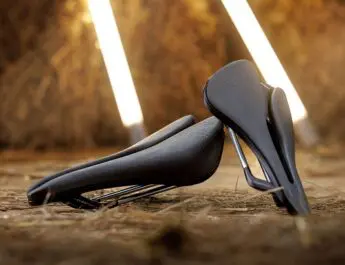
A saddle will eventually sag! And it becomes custom-fitted… Your sensation is never the same with an identical saddle. Because it also depends on wear. Gradually, you will find yourself better and better positioned. And if, despite your adjustments, you feel too short or too long, it may be the stem that is the problem. You can have the same length between the saddle and the center-to-center of the handlebars and feel too short or too long. It also depends on the saddle angle. Not to mention the saddle tilt. In short, cycling is not just about measurements in meters and centimeters. Cycling is also about angles in degrees.
And speaking of degrees…
And speaking of measurements in degrees, if you’re okay with the length of your stem, have you checked its inclination? While length is the priority, it’s not certain that bike fits are as precise as your own dynamic sensations. Nothing will ever beat your perception in motion. And it’s the same with the stem angle. You might even change it over the kilometers during the season. Perhaps because your physique is getting leaner. Or because you’re becoming more flexible. You absolutely have to experiment. Just because you’re replicating the exact same measurements with your new bike doesn’t mean you won’t have to change certain settings, certain heights, certain angles, certain inclinations, certain measurements, etc. Did you know, for example, that the seat tube angle at the bottom bracket shell can vary from 71 to 75 degrees? This changes the position of the saddle relative to the plumb line of the bottom bracket. Here too, it can give very different perceptions even though everything else is the same.
Just because you’re replicating the exact same measurements with your new bike doesn’t mean you won’t have to change certain settings, certain heights, certain angles, certain inclinations, certain measurements, etc.
Tube angles
While the sloping top tube is the first thing obvious to the eye, it is only virtual. However, the seat tube angle can influence how one feels on a particular type of terrain. On flat terrain or for fast riding, one may tend to move forward, because one adopts a lower torso position. Conversely, when climbing or riding long distances, one may tend to move backward. So we also adapt to the type of course we are interested in, knowing that we will not change position during the ride. The head angle affects the responsiveness or stability of the steering. A steeper angle than average will give a very lively and precise steering, but less stable at high speed. To address this contradiction and offer both responsiveness and stability, some manufacturers manage to modify the stiffness of the front end. This is also one of the elements that distinguish a high-end bike from an entry-level machine.
The devil is in the details
Even a different bar tape on your handlebars can give you a different perception. Whether it’s its material, its composition, its newness, etc. So I’m not even talking about the handlebars themselves. If we most systematically refer to shoulder width and then decide, the point to check is the drop. What is the drop? The drop is the distance between the top and bottom of the handlebars. And to be clear, generally, the less there is, the better. Hence the explosion of so-called compact handlebars which have between 125 and 130 mm of drop, as Dany Maffeïs explains to us once again.
The perfect position
Ultimately, determining the perfect position is very subjective, and from one cyclist to another, the sensitivity to position, but also to materials, context, conditions in space relative to a reference, no matter what it is, means that you will never have exactly the same sensations even with a second bike adjusted to the millimeter like the first. The method chosen for taking measurements, however perfect it may be, will always have a degree of uncertainty. And this is linked to the position of the support points depending on your practice, but also on your morphology, your flexibility which itself evolves, any handicaps, pathologies, and the equipment that goes with it (shoes, pedals, clothing, etc.).
In the end, your feeling on the bike matters most. The perfect position or what we define as the ultimate machine is what you will create with your new bike, and it doesn’t matter if someone tells you your torso is too inclined or your arms are bent. Depending on whether you spin or push a big gear, the position will never be the same, and the perception that goes with it will also differ. Cadence is another element to consider. You define it. Also think about your shoes. This is a very important element because it is through them that all the power developed in pedaling is transmitted. In cycling, you need to optimize this particular point and have a shoe that is truly adapted and personalized in terms of adjustments. Get help! It shouldn’t just be beautiful… It might be your pedaling, linked to a change in the shoe itself, that makes the sensations different. Had you thought of that?
Materials
Steel, aluminum, titanium, carbon: each material, at first glance, offers different performance, but they also evolve and age differently. A priori, a carbon frame does not age in terms of its structure. But on a well-used bike, it is all the other elements that suffer in terms of their stiffness or responsiveness: wheels, cockpit, crankset, pedals… This also affects the perception and sensations when you get on a new bike.

From one price range to another
It is between an entry-level frame – even one made of carbon fibers – and a high-end frame that you will feel the most differences in behavior, mainly due to the dynamic properties provided by the complexity of manufacturing. Thus, some models are composed of no less than 500 carbon parts, strategically placed to offer the best compromise between efficiency, comfort, and light weight. Then, you have the wheels, more or less light, more or less stiff, more or less aerodynamic, with more or less fluid and durable bearings. Tires also offer very different sensations, and performance in terms of rolling resistance and grip that can transform a bike’s behavior. Finally, there is the drivetrain, more or less precise and fast. All these elements influence the total weight of the bike, but also its dynamism.
Some frames are composed of no less than 500 carbon parts, strategically placed to offer the best compromise between efficiency, comfort, and light weight.
Are the prices charged justified? Not necessarily if one only considers the subtle differences between certain levels of range, which are not always worth the price difference. But yes if one considers that novelty, exclusivity, and perfection, as in any field, have their justification. Nevertheless, it is in the mid/high-end – bikes around €5000 – that one finds the best deals. The fact remains that the entry-level also benefits from its evolutions in the long run, and a bike around €2500 today is no worse than a bike of equivalent price a few years ago.
Did you know?
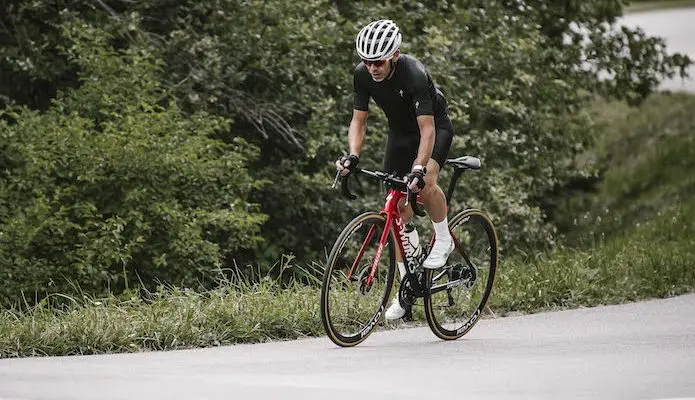
A pro’s bike is comfortable at 40 km/h, but when you ride at 25, it’s much less so. What do we really mean by that? It’s that the position makes the bike comfortable more than the bike itself. So, most of the time, the differences in sensations from one bike to another are mainly due to differences in position. Differences that need to be checked in terms of support points, angles, measurements (and there are more than you think), and the wear of materials (leather, cork, fibers, etc.). And it’s not just a detail, or the novelty effect…
=> SEE ALSO: All our Gear articles
Share the post "What difference does a new bike make?"