Share the post "First Ride Review: New Specialized Tarmac SL7"
The flagship model of the Specialized range is now available in its seventh version. A light, stiff, agile, dynamic, comfortable, and now aerodynamic bike, to the point of performing almost as well as the Venge in this area. It was designed by the American brand to be the ideal bike on almost all terrains. Let’s see what it offers in detail and on the road.
By Guillaume Judas – Photos: Pauline Ballet
With the new Tarmac, Specialized had no other ambition than to create the most versatile and fastest bike on the widest variety of terrains possible. Beyond a well-oiled marketing speech that can rightly instill some distrust, this marks a change of direction for Specialized, which until now had tried to convince us that a different bike was needed for each type of course, with each model offered in several levels of range.

A very clear segmentation that relied on three quite different models within its range of carbon road bikes. First, there was the iconic Tarmac (SL6 version), known for its agility and accessibility, with a light weight and a playful side that appealed to amateur riders as well as great champions like Julian Alaphilippe. Then there was the Venge (still in the catalog in 2021), a bike highly optimized for aerodynamics, for flat and fast courses, and preferred, for example, by Peter Sagan for sprint finishes. And finally, somewhat on the sidelines, there was the Roubaix, a bike designed for cobbled classics, and also appreciated by many sportive riders for its comfort. With its innovative solutions for damping vibrations, the latter naturally remains up-to-date. But with the new Tarmac SL7, it might ultimately be the Venge that could find itself without a place in the American manufacturer’s catalog.

Because until now, the choice between the Tarmac or the Venge often represented a dilemma for both professional riders and amateur enthusiasts aiming for performance. On one hand, a lively and agile bike, praised for its “easy” character; on the other, a brute of stiffness and aerodynamics, extremely fast but also a bit more difficult to handle, especially when strength begins to wane.
Starting from the observation that professional races are increasingly featuring courses with more elevation gain, but that they often end with a very small gap between the favorites, Specialized wanted to design a bike with the new Tarmac that combined as many as possible of the qualities of the two aforementioned models. For pros, but also of course for amateurs, who would no longer have to choose between champagne and caviar, with a bike at ease on all terrains.
Specialized wanted to design a bike with the new Tarmac that combined as many as possible of the qualities of the Venge and the Tarmac SL6.
By further optimizing the carbon fibers used, and by working on the shape of the tubes and the integration of cables and housing, the brand thus offers a bike that is almost ideal on paper for all users and on virtually all terrains, both flat and mountainous.

Lightweight
In its commercial S-Works version, equipped with either the Sram Red eTap AXS or the Shimano Dura-Ace Di2 groupset, the Tarmac SL7 is announced at 6.7 kg out of the box, which makes it a little over 7 kg with pedals and bottle cages, ready to ride. A weight very close to the UCI limit (6.8 kg) like the previous Tarmac S-Works, but with reliable and proven equipment, deep-section wheels, tires, disc brakes, full integration, and tubes designed to cut through the air, all while gaining stiffness. The S-Works frame alone weighs 820 g in size 54. The Tarmac Pro version, which will undoubtedly be very successful on the market, is announced with an additional 80 g on the scale. Note that to achieve this light weight, Specialized does not skimp on paint and finish. Each of the 11 colors offered benefits from superb craftsmanship, with deep and/or slightly glittery hues in the sun and excellent assembly quality. Even the matte colors are worked with reflections. It’s globally superb.

To create this new S-Works frame, Specialized relies on its very high-end Fact 12r carbon fibers (on the Venge it’s Fact 11r, and on the Tarmac Pro and Expert it’s Fact 10r) which are primarily assembled according to the Rider-First Engineered principle, meaning that each frame size is manufactured independently of all others with a complex interlocking of 500 carbon pieces. This is to provide the same sensations of stiffness or flexibility regardless of the user’s size. According to the brand, each frame size is built with different fiber orientations and material quantities depending on the zones.

It is thanks to internally developed software that Specialized engineers were able to advance on tube shapes offering the best balance between weight, stiffness, and aerodynamics. The Tarmac SL7 thus resembles the Venge in its general lines, but with slightly less imposing tubes. The front section with the fork and the hourglass-shaped head tube is, in any case, very similar.


The Tarmac adopts the Venge’s Aerofly II handlebar, with integrated cables and housing and an airfoil-shaped top section. The cables and hoses then pass under the stem to integrate into the head tube. This system not only offers handlebar adjustment possibilities but also allows for the mounting of a classic handlebar, as is the case on the more accessible versions of the Tarmac SL7.


The Tarmac SL7 also evolves in detail regarding its tube shapes. Only the down tube and top tube seem very similar to the previous version. While it retains the same proportions and seat tube junction height, the rear triangle is now much closer to the Venge, with not only more imposing chainstays but also seatstays that have lost their round shape. The seat tube now “wraps” around part of the rear wheel’s shape, then extends in a “D” shape, leading to the seatpost which thus adopts a design already used by many brands to ensure the best compromise between air penetration and maintaining a certain level of comfort.


Specialized also takes the opportunity to return to a threaded bottom bracket shell, with a 68 mm BSA standard, to facilitate maintenance and avoid the sometimes recurring creaking noises with BB30 bearings. The brand also abandons the delivery of S-Works models with its in-house carbon crankset, which had an integrated power meter. Now delivered with a power meter as standard, the two S-Works models in the catalog are supplied either with a Quarq/Sram model for the Sram Red bike, or with the Specialized power meter mounted on a Shimano Dura-Ace crankset.

A bike enhanced by the new Roval wheels
Available with Sram Red eTap AXS or Shimano Dura-Ace Di2, the S-Works version of the complete bike at €11,499 is also sold with the new Roval Rapide CLX wheels, which are light and aerodynamic. With a differentiated rim depth between the front and rear wheels (51 and 60 mm), and also a differentiated width (35 and 30 mm) to optimize front wheel stability and control, the Rapide CLX are also very light, with an announced weight of 1400 g for the pair. A real performance for wheels of this type, which are only compatible with tubed tires.


Ideal for the bike’s versatile character, these wheels can also be replaced by the new Roval Alpinist CLX, as part of a custom build from a frameset only (€4,199 for the S-Works, €2,999 for the Pro). With their 33 mm rim depth, the Alpinist CLX are also only compatible with tubed tires, and weigh 1258 g. This means they reduce the Tarmac’s weight by almost 150 g, making its handling even easier.

The rest of the equipment also lives up to this new chassis and these new wheels, with Specialized Turbo Cotton 700×26 tires, an S-Works Power saddle, and a Tarmac stem specially designed for this bike.
The Range
Available in two complete bike versions and also as a frameset, the S-Works is complemented in the range by two Tarmac Pro models (Fact 10r carbon with Sram Force eTap AXS in a single chainring setup but with the possibility of switching to a double, and Shimano Ultegra Di2) with Roval Rapide CL wheels at €7,399 and €6,999, followed by two Tarmac Expert models with Shimano Ultegra Di2 or mechanical, featuring a Pro frame, classic handlebar, and DT R540 or Roval C38 wheels at €5,299 and €4,999.

Efficiency and comfort delivered
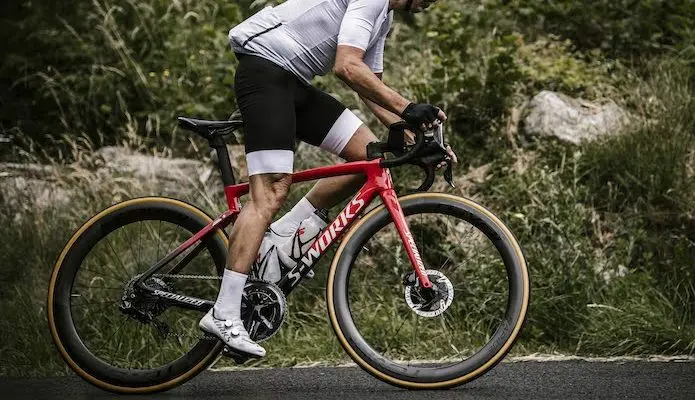
Has Specialized succeeded with this Tarmac SL7? Beyond a noticeable lightness even before getting on the bike and a finish worthy of a product of this price, the first few pedal strokes immediately show that the handling and road feel of the previous iteration are preserved. The bike is lively, responsive, playful, while gaining rolling qualities and positive inertia previously unknown on a machine initially designed for climbing.

The Rapide CLX wheels are obviously a big part of this, as they do much more than just accompany the bike on the flats, seeming to push it as if the mainsail were hoisted as soon as you catch a quartering tailwind. In gusts and with a strong quartering headwind, they require a minimum of attention for bike handling, but less so than competing wheels with comparable rim depth. And above all, they don’t feel like a handicap as soon as the road goes uphill, thanks to their light weight combined with stiffness perfectly in line with the frame.

On climbs, the Tarmac SL7 feels a bit stiffer than its predecessor, more compact and less soft under the pedal. But what efficiency! Its overall performance is appreciated, thanks to the perfect unity felt between each part of the bike, and without any sensation of flex. While the bottom bracket shell seems stiffer than the SL6, the new Tarmac retains its devilish geometry, starting with a very lively and direct front end, particularly noticeable on steep sections when you’re out of the saddle, pushing on the pedals and trying to make small zig-zags with the front wheel.

On descents and in corners, this lively steering makes the bike incredibly agile, but without ever posing stability problems, thanks again to the well-designed geometry and the particularly reinforced head tube. The Tarmac SL7 inspires confidence on fast, winding descents and encourages aggressive sprinting. A delight for those seeking performance!

Although the Tarmac SL7 is not intended to tread on the Roubaix’s toes, this increased level of efficiency does not come at the expense of comfort. This is, in fact, surprising from the very first pedal strokes: vibration absorption is very good, and the bike seems to glide on a cushioned surface. After a long ride combining windy conditions and high elevation, the Tarmac doesn’t turn into a jackhammer and allows you to return safely, simply by reducing the pace.
Vibration absorption is very good, and the bike seems to glide on a cushioned surface.
Not only does the frame remain versatile enough to retain many of the qualities of its predecessor, but it also benefits here from the width of the rims and the Turbo Cotton tires perfectly seated within them. The tire thus presents a perfectly open shape and sidewalls exactly in line with the rims (without forming a bulge), which allows for a slight reduction in pressure while maintaining perfect control in tight trajectories. This characteristic also inspires confidence in handling and truly makes descents safer. For the rest, the S-Works Power saddle proves firm, but you are perfectly positioned on it, provided you find the right adjustment. The same goes for the Aerofly II handlebar, whose upper shape is quickly appreciated for resting hands during long climbs.

While the complete bike is sold with Rapide CLX wheels, a ride including a climb up a pass and still in windy conditions also allowed us to note the difference with the Alpinist CLX wheels. These lightweight wheels make the bike even more agile and lively, obviously less sensitive to crosswinds, but without distorting its general character. They remain stiff despite their weight and work well in line with the frame’s stiffness. On the flats, they retain some inertia and do not require frequent accelerations. These sharp wheels will undoubtedly be preferred by enthusiasts of long mountain rides.

Ultimately, the Specialized Tarmac SL7 in this S-Works version is a resounding success. While a bit stiffer than the SL6, it gains versatility without losing any of the qualities that made the model successful. A kind of ideal bike, for all terrains, but one that comes at a high price for its level of technicality. Beyond the price, our only complaint concerns the inability to choose gear ratios, crank arm length, or stem size when ordering a complete bike. Most of the time, it will be necessary either to arrange with the shop or to opt for a custom build, an option also allowed by the availability of framesets, in S-Works or Pro versions.

| SPECIALIZED TARMAC S-WORKS SL7 |
| Note: * Pros: Lightweight, versatility, stiffness, finish, wheels Frame: Tarmac S-Works SL7, Fact 12 R carbon – Fork: Specialized Fact Carbon Disc (thru-axle) – Handlebar: Aerofly II Carbon – Stem: Specialized Tarmac integrated – Brakes: Shimano Dura-Ace R9170 hydraulic 160/140 mm – Front Derailleur: Shimano Dura-Ace R9150 Di2 11 sp. – Rear Derailleur: Shimano Dura-Ace R9150 Di2 11 sp. – Levers: Shimano Dura-Ace R9170 hydraulic Di2 – Cassette: Shimano Dura-Ace 11-30 – Chain: Shimano Dura-Ace 11-speed – Crankset: Shimano Dura-Ace 52/36 (with Specialized power meter) – Wheels: Roval Rapide CLX – Tires: Turbo Cotton 700×26 – Saddle: Body Geometry S-Works Power – Seatpost: S-Works Tarmac carbon – Weight: 6.7 kg in size 54 without pedals – Number of sizes: 7 – Price: €11,499
|

| Contact: www.specialized.com |
=> SEE ALSO: All our Gear articles
Share the post "First Ride Review: New Specialized Tarmac SL7"