Share the post "The First Crash"
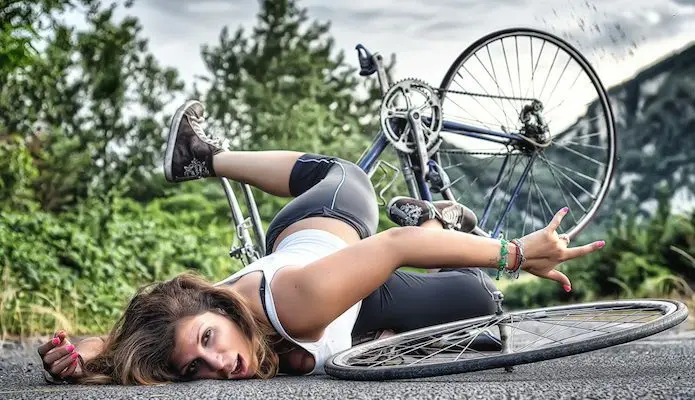
Many dread it, and some are even traumatized by the mere thought of it. Falling off your bike is one of the risks of cycling, but fortunately, most of the time it’s not serious. From a minor bruise to a fracture, you can get more or less hurt when falling off your bike, but the important thing is to get back on. All experienced cyclists have been there, and they can explain the causes and possible consequences.
By Jean-François Tatard and the editorial team – Photos: Pixabay.com, Wallpaper.com, Flickr.com, Frédéric Poirier

I knew that one day crashing face-first was inevitable… It was a Tuesday evening in June. It should normally have happened in a bike race. I imagined the scene where I would get elbowed by a competitor in a mass sprint on the Champs Elysées. But instead, it finally happened in a Decathlon store on a 5-year-old’s bike without training wheels. And you? Do you remember your first real bike fall? Did you dread it? Did you anticipate it? Or do you fear it to the point that this prospect paralyzes you?
A 16-inch race
As ridiculous as it may sound, my first real fall was the result of a 16-inch bike race. When you’re a student, you often have the choice between Decathlon and McDonald’s to pay for your tuition. And since I don’t like my hair smelling of fried food, I chose a more athletic environment to earn some pocket money. With my colleagues, when it came to working at night to arrange the shelves, we had gotten into the habit of ending our night of hard work with a bike race, slaloming between the customer-empty aisles. The smaller the bike, the more fun the Race Bike was. Except that this time it turned into a Crash Bike.
My legs felt good. My pedal stroke was light. I felt like I was going to win. I stayed in second position only to maintain the draft. And when I pulled out just after the team sports aisle, opposite the 4500 meters of the store, I found myself face to face with fishing rods. Then, all I remember is waking up with three firefighters over my head!
“The danger is when there is none!”
I didn’t expect that one! Yet, I was completely shaken. As funny as the anecdote is, the accident had wreaked havoc on my body – it was sore for weeks – with a broken collarbone, a concussion, fishhooks everywhere under my skin, but I was also mentally and emotionally distraught. So, for you to also learn lessons from what a first fall means, we have prepared a topic meant to de-dramatize the situation.
Falling often happens when you least expect it. Or more precisely, when vigilance drops. Due to overconfidence. The first few pedal strokes are often very cautious. You don’t launch yourself onto the road or into the middle of a peloton without a legitimate apprehension. Potential danger is everywhere when you’re balanced on two wheels.

You can make a trajectory error. You can lose grip in a turn, sliding due to rain or an oil slick left by a vehicle. You can hook another cyclist’s wheel and lose your balance, or pile up on other bikes that have already fallen in front of you. You can be hit by a vehicle, or simply fall while stopped, unable to unclip from your clipless pedals. You can also experience a mechanical problem. With each of these falls, you can damage your equipment (scratches), break your bike, and hurt yourself to varying degrees. From a simple bruise to a fracture that will require immobilization for a more or less long period.
Fortunately, most of the time a fall results in a bruise or a burn, to the hip, knee, or elbow, the consequences of which disappear in a few days.
In this case, it is often the upper limbs that are affected: collarbone, wrist, elbow, and much more rarely femur, hip, or knee. Fortunately, most of the time a fall results in a bruise or a burn, to the hip, knee, or elbow, the consequences of which disappear in a few days. This is what you risk. It remains “reasonable” as long as a vehicle is not involved. What you need to remember is that falls are generally avoided when you control the situation, stay focused, and are engaged in your activity. You can descend fast or rub shoulders in the peloton, but always keeping in mind the danger of the situation, taking into account the elements around you, and always trying to anticipate the reactions of your machine or other cyclists.

The helmet
Is it still necessary to revisit the topic of helmet use? It took time, but today the importance of wearing a helmet has become completely clear to everyone, even if it is not mandatory for cycling (except for children under 12). But it never strikes you how necessary it is until your skull meets the asphalt for the first time. For many who have tasted the bitter flavor of the tarmac, it has become obvious that things could have been much worse without wearing a helmet. Certainly, things could also have been much better by wearing the helmet correctly. I am referring to the adjustment of the chin strap, which must be tightened sufficiently.
Your bike?
Then check your bike. If you intend to jump on it immediately, you need to be 100% sure that both you and it are in working order. Some key elements to check are:
- Your brake calipers or rotors
- Your shift levers
- Your front and rear derailleurs
- The condition of your wheels
- The condition of your tires
Most other problems will likely be obvious, such as cracks in the frame, a loose saddle, stem, or handlebars. Get help! Seek the support and expertise of a qualified mechanic at your bike shop!

Don’t wait to get back on
Don’t wait to get back in the saddle! As they say: “Practice makes perfect!” Unless you are seriously injured or your bike is irreparable, try to get back in the saddle the very next day. Make sure your doctor agrees with this too. This is especially important, especially when it’s your first crash. If you can convince a teammate or an understanding friend to come with you, do it. It doesn’t have to be a long ride, even a few kilometers around the house are enough. What’s important is the goal, it’s just to remind yourself that you love riding more than your fear of crashing your head on the ground.

To conclude
Learn from your fall! It shouldn’t stop you from continuing to hit the road. Analyze the reasons for it and accept your mistakes. Acknowledge your lack of concentration or unnecessary risk-taking. And since you’ve crossed the mental barrier, it’s time to recover physically. Keep that road rash exposed for the first few days and treat any other injuries you may have sustained. Eat ice cream or something comforting. And whether you do it yourself or send it to your bike shop, get the necessary repairs done on your bike. Take care of yourself, take care of your bike, and get back on the road, because there are only two types of cyclists: those who take the risk of falling and those who only ride on an indoor trainer!
=> SEE ALSO: All our Magazine articles
Share the post "The First Crash"