Share the post "Logbook – Long-term test of the Orbea Orca OMX #5 – Comfort and review"
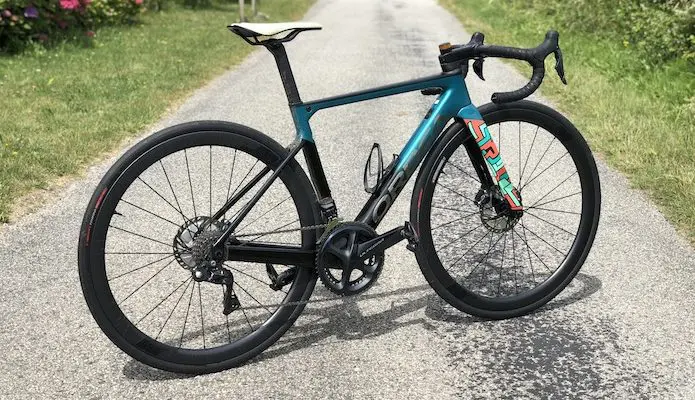
In addition to our first exclusive test of the new Orbea Orca OMX at the time of its official presentation, how does this bike really perform in everyday use? We answer this question with a long-term test of the Orca M20iLTD-D on our usual training routes, whose progress you have been able to follow regularly. Fifth part with the results of this intensive 6-month test, with a particular focus on the comfort provided by this bike.
By Guillaume Judas – Photos: GJ / 3bikes.fr – All rights reserved
After 6 months and nearly 10,000 km on different terrains, the Orbea Orca OMX has been able to demonstrate the full extent of its qualities, but also, of course, a few minor flaws inherent in this type of machine. Stiff, stable, and responsive, the latest Orca was designed in the Basque Country, a very steep region where it’s best to know how to climb, and preferably on steep gradients.

Despite a slightly high weight for this model equipped with Shimano Ultegra Di2 Disc at a catalog price of €5699 (around 8 kg fully equipped), the Orca never failed on this terrain, especially with the Vision 40 SC wheels, one of the very pleasant surprises of this test due to their versatility, maneuverability, and stability during windy rides.

Because the other good surprise of this long-term test is the bike’s excellent performance on flat terrain and during fast rides. The Orca never seems to dissipate a single watt or flex with large gears. In a sprint, it proves very effective, whether on almost standing starts or when launched at high speed. Even if it wasn’t specifically designed for it, it is more aerodynamic than its predecessor, thanks in particular to the integration of the Di2 electric wires and brake hoses, and its thick, blade-shaped fork, designed so that drag diffuses around the imposing down tube.

It is therefore versatility that prevails, as we can see on all terrains. However, the question of comfort remains, since the very design of the frame does not seem to have been studied in this sense. Moreover, from the presentation of the bike, Orbea confided its bias on this subject: rather than seeking to modify the shape of the tubes to the detriment of stiffness and efficiency (except for the upper part of the frame) or to place elements intended to dampen vibrations to the detriment of weight gain, the brand preferred to bet on the possibility of mounting larger tire widths, up to 32 mm.


We know that larger tires improve grip, but also the versatility of the bike by making Gravel-type dirt roads accessible, in addition to providing comfort with lower inflation pressures without significant loss of efficiency. When we mounted 28 mm tubeless tires (actually 31 mm on Vision wheels, whose rims are wide), we observed a very clear gain in this area compared to the original setup. The comparison with DT Swiss wheels (available as an option) with 25 mm tires also showed the influence of the wheels/tires combination on vibration filtering.
Contact points
Beyond the question of tires, comfort is also provided by the contact points, namely the saddle and the cockpit. The stiff carbon handlebar shows no particular flex, either laterally or longitudinally. And that’s good because the cockpit thus remains in perfect harmony with the frame. The dimensions and shape of the handlebar play a significant role in the feeling of comfort, thanks to the natural grip they allow. To do this, we had to modify the original adjustment to place the lower part of the handlebar almost horizontally and then raise the brake levers. Despite so-called “compact” dimensions, the Orbea handlebar differs from the competition with a rounded shape in the drop of the handlebar that offers a good firm grip, and another rounded shape on the top that allows the wrists to clear when riding out of the saddle. For vibration damping, we had to rely on the padding of the handlebar tape. It must be admitted that the original setup ultimately proved more comfortable and less firm than the model we subsequently mounted.


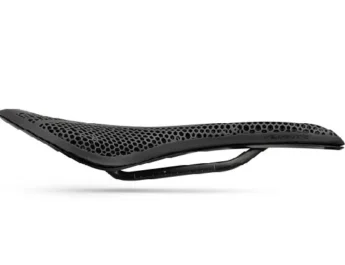
For the saddle, we adopted for the end of the test the new fi’zi:k Antares Versus Evo Adaptive with 3D printed padding, which proved to be totally in the spirit of the bike, with an almost inflexible shell ideal for efficiency and avoiding the sensation of bobbing when pedaling, but with support that provides almost personalized comfort on long rides.

It should also be noted that the saddle could only be mounted by obtaining a specific saddle clamp for carbon rails, available as a spare part from Orbea and not supplied as standard.

The Orbea Orca OMX is a sporty and dynamic bike, designed primarily to help you transmit all your energy to the road. It can be classified among “performance” bikes, but it is not without comfort, provided that the position is carefully adjusted and the contact points or type of tires are customized according to the terrain or distances envisioned.
Component wear
Tested in all weather conditions and even on an indoor trainer during the lockdown period, the Orca OMX must, of course, undergo a thorough overhaul upon its return to Mallabia (Biscay) at Orbea.

The headset bearings are very worn and probably need to be replaced. But there’s nothing unusual, especially after the very rainy winter we experienced.

The same goes for the chain (the second one), which is nearing the end of its life after about 5000 km. Gear changes are still precise, but the drivetrain is becoming increasingly noisy on certain cassette cogs. This is a sign to consider with the Shimano drivetrain, to avoid premature wear of the cassette and chainrings.

While the disc brakes are still as effective, we are closely monitoring the front brake lever, which has already required two bleeds. Each time, the travel became longer and longer until it had to touch the handlebar when braking. No issues with the rear brake, however, nor with the rotors and pads. Note that when changing wheels, adjusting the calipers to prevent the rotors from rubbing was extremely easy.
In total, the Orca OMX was used with four different pairs of tires, two handlebar tapes, two chains, but also two pairs of wheels and two saddles, for testing. The bike was used on flat terrain by the sea, in medium mountains and on the hills of the Chevreuse valley, in the rain and wind, day and (rarely) night, and with both 53/11 and 39/28 gearing. Good ways to get to know a bike thoroughly, and an opportunity here to appreciate one of the best value-for-money machines currently available.
| ORBEA ORCA OMX M20iLTD-D |
| Rating: * Pros: Versatility, stiffness, finish, stability, value for money, MyO color customization system Frame: Orbea Orca carbon OMX Disc – Fork: Orca 1-1/8″ – 1.5″ – Handlebar/Stem: OC2 Road Carbon/Orbea ICR – Brakes: Shimano Ultegra Disc (160/160mm) – Rear Derailleur: Shimano Ultegra Di2 11-speed – Levers: Shimano Ultegra Di2 11-speed hydraulic – Cassette: Shimano Ultegra 11-28 (choice of teeth) – Chain: Shimano Ultegra 11-speed – Crankset: Shimano Ultegra 53-39 (choice of teeth) – Wheels: Vision 40 SC (Mavic Ksyrium Carbon or DT Swiss Arc 1400 DiCut optional) – Tires: Hutchinson Fusion 5 All Season TLR 700×25 – Saddle: Selle Italia SLR Boost SuperFlow – Seatpost: Orbea Orca OMX SB0-25mm – Weight: 7.720 kg in size 49 without pedals – Sizes: 47 – 49 – 51 – 53 – 55 – 57 – 60 – Price: €5,699
|
| Contact: Orbea.com |
=> SEE ALSO: All our Gear tests
See all our articlesBikesShare the post "Logbook – Long-term test of the Orbea Orca OMX #5 – Comfort and review"