Share the post "Compartment syndrome"
Whether you’re a Sunday cyclist or a high-level athlete, injuries spare no one. They make us sad and grumpy and deserve a detailed explanation sheet for each one, using the 5W1H method. The idea behind this series of short articles is to better understand them, adopt good behaviors to avoid them, and know what to do to recover better.
I propose to review each time, in the form of the “5W1H” (What, Who, Where, When, How, Why) and in as many articles as there are recurring injuries in cycling and triathlon, all possibilities of frustration related to forced rest.
After the knee, the clavicle, saddle sores, spinal pain, iliac artery endofibrosis and Achilles tendonitis, today I offer you an explanatory sheet – always with the 5W1H approach – this time for compartment syndrome.
By Jean-François Tatard – Photos: commons.wikimedia, Jean-François Tatard
=> SEE ALSO: All our Infirmary articles
WHAT?
Fellow athletes, have you ever felt like your leg muscles were compressed in their sheath? As if the increase in pressure in the fascial compartment was significantly limited? The impression that the compartment becomes inextensible? In medicine, this is called muscle ischemia in the compartment. The first symptom is pain regardless of the severity of the trauma. The diagnosis is clinical and is usually confirmed by measuring the pressure in the muscle compartment. The treatment is fasciotomy.
This pain may be accompanied by a sensation of muscle tension and cramping, sometimes with neurovascular signs such as paresthesia. Furthermore, it is a global muscle pain without the precise painful point that one would find in a muscle lesion. Finally, it is often bilateral, and the topography can ultimately be quite evocative.

WHO?
Generally speaking, compartment syndrome is found mainly in young athletes aged 20 to 30. There is no notion of sudden onset of pain as in a strain or tear. It is much more insidious.
As for the sports concerned, these are mainly running, but also football or even swimming, especially if practiced with fins. However, after a good deal of research, fellow cyclists, you can already rule out this possibility if you experience associated symptoms. Indeed, compartment syndrome is almost never found during the exclusive practice of cycling.

Furthermore, concerning the upper limbs, these compartment syndromes are usually found during the practice of mountain biking, cyclocross, or BMX. Finally, compartment syndromes can be found in professionals practicing demanding and prolonged activities, such as those working on construction sites or musicians.

WHERE?
The location of the symptomatology is one of the major guiding elements, as it is most often an anterolateral leg pain, whereas periostitis or stress fracture pain awakens pain in the medial part of the tibia. For other locations, sensitivities are found in the posterior compartment of the leg, but also in the thigh or forearm. But don’t forget, and this is very important, because don’t think it’s that easy, location is not a guiding factor.
WHEN?
The most typical case concerns running. It is in this population that most cases are found. The pain will almost always occur for the same running time, unless the athlete has made a recent effort in the preceding days. In this case, the pain may occur earlier. But where it is again tricky, the pain will not occur in another sport. If you combine strength training sessions, for example, or go cycling, it is not at all obvious that you will find the pain. The fact of having pain in a specific sport. And in this case most often running and no pain in another sport is very evocative. Classically, for those of you reading this, it is the case of the triathlete who will suffer while running but not while cycling or swimming.
If there is one essential point to remember in the diagnosis: remember above all that the precision and reproducibility of the delay in the onset of pain are probably the most evocative signs.

HOW?
Get ready! You’re going to be interrogated, but it’s fundamental. It’s what allows, in most cases, to make the diagnosis. The doctor will question the patient about the duration of the condition and will also ask if there has been a cessation of sport. They will also ask about the examinations performed and the various treatments carried out: use of analgesics, NSAIDs, infiltrations, physiotherapy sessions, osteopathy, and rehabilitation.
In the latter case, it is very important to specify the nature and content of the rehabilitation sessions. We are often not precise enough, whereas the devil is often in the details. The other element that can point to compartment syndrome is that it is sometimes asymmetrical, with a most often bilateral character 9 times out of 10. In short, there comes a point where it becomes unbearable, and the pain will force the athlete to stop. Following the stop, the pain will significantly decrease, but the discomfort may persist for a few more days.
There will be no pain on palpation, stretching, or during isometric tests, and even dynamic tests do not always work.
Another complexity of the problem is that the clinical examination is often normal. Nothing will be found! Why? Because, for the most part, there will be no pain on palpation, stretching, or during isometric tests, and even dynamic tests do not always work. I have seen cases where the doctor makes the athlete stand on their tiptoes to find that horrible sensation of inextensibility of the calf compartment in concentric contraction, and nothing happens.
So, to obtain positive clinical signs, the ideal is to perform a post-exercise examination and objectively observe the “hardness” of the muscle.
It is also necessary to rule out differential diagnoses. They are much more frequent than compartment syndrome, and it is by eliminating them that one will lean towards compartment syndrome. Finally, only complementary examinations can confirm the result. The measurement of intramuscular pressures, for example, can confirm the diagnosis. It must be performed during the symptomatic period and by a practitioner with real expertise in this type of exploration. It is not an examination that everyone can perform just like that. Doppler ultrasound can also be tried, which will allow for the search for associated pathologies, or ultrasound, which can rule out a muscle lesion. In some cases, MRI, or even muscle scintigraphy, may be proposed by the sports physician.
WHY?
It’s often a real mess. The sports doctor is often confronted with numerous muscle lesions, whether acute or chronic, pains of neurological or bone origin, or tendon pains. This is why the diagnosis of compartment syndrome is often made with (too much) delay, sometimes after several months, or even several years of evolution. The clinical examination is therefore of paramount importance because it is what will allow, in most cases, to guide the athlete in the right direction. Thus, a few simple elements are to be sought.
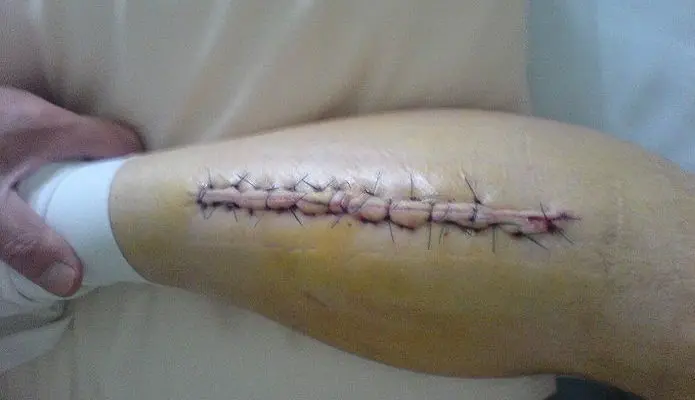
Friends, if your diagnosis is confirmed and you love your sport that much: good or bad news, take it as you will, surgical treatment is inevitable. I know, the decision is difficult to make because this treatment is not medically necessary. Surgery is only offered to continue practicing one’s sport. This approach requires a long discussion between the doctor and the patient. It will be necessary to explain to them that this operation, in addition to all the potential complications related to a surgical procedure, will result in a rather significant scar, etc. But above all, the athlete will most often have to choose between a surgical procedure or stopping their sport, most often running.
CONCLUSION
In the next explanatory sheets, I propose to continue reviewing the injuries that most often paralyze us. We will thus see next time head traumas, wrist pathologies, digestive pathologies, plantar fasciitis, and periostitis.
=> SEE ALSO: All our Coaching articles
Share the post "Compartment syndrome"