Share the post "fi’zi:k Antares Versus Evo 00 Adaptive saddle review"
With its 3D-printed padding, the fi:zi’k Antares Versus Evo 00 Adaptive is the first saddle to be introduced with this technology, which is supposed to revolutionize comfort and open up possibilities for customizing the seating area. Let’s see how it performs in testing, after several weeks on the indoor trainer and on the road.
By Guillaume Judas – Photos: 3bikes.fr

A few weeks before the Specialized S-Works Power Mirror already tested here, fi’zi:k introduced a version of one of its flagship models that revolutionized the way we can conceive of seating on a bike. The Antares Versus Evo 00 Adaptive, with its extraordinary price, its futuristic and sleek look, and especially its promising technology, already made an impression even before its market launch and the possibility of being tested in the field.

It’s no coincidence that the Power Mirror and the Antares Adaptive are the two standout saddles of the year. They benefit from the same 3D printing padding technology, created by the same company, Carbon, based in the heart of Silicon Valley, California. Nevertheless, the two saddles are different in spirit, even if the objective remains the same: to improve comfort. Lighter, the fi’zi:k Antares is also much firmer to the touch, at least in terms of its shell. This suggests more sportive aims.

3D Printing
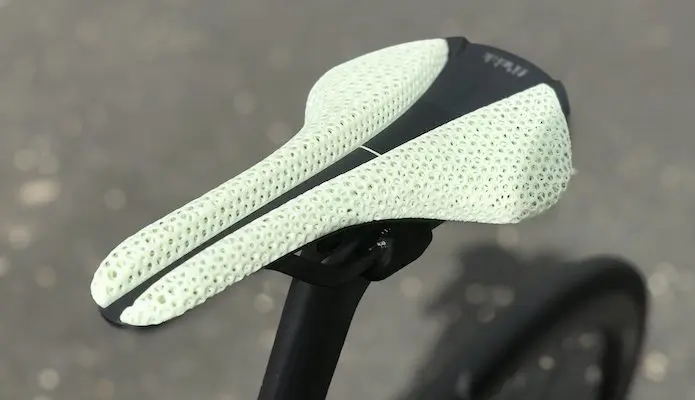
3D printing is the set of processes that lead to the manufacture of an accessory or object by adding material instead of removing it to achieve the desired shape, which is the case with traditional foam for a saddle. Instead of this foam normally placed between the shell and the cover, a complex 3D matrix is printed here from liquid polymer to create a framework with independent cross-braces, capable of deforming very precisely and very locally.
This technology offers much more personalized support than with foam. Even if we notice by touch that fi’zi:k chooses different densities depending on the positioning of the matrix on the saddle (soft at the very back, firmer at the crescent, medium at the nose), the very principle of cross-braces and air holes leads to very localized deformations according to anatomy that do not produce other deformations in the peripheral areas. This is a plus for comfort.

However, this technology primarily opens up other perspectives, given that fi’zi:k, like Specialized, believes they have reached the limits of traditional foam evolution. One can thus imagine that in the near future, 3D printing will allow the custom manufacturing of saddle padding in terms of density for each individual, according to their weight, anatomy, and riding style.
Racing spirit
This saddle is designed based on an Antares Versus Evo, which means it retains some of its characteristics, particularly in terms of dimensions. Relatively flat (though slightly less so than the Arione), the Antares is offered here with a crescent width of 139 or 146 mm for a length of 274 mm, with a “saddle dip” (or at least a reference point representing the middle of the saddle with a width of 75 mm) located 151 mm from the nose. These data must be taken into account when transferring measurements for saddle adjustment.

The full central channel is carried over from the Versus Evo versions, and helps relieve pressure on soft tissues, without, however, causing a lack of support, especially when adopting an aggressive posture (forward) on the bike. And while the edge of the central channel can sometimes be very firm or even painful in some cases with this type of saddle, the 3D-printed padding eliminates this discomfort here.
The Antares Versus Evo 00 Adaptive immediately presents itself as a sporty saddle intended for experienced riders. The 148 g verified on the scale (which is very light for a saddle) are achieved thanks to carbon rails and a chassis of the same material, which is almost inflexible under pressure. It’s stiff as a board. Only the padding initially provides a bit of softness, but you still have to apply finger pressure in the right place to be convinced. In profile, this very high-end saddle is very aggressive, even if the pastel color and the superb finish of the un-covered padding indicate that we are dealing with an extraordinary product above all. In short, while the asking price of €390 seems very high, one must consider all the technology deployed to judge whether the investment is worthwhile. Lightweight saddles at nearly €300 are already not so rare…
Firm comfort
More than 1000 km on the indoor trainer and on the road allowed us to form a precise idea of the qualities of this fi’zi:k Antares Versus Evo 00 Adaptive, which is quite different in spirit from the Specialized S-Works Power Mirror, even if they are almost cousins.
Shorter and wider at the rear, the Power Mirror is also much softer in the shell, which has the effect of providing astonishing, even unsettling, passive comfort, to the point where you completely forget the saddle after a few tens of kilometers.

The Antares here is much more rigid, with a shell that barely moves, whether under the rider’s weight or when riding over uneven terrain. Only the 12 mm thick padding, whose density is not uniform everywhere as we mentioned earlier, provides the cushioning.
This does not mean that the saddle is spartan. Its “comfort” is simply more suited to a sporty and committed cycling practice, when you appreciate stable and firm support, and especially the feeling of being well “anchored” on the saddle in a speed-seeking position. However, it is the kind of model to forget for bikepacking, or if you are used to coasting on false flats.
The first pedal strokes on the indoor trainer still show a slight floating sensation of the sit bones, which have to get used to sinking into the padding rather than rotating around it. This impression quickly disappears during a practice that is still quite demanding for the seating area. Some hard spots eventually appear after 1h30 without any coasting time and with minimal out-of-the-saddle riding: first, the width of the crescent, which remains that of an Antares, and which is slightly wider than what we usually use (139 mm vs 130), and then the central channel on the front part, which also proves to be particularly firm. However, overall, in conditions of excessive sweating and despite numerous frictions, not only do we not notice the appearance of redness or other irritations, but we also appreciate this clever blend of grip and freedom of the polymer padding, which does not attack the bib shorts’ fabric while allowing you to feel well-fixed on the saddle.

On the road, the appearance of shocks due to uneven asphalt does not darken the picture, quite the contrary. Out-of-the-saddle accelerations and the few possible reliefs by slightly lifting off the saddle are enough to eliminate the discomfort felt at the front in the central channel. It must be noted that holes and small bumps are well absorbed despite the very hard shell. It’s firm and sporty, but it remains comfortable. Obviously, the dimensions of the crescent can be more problematic, at least for those whose pelvic width is far from this rather standard size. After a few hours, one can feel a certain pressure on the back of the seating area, which is not felt with our usual slightly narrower saddle.
However, the fi’zi:k Antares Versus Evo 00 Adaptive is the first of its kind for the brand, and it is very likely that other saddle shapes will follow, such as the Arione or the Aliante, always with the same technology. A new way of designing saddles capable of solving many seating problems, without distorting the very principle of a sports saddle. For us, the fi’zi:k Antares Versus Evo 00 Adaptive is in any case much more comfortable than the Antares 00, the other lightweight version of the same model, but with truly minimalist traditional padding. And as for the very high price, it is to be expected that if this technology is well received, other versions with a synthetic shell or alloy rails may be offered, and thus at a more affordable price.
| FI’ZI:K ANTARES VERSUS EVO 00 ADAPTIVE SADDLE |
| Rating: * Pros: Weight, finish, concept, firmness/comfort combination Shell and rails carbon – Length 274 mm, width 139 or 146 mm – Weight: 148 g in 139 mm – Price: €390 |
| Contact: fizik.com |
=> SEE ALSO: All our Gear articles
Share the post "fi’zi:k Antares Versus Evo 00 Adaptive saddle review"