Share the post "Achilles Tendonitis"
Whether you’re a weekend cyclist or a high-level athlete, injuries spare no one. They make us sad and grumpy and each deserves an explanatory sheet using the 5W1H method. The idea behind this series of short articles is to better understand them, adopt good behaviors to avoid them, and the right course of action for better recovery.
I thus propose to cover each time, in the form of the “5W1H” (What, Who, Where, When, How, Why) and in as many articles as there are recurring injuries in cycling and triathlon, all possibilities of frustration linked to forced rest.
After the knee, saddle sores, spinal pain, the clavicle and the iliac artery, today I offer you an explanatory sheet – still using the 5W1H approach – this time for Achilles tendonitis.
By Jean-François Tatard – Photos: Pxabay.com, Pxhere.com, Wikimedia.commons, Jean-François Tatard
WHAT?
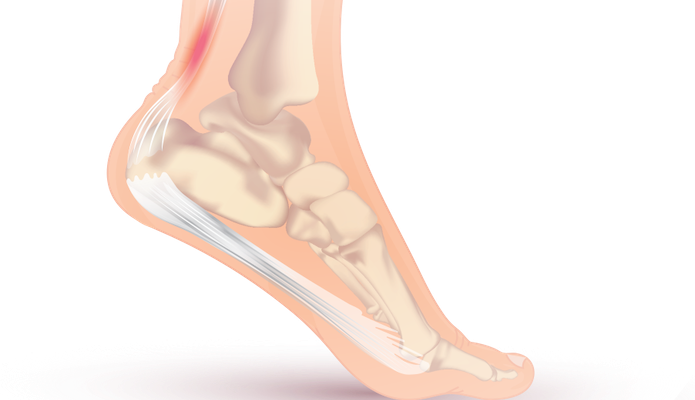
Achilles tendonitis is pain in the Achilles tendon linked to a structural modification of the tendon and a loss of its ability to withstand a given stress. The tendon itself is by definition a connective tissue composed of a multitude of tendinous fibers, which connect the muscle to the bone, and which allows joint movement. This tendon has the ability to absorb and then retransmit energy. If you give it sufficient load, it will be able to withstand and return it. However, if you give it too much, it will suffer more or less significant lesions. That’s inflammation! In detail, it is mainly present at the beginning and then often disappears after a few days. Nevertheless, the lesions prevent you from having normal activity for even longer.
The Achilles tendon is the longest and thickest tendon in the human body, with a length of about fifteen centimeters and a thickness of 5 centimeters. It can normally support a load of 400 kg.
Achilles tendonitis mainly affects runners, and therefore triathletes, but can also, more rarely, affect other athletes such as cyclists. Laurent Fignon, for example, suffered from Achilles tendonitis in 1985, a pathology for which he underwent surgery.

You have chosen to practice running, and you have done well. Nevertheless, it is not without risk. Injuries are almost inevitable, and Achilles tendonitis is the most frequent of all possible lesions. Learning to manage it is therefore crucial. And even if this 5W1H sheet will enlighten you on the causes, consequences, and solutions, nothing beats the work and support of a sports physiotherapist. They are the only one who can truly guide and correct you on this type of problem. In addition, some of their equipment (Compex, shockwaves, laser, cryotherapy, cupping, Tecar, etc.) will most certainly allow you to accelerate the healing process.
WHO?
Achilles tendonitis mainly affects runners and therefore triathletes. And it is not the sole preserve of high-level professional athletes. Everyone can be affected.
WHERE?
The very serious British Journal of Sports Medicine published the results of a 2007 study, and we can imagine that the figures have not improved since then. Thus, one in two runners does not run forcibly and unintentionally due to injury. In other words, 50% of practitioners will get injured this year. This is statistically proven. In the same study, out of 1,000 runners surveyed, the frequency is one injury per individual every 82 hours. And in 86% of cases, these injuries occur in the lower limbs. Finally, this injury will force you to cease your favorite activity for an average duration of 20.7 days. Achilles tendonitis is the most frequent among runners. In 14% of cases, when injured while running, it is an inflammation of the Achilles tendon.
50% of runners will get injured this year.
WHEN?
Achilles tendonitis is an excessively frequent pathology among athletes. Unlike most other injuries, Achilles tendonitis is not necessarily linked to a postural reason. Most often, it results from an inadequate practice of your sport. In this inadequacy, the causes can be internal or external.
Tendonitis requires care, so as not to lead to an Achilles tendon rupture and, at the same time, to surgical intervention, which is inevitable in this case, with much heavier consequences in terms of recovery than a few days of forced rest from the first pains.

HOW?
The pain is very often localized primarily in the body of the tendon. Not hard to find, you only have one, at least one per leg (if you have two legs). However, it can occur at different times. During, before, after, “during and before”, “after and during”, and “before and after”. And there are thus 3 levels of severity.
- STAGE 1
You only feel pain in the morning when you get up. Then it passes after a few steps. To summarize: it is mainly present in the first few minutes of the day. But as soon as you put a little activity back into the tendon structure, you will regain “normal” mobility.
- STAGE 2
You keep the pain beyond the first steps after waking up. It continues to persist even during the first few minutes of jogging. And then it fades after 10 or 15 minutes, giving you the illusion that the tendonitis has disappeared until you find your pain again once the body has cooled down. Sometimes in the evening, when going from the sofa to bed.
- STAGE 3
The pain is omnipresent and intensifies at the first overexertion. You can barely touch the tendon with your fingers without jumping to the ceiling. Running is unthinkable!
- DIAGNOSIS
It is preferable to consult a doctor to confirm or rule out what you think is Achilles tendonitis. We are talking about tissues, so ultrasound is in order.
Solutions
Don’t tinker! Don’t play doctor! Consult, and better than a family doctor, a sports doctor. Long-term rest is not recommended. It is indeed not the best solution. After the inflammatory phase and treatment with anti-inflammatories if necessary, it is better to maintain some activity and gradually bring the tendon back to proper function than to risk weakening it through inactivity, which will only cause the tendon to lose strength and flexibility.

Recovery exercises
These are exercises that the physiotherapist may invite you to perform. Once you have understood the movement and, ABOVE ALL, checked – and had your physiotherapist check! – that you are doing it correctly, perhaps you can do them at home.
- Phase 1
Initially, it will involve performing static contraction exercises, voluntarily without producing movement. Immobilize your Achilles tendons by standing on your tiptoes for 30 seconds. Then rest for 30 seconds. And repeat this 5 times. You can even do it morning, noon, and night. These are called isometric exercises.
- Phase 2
Have you ever heard of the Stanish protocol? It’s a must when talking about Achilles tendonitis. The movement consists of going up on your tiptoes and slowing down the descent. For example, on stairs, you position yourself on your tiptoes and slowly descend for 5 seconds to repeat the movement, for example, 10 times per leg over 3 sets. These are called eccentric exercises.
- Phase 3
You can evolve the exercise by adding weight. A weighted vest, for example, or a backpack that you load with what you think is possible to make the content heavier.
- Phase 4
After a few weeks, you can consider jumping rope. These are called plyometric exercises. The goal is to perform eccentric jump landings followed by an explosive push-off. However, you will need to gauge the quantity and intensity yourself or be accompanied by a professional, a coach, a physiotherapist, or a sports doctor.
WHY?
We can distinguish between internal causes (sudden increase in mileage or non-progressive increase in intensities) and external causes (change of insoles, new shoes, difference in drop height, and variation in ground surface).
CONCLUSION
In the next explanatory sheets, I propose to continue reviewing the injuries that most often paralyze us. We will thus see next time, head traumas, wrist pathologies, digestive pathologies, plantar fasciitis, shin splints, compartment syndrome, and pubalgia.
=> SEE ALSO: All our Infirmary articles
=> SEE ALSO: All our Coaching articles
Share the post "Achilles Tendonitis"