Share the post "Canyon Endurace:ON 7.0 Review"
The range of hybrid bikes (or road e-bikes, although the term hybridization is more appropriate here) is expanding and prices are starting to become more accessible. Canyon obviously couldn’t be absent from this segment, and thus offers its vision of an assisted bike at a relatively affordable price with its new Endurace:ON 7.0.
By Guillaume Judas – Photos: 3bikes.fr

We have already mentioned it in our columns, but it is worth emphasizing that most manufacturers, in the field of electric-assist road bikes, have chosen moderation by not falling into the ridicule sometimes encountered with assisted mountain bikes. While one might have expected a power race from the first models offered 5 or 6 years ago, the opposite has happened, with research focusing on the integration of the motor unit, battery autonomy, smooth operation and transition between assistance modes, and contained weight gain.

By aligning with the regulation that requires electric assistance to cut out at 25 km/h, manufacturers are clearly targeting this type of bike at people who are impaired, injured, or lacking physical condition, rather than true athletes who want to break records. And that’s a good thing. A road e-bike is not meant to provide no effort either. But it offers the necessary boost to conquer a climb or limit the energy cost of an acceleration while continuing to ride almost normally. This opens up possibilities for new riders or older individuals diminished by age, for example, who can thus continue to enjoy the pleasure of cycling, especially when it comes with significant social benefits.

With the Endurace:ON 7.0, Canyon thus offers its first electric-assist road bike, meeting several of the brand’s specific criteria. It is, of course, a perfectly accomplished bike, with a favorable price-equipment ratio and a relatively accessible general price of €2999. Above all, it is a bike that benefits from the latest Fazua Evation 1.0 motor, which we discovered for the occasion. Its silent, smooth, and progressive operation, and especially its almost transparent transition when disengaging when exceeding 25 km/h, make us fully understand the concept of a “hybrid bike,” perfectly suited to its characteristics. In short, although a little heavy and offered in only four sizes, this machine perfectly fulfills its objectives.
A question of price
At 15.2 kg on the scale without pedals, a bottle cage, and a bike computer, the Endurace:ON 7.0 is not a featherweight, especially when compared to other bikes of the same type already tested in our columns, such as the Cannondale Super Six Evo Neo 2 at 12.5 kg, or the Specialized S-Works Turbo Creo SL at 12 kg. But the Canyon is not at all in the same price category, as it sells for “only” €2999, compared to €5499 for the Cannondale or over €12,000 for the Specialized.

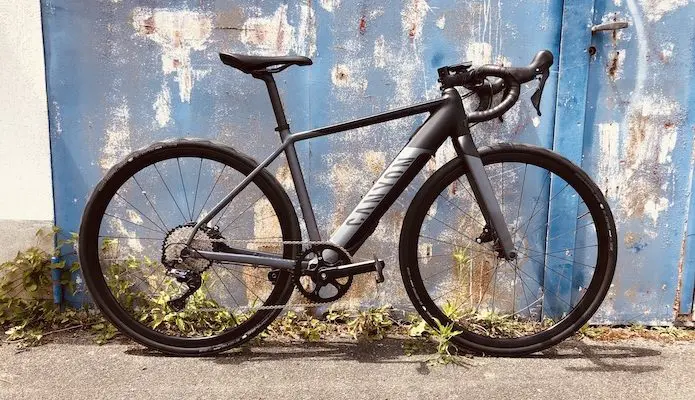
A higher weight is explained first by the frame material, aluminum (whose excellent finish is noticeable) and without other details concerning tube thickness or internal reinforcements. Then by the wheels, also made of “sturdy” aluminum. The Shimano GRX groupset, normally designed for Gravel riding, may also be slightly heavier than Ultegra, but it ensures precise and efficient operation, both in terms of gear changes and braking. As for the components, they are, as usual with Canyon, understated and well-finished.


The motor is located in the bottom bracket shell, weighing 1.31 kg, and especially the long battery and its support (the Drivepack) of 250 Wh integrated under the down tube, which weigh 3.270 kg. As it is necessary to remove it from the bike to recharge it, it is better to avoid overly quick manipulations. The assistance system here weighs almost 4.6 kg, to which must be added the remote control system positioned at the top of the down tube, as well as the rear sensor system to measure speed and thus comply with regulations. If we add the size of the frame tubes and the equipment, the weight is then entirely consistent.

Three assistance modes
The Fazua Evation 1.0 system is chosen by several brands to equip their hybrid bike(s) – or road e-bike, depending on the name, due to its ease of use and especially because it offers no pedaling resistance when the assistance cuts out.
First, the assistance is almost completely silent, and it’s hard to distinguish it from the usual drivetrain noises. Then, we notice a very smooth transition between the moment the motor unit is active and the moment it cuts out, between 25 and 26 km/h on the GPS display. Unlike some systems, it’s even impossible for us to say precisely when it stops providing a boost, at least on moderately hilly routes. It acts to help you accelerate and overcome the bike’s weight during accelerations, after a turn, a traffic light, or a Stop sign. On climbs, it helps limit effort by gaining watts, but without propelling you forward either, and mainly by operating optimally at a pedaling cadence of around 90 revolutions per minute, which still requires a certain physical effort.

But once you’ve accelerated and overcome the bike’s inertia, going from 26, 27, 28 km/h and beyond on the flat is completely seamless. And if a false flat or a headwind section slows you down, the assistance gently kicks back in, discreetly.

With the Fazua Evation 1.0 system, the Canyon Endurace:ON 7.0 benefits from three levels of assistance: the “Breeze” level (green LEDs) provides assistance up to 100 watts added to your own power, the “River” level (blue LEDs) adds up to 210 watts, and the “Rocket” level adds up to 250 watts. The power delivered depends on the pedaling cadence, and also, despite everything, on your physical engagement, the torque you put on the pedals. Let’s say that by simply spinning, the transition from one mode to another is also quite seamless. With the maximum assistance mode, you can climb a steep hill effortlessly up to 15 to 16 km/h, simply by turning your legs, which the minimum gearing of 48/42 allows. But to climb faster and approach the 25 km/h limit, you already have to put in much more effort, which remains quite logical in the end.

You switch from one assistance mode to another by pressing one of the two up and down buttons on the remote control located on the down tube. Only the color of the LEDs and their number indicate the assistance level and the autonomy level (from 1 to 5). With a 250 Wh battery, Canyon indicates an autonomy of about 90 km in assisted mode, but we pushed it up to 140 km by leaving the system constantly on (most often in “Breeze” mode) and often riding above 25 km/h on the flat (under our own power, therefore).
The central button on the remote control allows you to turn off the system. But the manipulation of this button, like that of the other two buttons, lacks a positive feel for our taste, and we would have liked a clearer “click” with each manipulation.

Once the ride is over, 3 hours are needed to fully recharge the battery, using the charger supplied with the bike. It’s a shame that the battery has to be removed from the bike, as it’s quite heavy to handle. It is secured to the bike with a key, which it’s obviously best not to lose.
Flawless operation
In terms of braking and drivetrain, the Endurace:ON 7.0 performs like a good mid-range bike. It’s reliable and precise in gear changes, even with the single 48-tooth chainring. The 11-speed cassette from 11 to 42 teeth certainly has gaps in the gear range, but for this type of bike and its intended use, it’s not very bothersome, especially since the assistance helps smooth out pedaling jerks on climbs and false flats.

With levers originally designed for Gravel use, the Shimano GRX brakes are smooth and effective, and we appreciate their grip and manipulation, even with palms on the hoods.

The saddle can be easily changed if it’s incompatible with your posterior (but be careful with the saddle clamp, which is incompatible with carbon rails). As for the Schwalbe E-One Evolution 32 mm tires, they were specially designed for electric road bikes, taking into account their higher weight, the necessary road holding and durability, and braking constraints. In short, they are reassuring and never fail.


Discreet assistance that erases the weight
On the road, the bike’s weight is almost imperceptible, as soon as the minimum assistance is engaged. Only the steering of the bike seems a little heavy to handle, not in choosing or maintaining trajectories, but when getting out of the saddle and rocking the bike from left to right.

Overall, this “Breeze” mode, indicated by the green LEDs, is enough to provide a minimum dynamism to offset the bike’s weight. Accelerations are made easier, and false flats or short climbs are swallowed up without the sensation of hitting a wall. On descents, the Endurace:ON picks up speed without the slightest transition, silently and smoothly.
On the flat, it’s possible to ride at 30 km/h with the assistance off without the sensations being different from those of a classic road bike.
On the flat, it’s possible to ride at 30 km/h with the assistance off without the sensations being different from those of a classic road bike. Heart rate doesn’t soar, proof that the bike is no more demanding than any other in this configuration. It’s at higher speeds that it lags a bit, becoming a little less fluid and less free-rolling, as in this usual descent where we notice a difference of a few km/h compared to a traditional road bike.

As mentioned above, the assistance is, of course, more noticeable on climbs, and even more so on steep gradients. A quick press of the upper button on the control allows you to increase the assistance level, which is even more effective if you accompany the change in gradient by engaging a smaller gear, in order to maintain a high cadence. Nevertheless, it is still possible to climb while conserving energy and limiting the increase in heart rate, simply by letting the assistance carry you, but without aiming for performance, of course.

This bike thus approaches the most advanced models of the moment, with smooth and silent assistance that is enough to relegate the excess weight to the background. As long as you know how to conserve battery life or don’t embark on a route that is too long or too demanding, the 3 kg given away to other models are secondary. Those looking for an assisted but “hybrid” bike in spirit, because it is ultimately not so different from a classic road bike in its behavior, will get their money’s worth.
Riders who can discover or rediscover the pleasure of cycling without being limited by elevation gain or weather conditions (wind in particular), or who can benefit from gentle rehabilitation to get back in the saddle, as was our case after a serious illness.

Given the audience it can appeal to, and we are particularly thinking of women, it is a shame that the Canyon Endurace:ON 7.0 is only offered in four sizes, with an S size that is difficult for people under 1m65 to access. For the rest, the “endurance” geometry with a slightly raised and comfort-oriented cockpit is perfectly in line with the bike’s spirit, while perhaps waiting for a lighter and more aggressive carbon version of Canyon’s hybrid bike.
| CANYON ENDURACE:ON 7.0 |
| Rating: ***** Pros: Smooth and silent motor unit, seamless transition, finish, groupset Frame: Canyon Endurace:ON aluminum – Fork: FK0074 CF DISC – Handlebar/Stem: Canyon V15/H17 Ergobar AL – Brakes: Shimano RT70 Disc (160/160mm) – Rear Derailleur: Shimano GRX RX812 GS – Levers: Shimano GRX RX600 11s – Cassette: Shimano SLX M7000 11-42 11s – Chain: KMC X11-93 – Crankset: Samox EC38 48T – Wheels: Alexrims RXD5C – Tires: Schwalbe E-One Evolution 700×32 – Saddle: Iridium Fitness – Seatpost: Canyon SP-41 CF – Motorization: Fazua Evation 1.0 250W – Battery: Fazua Evation 1.0 250 Wh – Weight: 15.2 kg in size S without pedals – Sizes: S – M – L – XL – Price: €2,999
|
| Contact: Canyon.com |
=> SEE ALSO: All our Gear tests
Share the post "Canyon Endurace:ON 7.0 Review"