Share the post "Spine injuries"
Whether you’re a Sunday cyclist or a high-level athlete, injuries spare no one. They make us sad and grumpy and each deserves an explanatory sheet using the 5W1H method. The idea behind this series of short articles is to better understand them, adopt the right behaviors to avoid them, and know what to do to recover better.
I propose to cover, each time, in the form of the “5W1H” (What, Who, Where, When, How, Why) and in as many articles as there are recurring injuries in cycling and triathlon, all possibilities of frustration related to forced rest.
After the knee and the collarbone, today we offer a new explanatory sheet – always using the 5W1H approach – this time for back or spinal pain.
By Jean-François Tatard – Photos: Frédéric Poirier, Pixabay.com
WHAT?
The bent position on the bike has long raised fears of a possible responsibility of regular cycling practice for a pathological rounded back in a practitioner. A better understanding of the different anatomical components of the spine has made it possible to dismiss this idea and to note that while some suffer from cervical pain, a larger number of others treat their low back pain through regular cycling.
The back, or spine, is made up of 19 vertebrae (bony framework) separated by shock absorbers (intervertebral discs and posterior joints) that allow for different movements and absorb the various pressures exerted daily on this entire structure, regardless of our positions, and even more so when we carry loads and perform manual strength activities.

Large ligaments arranged along the entire spinal axis on different sides and powerful neighboring muscles (paravertebral-abdominal muscles) will allow, through their tonicity, to maintain an upright position and to perform various daily activities.
Inverted curves to allow for better pressure distribution (cervical and lumbar lordosis, dorsal and sacrococcygeal kyphosis) and a perfect frontal balance on a pelvis balanced by equal length of the lower limbs will guarantee good functioning.
Other vital elements, such as the spinal cord and nerve roots, protected by this bony structure, allow for perfect motor autonomy and optimal perception of different types of sensitivity throughout the body. This is also why it is an area that must be absolutely protected.
WHO?
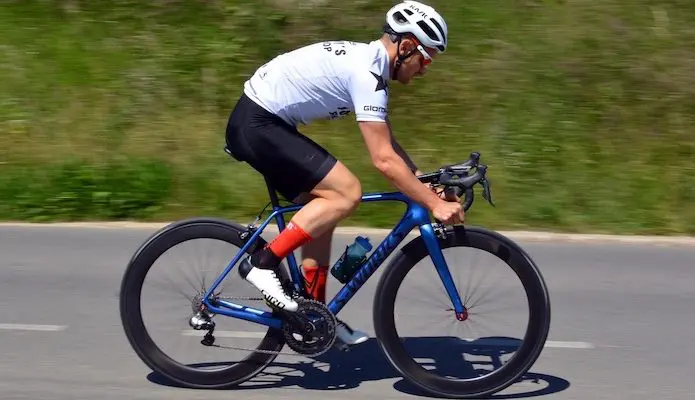
The “bent” or “stretched out” position on the bike has long raised fears of a possible link between cycling and back problems. However, today, experts agree that there is no cause-and-effect relationship, as long as the position is correctly adjusted.
On the bike, the bent position and the need to look at the road ahead can be responsible for cervical pain. And even more so in those who suffer from cervical osteoarthritis. Moreover, these are the same people who will have difficulty staying with their hands in the drops for long periods. As for the famous pathological rounded back, this is due to malformative anomalies or sequelae of growth disorders and is in no way linked to the position on the bike.

WHERE?
The lumbar region participates enormously in athletic effort. Whether cycling, swimming, or running. Between the trunk and limbs, it absorbs a maximum of pressure and undergoes significant deformations during exertion.
It is by nature more rigid than the dorsal area and must be specifically prepared. Its powerful musculature and its synergistic or non-synergistic relationship with the abdominal belt make it an essential element of the static and dynamic of the back.
WHEN?
Impact sports like running should be avoided in case of back pain. It’s better to stick to cycling and swimming. You should also avoid asymmetrical strengthening exercises, such as activities that can potentially cause contact or twisting of the back. Some exercises we do temporarily, like jumping rope, for example, tend to compress the spine.
HOW?
First and foremost, it is very important to warm up properly before starting the main part of your session and to stretch whenever you can. We often lack flexibility, and this only gets worse with age.
Beware of unequal leg length. Sport can reveal it through lower back pain. Hyperlordosis, an exaggerated arch in the lumbar region, should be approached with caution. Also, pay attention to growth diseases and spinal anomalies such as spondylolisthesis. Seek advice from a sports doctor. Perhaps not every year, but an osteo-muscular assessment can be beneficial, especially when resuming activity.

As in other sports, a good position on the bike, an adapted bike, and suitable training conditions, combined with regular stretching of all posterior planes (spine and lower limbs) and strengthening of the abdominal muscles, will guarantee comfortable practice for the back.
WHY?
It is often said that a lack of physical activity is the cause of most back pain because it leads to a weakening of the muscles, especially those that support the back. But that shouldn’t be your case, should it? Except that most of us make many wrong movements and misuse the distribution of forces in body balance. Indeed, the back is often forgotten by our community. Yet muscle strengthening is essential for back health. Good posture also helps to limit the pressures exerted on certain fragments of lumbar discs.
The back is often forgotten by our community. Yet muscle strengthening is essential for back health.
Another very simple and pragmatic thing is that the bike must be adapted to your morphology. The frame height is approximately 2/3 of the inseam, pedaling should be done without hip sway, and the handlebars are generally 5 cm lower than the saddle. However, in case of low back pain, the saddle can be lowered and the handlebars raised by about one centimeter. The advice of the bike fitter is essential at this precise moment.
CONCLUSION
In the next explanatory sheets, I propose to continue reviewing the injuries that most often paralyze us. Next time, we will look at head injuries, various saddle problems, wrist pathologies, arterial endofibrosis, digestive pathologies, plantar fasciitis or aponevrositis, Achilles tendonitis, periostitis, compartment syndrome, and pubalgia.
=> SEE ALSO: All our Infirmary articles
=> SEE ALSO: All our Coaching articles
Share the post "Spine injuries"