Share the post "Broken collarbone"
Whether you’re a weekend cyclist or a high-level athlete, injuries spare no one. They make us sad and grumpy and each deserve an explanatory sheet using the 5W1H method. The idea behind this series of short articles is to better understand them, adopt good behaviors to avoid them, and know what to do for a better recovery.
I thus propose to cover, each time, in the form of the “5W1H” (What, Who, Where, When, How, Why) and in as many articles as there are recurring injuries in cycling and triathlon, all possibilities of frustration related to forced rest.
After patellar tendonitis, I now offer an explanatory sheet – still using the 5W1H approach – on injuries concerning the clavicle.
By Jean-François Tatard – Photos: Anatomography/Majorkev/MELainesse/Commons.Wikimedia, Osi/Wikipedia, Pixabay.com, Frédéric Poirier
WHAT?
Frequent among professional cyclists, clavicle fractures also affect all amateur cyclists. These sometimes require surgical intervention. But to be more precise about what can happen, I suggest you observe this S-shaped bone, also described as tie-shaped.

The shoulder is composed of three bones: the scapula, the clavicle, and the humerus. Easily palpable under the skin, the clavicle resembles an elongated S or a tie, positioned horizontally on each side of the sternum, above the first vertebral rib. It connects the thorax to the shoulder. It also serves as an anchor point for the muscles of the shoulder, thorax, and cervical region, particularly the trapezius.
The clavicle is one of the first bones to develop in the embryo. With the acromion, which is the apophysis of the scapula, it forms the acromioclavicular joint, often injured during bike falls. With the scapula, it forms what is called the shoulder girdle. As for the scapula, it is a flat, symmetrical, and triangular bone, located on the dorsal surface of the thorax, extending from the second to the seventh vertebral rib. Finally, the humerus forms the skeleton of the arm; it is a long bone whose head fits into the scapula to form the shoulder joint.
WHO?
A legend circulates in the cycling world: the clavicle is to the cyclist what the bumper is to the car. What cycling champion has never fractured their clavicle at least once? Tony Martin, Richie Porte, Lance Armstrong: they have all broken their clavicle. A clavicle fracture is one of the most painful experiences, but it is almost an essential anecdote to achieve the status of a true cyclist.

WHERE?
It is often the consequence of a fall in the peloton, but not only… Assume that in the majority of cases, a lack of vigilance is associated with this fall. You don’t need to ride fast to break your clavicle. Do you remember the saying “danger is when there is no danger“?

Furthermore, it is assumed that a quick hospital visit is necessary when displacement, spacing, or overlapping of bone fragments greater than one or two centimeters is observed, according to the studies I have read on the subject. In such a case, there is indeed a risk that the callus will form late. This is not without consequences. Beware of a more or less voluminous deformity that can eventually become painful.

Surgical intervention here aims to reduce this risk by repositioning the bone fragments adequately. But I notice that this rule apparently does not apply to professional cyclists. And why not? The slightest difference in shoulder length can bother them and diminish their performance. Pros need to be perfectly symmetrical on their bikes to be comfortable. This is also why, for the same severity, a clavicle fracture is more often operated on in pros than in the amateur peloton in general.
WHEN?
When riders fall, they tend to try to curl up or brace themselves with their hands to protect their heads. And so it is often the shoulder that hits the asphalt first.
The pain does not always appear immediately, but when it does, ask someone who has already broken their clavicle: the pain is described as very intense by the cyclist. An inability to lift the arm is also observed. Other symptoms (swelling, hematoma, contusions) may also appear…

HOW?
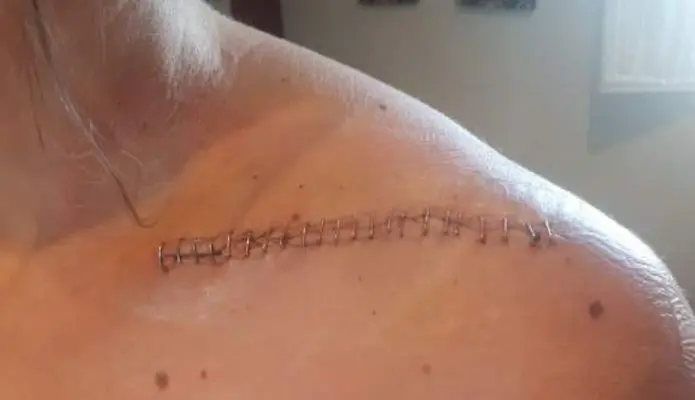
The question then arises as to whether the fracture requires surgical intervention or not. If, according to the X-ray, the bone fragments are close to each other and aligned, surgery is not indicated because the fracture will be able to heal naturally within six weeks to three months thanks to the formation of a bone callus. Initial consolidation appears after just 3 weeks. To relieve the injured limb, either an orthopedic vest or contention rings are prescribed, depending on the type of fracture. Contention rings are a figure-eight bandage that crosses in the back and passes over the front of the torso to keep the shoulders back, much like a backpack would. They have the advantage of leaving both arms free, unlike the orthopedic vest which keeps the elbow flexed at 90°.
WHY?
Under the impact of the shock, the clavicle curves, then breaks at the flexion points, like a carpenter’s ruler being folded. A break can occur in one or more places along the bone.
Anecdotes about cyclists who got back on their bikes a week after surgery are not lacking… I even have a concrete example from last week. It’s true that one can quite quickly start moving again without pain, and it’s not uncommon to see cyclists resume training after just three weeks, or even earlier. The problem is that the clavicle is not yet solid. If they fall again, there is a risk of a new fracture.

CONCLUSION
In the next explanatory sheets, I propose to continue reviewing the injuries that most often paralyze us. We will thus see next time, head traumas, spinal pain, sciatica, low back pain, various saddle problems, wrist pathologies, arterial endofibrosis, digestive pathologies, plantar fasciitis or also called aponeurosis, Achilles tendonitis, periostitis, compartment syndrome, and pubalgia.
=> SEE ALSO: All our Coaching articles
=> SEE ALSO: All our Infirmary articles
Share the post "Broken collarbone"