Share the post "Patellar tendonitis"
Whether you’re a Sunday cyclist or a high-level athlete, injuries spare no one. They make us sad and grumpy and each deserve an explanatory QQOQCP sheet. The idea behind this series of short articles is to better understand them, adopt good behaviors to avoid them, and the right approach to better recover.
I thus propose to cover each time, in the form of the “QQOQCP” (What, Who, Where, When, How, How Much, Why) and in as many articles as there are recurring injuries in cycling and triathlon, all possibilities of frustration related to forced rest.
Today, we will focus for a few minutes on knee problems, particularly patellar tendon issues, using the QQOQCP approach.
By Jean-François Tatard – Photos: Flickr.com, Pxhere.com, Wikipedia / Dimdle, Piqsel.com
WHAT?
Patellar tendonitis refers to knee pain. Do you remember “the Bernard Hinault episode” in the 80s? Forced to withdraw from the Tour de France due to a knee problem… Patellar syndrome is one of the most frequent injuries among cyclists.
WHO?
Ultimately, it’s not just cycling that can cause knee problems. All sports are concerned. When you diversify your sports and venture into weight training or running, you expose yourself to it, for example. Any sport other than cycling can also cause patellar tendonitis or quadriceps tendonitis. We see it clearly with Rafael Nadal, who often wears a kind of strap below the knee to maintain pressure on the tendon.
WHERE?
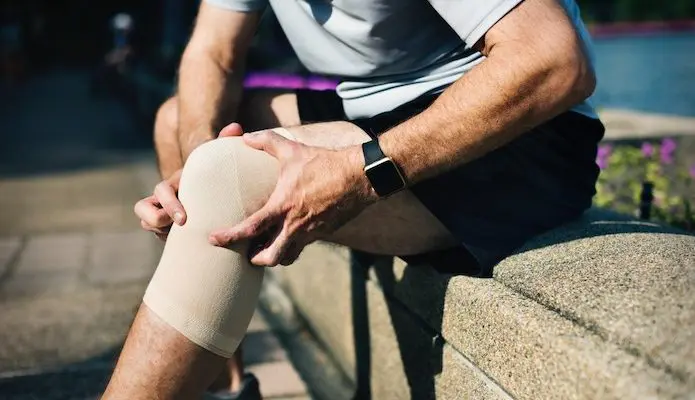
The problem occurs below the kneecap. The sufferer feels pain, especially after exertion. If it worsens, it even occurs during exertion, and then it becomes truly debilitating for practice, and you end up having no choice but to temporarily hang up your bike.
WHEN?
This injury occurs off the bike but also during practice. It is exacerbated the longer your ride lasts. Often it is associated with a gearing problem. Indeed, too large a gear ratio used over time will prematurely wear out tissues and inflame tendons exposed to over-solicitation. A saddle height that is too high or too strong a resumption of activity after an interruption can also cause the syndrome.
HOW?
To treat the syndrome, the combo icing / stretching seems to work well. Indeed, this anti-inflammatory as old as the world will be very effective. Combined with quadriceps stretches, you will succeed in relaxing the muscle, which will stop pulling on the tendon. In parallel: a little rest won’t hurt either. In other words, calm the inflammation, then quietly get back on the road.

If you decide to go the physio route, that’s a good idea: you can get a MTP (deep transverse massage) or shockwave therapy. This involves tapping the knee to promote healing. And another way to relieve the tendon is physiotherapy or tecar therapy. The goal is to “re-promote” collagen fibers within this tendon so that it regains elasticity, and thus, calm the inflammation.
WHY?
This injury is often associated with a position adjustment problem. A saddle too low. A saddle too high. A saddle too far forward. An inappropriate cleat position. In short, it is in the majority of cases a posturology problem. And it will therefore also be necessary to have your position checked by your bike fitter or correct your body’s strength and flexibility imbalance through strengthening exercises that themselves take into account our muscular weaknesses and flexibility.
TO BE CONTINUED
In the next explanatory sheets, I propose to continue reviewing the injuries that most often paralyze us. We will thus see: the traditional clavicle fracture, but also head trauma, spinal pain, sciatica, low back pain, various saddle problems, wrist pathologies, arterial endofibrosis, digestive pathologies, plantar fasciitis or otherwise called aponeurosis, Achilles tendonitis, periostitis, compartment syndrome, and pubalgia.
=> SEE ALSO: All our Coaching articles
See all our articlesHealthShare the post "Patellar tendonitis"