Share the post "Focus on PRP"
Among the methods available to treat certain stubborn injuries, PRP (Platelet-Rich Plasma) is not the least criticized, because for some it is not far from crossing the ethical limits, at least in appearance. In detail, even if this type of care is not accessible to everyone, it remains within the lines. We explain why and how it works.
By Jean-François Tatard – Photos: flikr.com, commons.wikimedia.org
Who has never been stopped by an injury? Don’t tell me you’ve never experienced that unbearable feeling of no longer being able to do what you love? Injury is often quite devastating for all athletes. The physical pain linked to this dysfunction often exceeds intolerance, but even more painful is this feeling of deprivation and worse: this feeling of life imprisonment when you can’t find the solution…
A question of ethicsGrandma would turn over in her grave if she read this article. Indeed, with PRP (Platelet-Rich Plasma) we are drastically moving away from the grandmother’s method. We are even the opposite of applying green clay. It is a revolutionary laboratory method that saved me from a stubborn plantar fasciitis some time ago. I warn you: superficially, one might wonder if we are not crossing the boundaries of ethics. In detail, it is already closer to the good morals of your favorite website.
Once you have tried everything to heal your tendinitis, and only if nothing responds to all the most common treatments (rest, icing, anti-inflammatory, physiotherapy and all the methods found in the practitioner’s office, podiatric support, etc.), you can, for several years now, turn to PRP treatment. Indeed, to treat tendinitis after the failure of other treatments, I don’t know of anything more effective.
Most muscle and/or skeletal lesions occur in poorly vascularized and therefore weakened areas, such as the Achilles tendon. Thus, the body’s natural healing process is slow due to this lack of vascularization and therefore immediately available growth factors in sufficient quantity.
What is PRP?
Let’s start with an English lesson: PRP stands for Platelet-Rich Plasma. And it is obtained from a centrifugation system of your own blood. Centrifugation, for those who don’t know, allows the different components of blood to be separated to retain only plasma and platelets.
Thus, the fact that it is autologous, or in other words that the blood used is that of the athlete himself, limits any risk of contamination. PRP is then injected intratendinously to accelerate the tendon’s healing reaction.
Platelets contain different growth factors. If we go into the technical part a bit, these are PDGF, transforming beta growth factors (TGF-ß) and vascular endothelial (VEGF). But let’s simplify! Just remember at this precise moment that it is prudent to analyze the results of this method.
In terms of doping, or ethics, I can already imagine your concern… Rest assured, WADA has authorized it since January 2013, unless growth factors are injected separately.
How it works
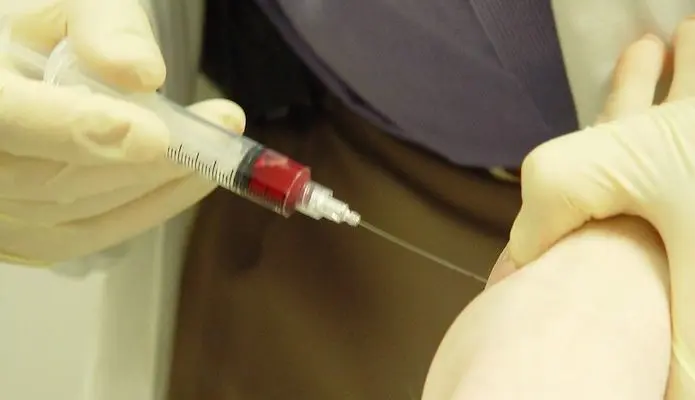
- The preparation of PRP requires a blood sample, according to strict and secure techniques, just like a normal blood test.
- The second step is based on centrifugation of the collected blood sample.
- Once you have the three parts of blood well separated, the doctor extracts only the upper part where the plasma is located.
After discussion with Doctor Laurent Aumont, the PSG players’ doctor, who is incidentally one of the pioneers of this technique in France, the method of obtaining it is as follows:
- Volume of blood collected: 15 ml with a single syringe
- Centrifugation time: 5 minutes
- Centrifugation speed: 1500 rpm
- Volume of PRP obtained: 5 mL
Be careful not to confuse this with the treatment of tendinitis by homologous blood injection. Studies show mixed results, and Actovegin is a molecule prohibited by the WADA anti-doping code if administered intravenously. Consult the list of prohibited products and substances.
The pain
Depending on the tendinitis and its location, a single injection may be enough. And for other more delicate areas, up to 3 injections can be given, each spaced two weeks apart.
Assume that you have to suffer to be beautiful. So you can feel pain at the time of injection: yes! And sharp: yes! On a scale of 0 to 10? Personally: 10 (laughs). Because, in principle, no local anesthesia is given before the injection. Afterwards, the level of pain also depends on several factors, including individual sensitivity and subjective reactivity. But from my point of view, the result is such that it would not be a problem to do it again if necessary.
So you can feel pain at the time of injection, even quite sharp!
This is followed by a 48-hour rest to start. Taking Paracetamol is often a good remedy to combine. And before resuming sports and for the magic substance to take effect, wait at least 15 days without activities on and/or with the affected area.
What are the risks? Apart from uncontrolled fear and anxiety or vasovagal syncope, I don’t see any. Furthermore, since it is your own blood, there is no risk. And cases of contamination must be extremely rare. Rejection is also by definition impossible. In short: the risks, the real ones, are exceptional.
In general, your doctor will conduct a preliminary interview to identify rare contraindications. A priori, a limiting factor would be fever, but also the use of NSAIDs or blood-thinning treatments, such as anticoagulants.
How much does it cost
The price? It’s very random… Between €100 and €400 for the most expensive, and sometimes even up to €1000 with certain big names in sports medicine (but that’s another subject). And are these injections covered by social security? The consultation perhaps… But the coverage of the injection and therefore the overall technical procedure: that’s outside the nomenclature and therefore unfortunately not reimbursed.
For what success?
I searched but found nothing. Moreover, if a reader of 3bikes.fr finds a prevalence study, let him share it with us with precise figures on the chances of success in treating the lesion by this method. Nevertheless, all the athletes or sportsmen I know who have, one day, benefited from this technique have all recovered from their problem.
The miracle solution?
Platelet-Rich Plasma is a promising product. With many advantages: its autologous origin, its simplicity of obtaining, and its mechanism of action. Its use in tendon and ligament lesions has shown faster recovery without significant adverse effects. However, the lack of well-conducted clinical studies and the absence of standardization of preparation methods to define the exact composition of the product prevent the establishment of global recommendations for the use of PRP. In my opinion, our authorities should better regulate its use, particularly for the treatment of tendinopathies in private practice.
In this context, today PRP must remain, in my opinion, a second-line healing technique for pathologies refractory to conventional treatments. On the other hand, I am still surprised that platelet count is not measured before re-injection. In short, if what I see seems quite fabulous in terms of results, it remains only a feeling and let’s perhaps wait for more feedback, because ultimately, it is still quite new in the history of medicine!
=> SEE ALSO: All our Coaching articles
Share the post "Focus on PRP"