Share the post "Green clay, or grandma’s remedy for recovery"
Among the so-called “grandmother’s remedies,” or at least those that work using natural ingredients, green clay is not the least recognized for relieving injuries, muscle soreness, and tendinitis. We explain how it works.
By Jean-François Tatard – Photos: Jean-François Tatard, Flickr.com, Pixabay.com
3bikes.fr has not yet opened its health section. But we promise, as soon as it’s online, Grandma will be in charge of the column. But why Grandma? Because Grandma (almost) never goes to the pharmacy. And yet, Grandma is the one who has the answer to all problems. Grandma is the one who knows all the remedies.

The advantage of being born in an era when things were repaired when broken, of making do with what you have, by buying as little as possible, is that you sometimes naturally develop remedies made from what you find at hand. A plant, a root, bark, a piece of wood, a stem, leaves, flowers, a fruit, seeds, sap, an essential oil… Open your eyes! Everything can have another use than the one imagined. And among the “good recipes” from Grandma, there is one that can save you from nasty tendinitis or simply help you recover better from a race or training session that left you deeply sore: green clay.
The clay poulticeA Gandhian classic, the clay poultice is capable of curing a large number of problems, and particularly tendinitis. And to be honest, it may be one of the only treatments that allows such a result. First, the clay absorbs toxins, which eliminates pain, and second, the clay facilitates healing.
Anyone can try it. It’s really not complicated. And it’s very cheap. How can you practically make a clay poultice:
- First, take €3 out of your wallet. Or €5, maximum!
- Then, with your money in your pocket, run to the nearest pharmacy, parapharmacy, organic store, or even the supermarket next door in the beauty section.
- Exchange it for a packet of green clay powder to prepare yourself.
- Once back home, pour about three centimeters of clay powder into a bowl or an empty jam jar and cover with water.
- Let the clay just slightly protrude to avoid having a too liquid paste.
You will then have to wait about 5 minutes. But this also depends on the level of crushing of your clay. Let’s say the finer it is, the faster it is.

Application
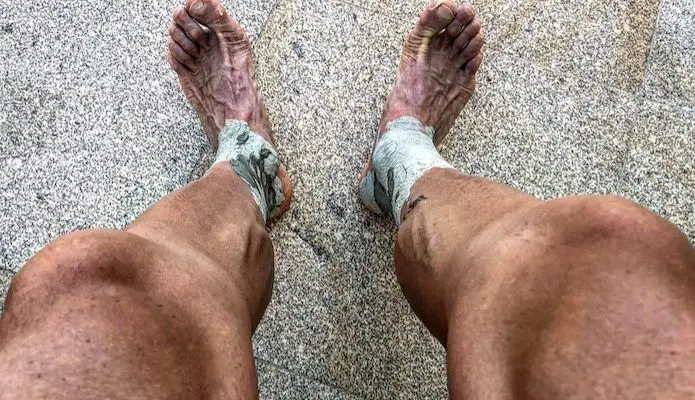
Once the paste is uniformly formed, you can apply the clay to the painful area or, more precisely, where the tendinitis is located, and a little beyond, to cover a larger area. So, in the evening after dinner, you can spread the nicely prepared paste about 2 cm thick. Then, comfortably seated in your armchair reading the latest 3bikes articles on your iPad, leave the poultice in place for at least 2 hours.
Advantages
|
If the tendinitis is well established, the treatment can last 15 days; if it’s just a minor tendinitis, then 2 or 3 applications may be enough. And for a training session or race that left you very sore: a single application offers noticeable benefits. But green clay has many other virtues, and as for the result, it is surprisingly effective. It’s worth a try…
Even better
Once you master Grandma’s recipe, you’ll even be able to “improve” it! Indeed, this rudimentary technique can gain another 10 points in effectiveness by adding ingredients easily found in your cupboards. So, to your clay, add sea salt or even essential oils.

To conclude the article: don’t tell Grandma! Promise? Without playing the proud reactionary who would want to do even better than Grandma, I’m sharing Grandpa’s recipe with you. But only on the condition that you don’t tell Grandma that Grandpa found a way to make the grandmother’s recipe even more effective. So, still in the same bowl of clay as Grandma: also homogenize two tablespoons of arnica oil, the same amount of white vinegar, and add coarse Guérande salt.

In conclusion
This remedy is often used for contusions, tendinitis, or to reduce hematomas. But even more often: after a long ride, it will help you recover and relax pleasantly. You’ll feel lighter on your next ride, and just thinking about it when you’re struggling to pedal will help you look forward to the rest of your training program with serenity.
=> SEE ALSO: All our Coaching articles
Share the post "Green clay, or grandma’s remedy for recovery"