Share the post "Improving your climbing… with the indoor trainer!"
Many riders discovered the intense and regular use of an indoor trainer during lockdown. While the time has finally come to return to the road, this activity can still be maintained with the a priori paradoxical goal of improving in the mountains. We explain why and how.
By Guillaume Judas – Photos: Flikr.com, pixnio.com / 3bikes.fr
| WHERE TO FIND AN AVAILABLE INDOOR TRAINER? Manufacturers and importers are struggling to meet the enormous demand for indoor trainers, especially during this lockdown period. Nevertheless, we have been able to find a few devices still available for you:
|
The indoor trainer is not the most pleasant tool for training, especially after two months of lockdown where you had no other choice but to use it to maintain good physical condition before resuming outdoor riding. You can now regain your freedom by riding outside, which is the very essence of true cycling, while still respecting a 100 km radius around your home. It would be a shame not to take advantage of it.
Perhaps you can no longer stand this torture device, or on the contrary, you have taken the opportunity to discover its multiple possibilities. The various applications that allow you to ride connected on virtual courses have the advantage of passing the time and offering variable resistances that can simulate climbs. You realize that when you resumed riding on the road, you maintained some of your physical abilities, especially the ability to pedal under load for long minutes thanks to the indoor trainer. We suggest you go further by using this tool to prepare for your future mountain escapades.
Still limited travel
For now, your travel, other than for professional reasons, is limited to 100 km around your home to prevent the spread of the virus. This is obviously insufficient for all those who live on the plains and are used to taking short trips to the mid or high mountains to prepare for the big summer events. There are different ways to improve in the mountains while living on the plains, even if the difficulties related to high-altitude effort cannot be reproduced. Starting with specific hill work, chaining difficult climbs with a small chainring, trying to find the rhythm of a long ascent. Or by riding on the flat at the target intensity you naturally adopt in a pass, provided you know yourself perfectly. In this case, however, you lack the specific position adopted in the mountains.
A specific position
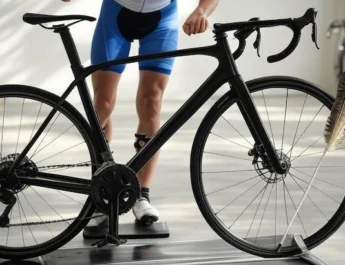
For the effort to be long and significant enough to properly prepare you for climbing a pass, the indoor trainer can, however, be an interesting solution to complement your usual training. Forget the famous three-roller indoor trainers, excellent for warm-ups or speed work, but out of scope here even if they have resistance. The idea of specific mountain training on an indoor trainer is to first work on your position. How? Simply by raising the front wheel to reproduce the bike’s inclination – and thus the posture you are forced to adopt when facing a climb.
To do this, simply measure the bike’s wheelbase (between the two wheel axles), and place as many shims as necessary under the front wheel: with 8 cm (this could be two or three books stacked on top of each other), you get the equivalent of an 8% gradient with a bike whose wheelbase is one meter. When you get on the bike, you will notice that your pelvis is pulled backward by gravity, and as a result, your handlebars will seem further away. You will thus more naturally adopt a hands-on-top position and a grip where you pull on the handlebars rather than push them. This backward pelvis will also force you to move slightly forward on the saddle, and you will have to attack the pedal stroke a little further forward, with the top and bottom dead centers of the pedaling cycle being shifted backward by the same amount. What is the consequence? You will be forced to amplify the ankle movement to pull the pedal (the bottom dead center being under your pelvis), and thus to work on the climber’s pedal stroke.
Working on power delivery
The indoor trainer also has something in common with long mountain climbs: it forces you – if you add resistance – to maintain power delivery throughout the pedal stroke. On the road and on flat terrain, you benefit from the inertia of the pedal stroke, thanks to pedaling cadence. Thus, even those who only push on the pedals see their legs come back up in the other direction, simply with momentum. In the mountains, such a lack of technique comes at a high cost in terms of efficiency, especially with a lower pedaling cadence.
When you add resistance on an indoor trainer, it’s the same thing because there’s no kinetic energy from forward speed. And on an indoor trainer, the slightest moment of coasting stops you instantly. You therefore understand the similarities between these two types of training, and the benefit there can be in preparing to climb passes on an indoor trainer.
Targeted intensities
To work specifically, you must therefore commit to series of exercises at an intensity close to that which will be adopted in the mountains. Once in position, you can aim for a working heart rate or similar power, in 10-minute sequences for example. But anything is possible: to work on your pedal stroke, you can alternate strength work with cadence work, but always with sufficient resistance to simulate the gradient. The ideal is to use the small chainring, however, as in the mountains.
You can also do longer sets, but in this case, be careful of the risks of dehydration and the induced cardiac drift. Those with better equipment can also use their smart indoor trainer to simulate a real course, with gradient variations directly chosen by the software. This is quite fun, even if you remain inclined on the bike as previously decided, it forces you to change gears regularly, just like in reality. In any case, this type of session is very interesting for those who live far from the mountains and wish to prepare themselves properly… without the altitude!
Finally, those with the best equipment will fully enjoy the difficulty of virtual courses with an indoor trainer that simulates the bike’s inclination according to the gradient, such as the Wahoo Kickr with its Climb option. This is currently the most realistic indoor solution, with a high price, but not necessarily the most essential for improving in the mountains while staying at home.
=> SEE ALSO: All our Coaching articles
Share the post "Improving your climbing… with the indoor trainer!"