Share the post "Exclusive first ride of the new Specialized Diverge S-Works"
Available in several versions, the new Specialized Diverge doesn’t revolutionize aesthetic standards, but it does benefit from the optimization of several innovative concepts brought together here for the best in Gravel. On the menu: versatility, lightness, dynamism, off-road capabilities, comfort and control, for a bike that remains understated and discreet in its high-end S-Works version.
By Guillaume Judas – Photos: Specialized/Etienne Schoeman – 3bikes.fr

Gravel is no longer just an atypical and niche cycling discipline, but is becoming increasingly popular with adventure seekers or simply those looking to escape the roads where automobile pressure is ever-increasing. And from the first bikes cobbled together or adapted from cyclocross or “endurance” machines, we are now discovering specific models that shine with their versatility and the variety of terrains they can tackle. With light and rigid frames that don’t look out of place in a road peloton, they can transform into off-road bikes, at least wherever a full-suspension mountain bike isn’t justified.

This is what we were able to verify around Girona just before the lockdown was implemented in Spain and France, during the press presentation of the new Diverge on two beautiful hilly rides. On rocky/dusty and sometimes harsh terrain mixed with some road sections, the bike in its S-Works version showed us the full extent of its capabilities.

A particularly understated bike in its S-Works livery, made from Fact 11R carbon fibers (Specialized’s highest-end) and with a matte varnish applied to the raw frame to save a few grams. The announced weight is less than a kilo for the frame, and just over 8 kilos for the complete bike with wide tires. From a distance, the bike looks like a Tarmac, but it’s when you get closer that you discover its specific features designed for committed Gravel riding.
It’s when you get up close that you discover the bike’s specific features designed for committed Gravel riding.
A deep evolution
Four main characteristics have been brought here by the Morgan Hill brand for this new Diverge. First, it’s the adoption of a new geometry with a longer top tube than a road bike, compensated by a shorter stem and by fork trail and angles adapted accordingly. The objective is to find the best possible compromise between handling on difficult terrain and stability on descents, whether they are bumpy off-road or fast on the road. It’s about rethinking the user’s weight distribution relative to the frame and the two wheels, similar to a mountain bike, but without making the bike too slow to react in terms of steering. The pursuit of stability is accompanied by a bottom bracket shell height raised by only 6 mm compared to the previous Diverge, in order to gain a little more off-road capability without raising the center of gravity too much. Note that to compensate, Specialized chooses to mount only 165 mm cranks on the smaller sizes (compared to 170 mm normally).

This new geometry is accompanied by a longer wheelbase, but above all by the possibility of mounting tires up to 47 mm wide (or 2:1 with 650b wheels), another major new feature here. This setup is closer to that of a mountain bike, with the possibility of significantly under-inflating, gaining comfort, traction, and especially off-road capabilities. The operation is not as simple as it seems, compared to a classic bike infrastructure with 700c wheels, and especially because the brand wanted to keep the chainstays relatively short for this type of bike, at 425 mm. Longer chainstays certainly improve stability even more, but significantly reduce the bike’s responsiveness. To achieve this, Specialized has very significantly thinned the part of the right chainstay located near the bottom bracket shell, with a piece that resembles a small blade and connects the bottom bracket shell to the rest of the chainstay.


The new Diverge, on the four highest-end models in the range, also benefits from the Future Shock 2.0 suspension system, introduced last year on the Roubaix, and which differs from the Future Shock system of the previous Diverge by being adjustable while riding. It’s a suspension installed in the steerer tube, which allows control over compression thanks to a dial located above the stem. Compression is adjustable from soft to firm (very useful when returning to asphalt or on very smooth trails), while the internal hydraulic system controls rebound. It’s effective on the trail, and almost invisible both aesthetically and in terms of dynamic behavior. A real success, which improves confidence and control, while producing no negative effects (bobbing) during intense efforts out of the saddle.

Finally, true to the philosophy already developed by Specialized with its SWAT transport tricks (for repair essentials, refreshments or even a windbreaker, and already seen on triathlon bikes or the previous Diverge, the bike benefits from an integrated transport system hidden in the down tube, and accessible by opening a small hatch under the bottle cage mount. Clever, clean, and aesthetic, this concept adds an extra option to a bike designed for adventure, as shown by its six bottle cage mounting points, or the bosses for mounting mudguards.

In terms of finish, we note the presence of rubber protections under the down tube and on the right chainstay, to limit the noise of small gravel or chain slap on bumpy terrain.
High-end equipment
This high-end version ensures versatility (but that’s the nature of modern Gravel bikes) by accepting slightly ribbed tires and/or those with a 38 mm tread (standard), or more off-road tires up to 47 mm wide on 700c wheels. While we weren’t able to verify the exact weight of the bike, it barely exceeds 8 kg with a 12-speed Sram Red/Eagle AXS eTap hydraulic groupset, disc brakes, wide tires, and a dropper seatpost, which can be lowered (to improve handling on descents) or raised to its original height with a small lever on the handlebar.

As is the case on many recent Gravel bikes, Specialized has opted here for 12 speeds and a single chainring, with a gigantic 10-50 tooth cassette (and a single 42-tooth chainring). It’s beautiful, it’s light, and it contributes to the bike’s clean aesthetic, but it remains debatable on the trail, at least for sporty use. The groupset and shifting operation are perfect, and always silent, even in difficult conditions. Electronic derailleurs, here wireless, have already demonstrated their qualities and reliability. Nevertheless, it must be noted that with dust and a little sand, the chain works quite poorly on the small 10-tooth cog, lacking grip and skipping quite often. And while the large 50-tooth cog allows you to climb any slope without getting exhausted, to clear technical uphill sections with hardly any destabilization (we were able to climb a large rocky hill for several hundred meters at 6 km/h without losing balance thanks to the very small gear), the gear gaps in the middle of the cassette are quite tiring on normal slopes.

The rest of the equipment consists mainly of Roval Terra CLX wheels with a rim depth of 32 mm and an internal width of 25 mm, perfect for using wide tires, an Easton EC 70 AX Carbon handlebar with a 16° flare in its lower part, and a Body Geometry S-Works Power saddle with a 143 mm wide crescent. A high-end and proven setup that ensures efficiency and comfort on a variety of courses.


Built for adventure or alternative routes
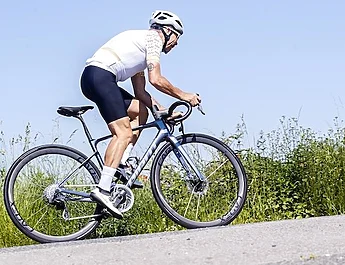
On the road, equipped with the original tire setup (Pathfinder Pro 2Bliss Ready in 38 mm) and provided the inflation is sufficient, the Diverge S-Works behaves like a good road bike in terms of dynamism and rolling efficiency. In the absence of wind, reaching 35 km/h and riding at a steady pace is not too complicated, the tires offering little rolling resistance. Accelerations are sharp and the lightness felt in the steering is appreciated when riding out of the saddle.
Accelerations are sharp and the lightness felt in the steering is appreciated when riding out of the saddle.
As the Diverge is laterally stiff, the geometry modification is completely transparent under these conditions. It is obviously on long rolling sections where you have to push a big gear that it shows some limitations, but mainly because the tires are not designed to cut through the air. Nothing really surprising, but it should also be noted that the gear range is not designed for this, with noticeable gaps in the range even on the small cogs.

When entering trails, the unlocking of the suspension is immediately noticeable, both in terms of shock absorption and trajectory control. This suspension function clearly limits rebounds and the loss of contact of the front wheel with the ground, without causing any vagueness in the steering. In terms of handling, the Diverge proves stable and reassuring, and comfortable enough to spend hours in the saddle alternating between road and trail. The variety of positions offered by the cockpit allows you to find road bike benchmarks, while appreciating the stability and control you get with your hands in the drops with the flared handlebar. From a sporting perspective, the dynamic qualities combined with overall comfort allow you to ride fast, smoothing out holes, ruts, and rocks.

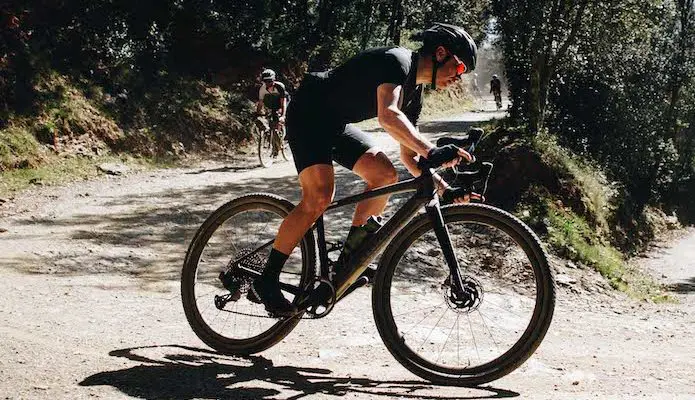
But it’s by mounting wider tires that the Diverge reveals the full extent of its possibilities. After a first ride in normal configuration, we were able to ride the next day with 47 mm wide tires, on even rougher terrain, normally reserved for mountain biking. A first long, very rough climb with rolling stones, rocks, roots and sand made us test the large 50-tooth cog for the first time. Seated or out of the saddle, the bike demonstrates traction. The steering is precise when you have to choose the right trajectory in a flash in the middle of this broken and steep terrain, and thanks to the position, the relatively low center of gravity and the bike’s front wheelbase, we never feel the front wheel rearing up. Despite the terrain, the bike’s lightness is a great asset, because at very low speeds, often below 10 km/h, the gain in inertia is really noticeable during accelerations or changes of pace, especially when it’s necessary to add an impulse to overcome an obstacle with momentum.

The long descents that followed gave the Diverge the opportunity to demonstrate even better stability and tracking, with the wide tires and their low inflation pressure absorbing most of the terrain’s irregularities. On very technical sections, the dropper seatpost can be lowered by several centimeters, which amplifies the rider’s range of motion around the saddle, provided they remain standing on the pedals. At the end of the descent, a simple action on the small lever located on the lower part of the handlebar is enough to return to the original saddle height.

Back on the road, the Diverge is of course less energetic with this tire setup, but the position, very close to that allowed by a road bike, provides more efficiency than any mountain bike. The light weight, lateral stiffness, and the wind-tunnel-designed lower part of the frame also contribute to overall performance. These characteristics should finally convince those still hesitant about Gravel riding. The Diverge, here in its lightweight and airy high-end S-Works version, is also a monster of versatility thanks to all the specific features we have just mentioned. It can now replace a rigid or even semi-rigid mountain bike for the majority of riders who are not true specialists in this discipline, while still performing well on the road. A true all-terrain bike, in short.

| SPECIALIZED DIVERGE S-WORKS CARBON ETAP |
| Rating: ***** Pros: Versatility, weight, stiffness, comfort, ability to fit tires up to 47 mm wide, eTap shifting Cons: Price, single chainring Frame: S-Works Diverge FACT 11r carbon – Fork: Future Shock 2.0 Smooth Boot, FACT carbon – Wheels: Roval Terra CLX – Tires: Pathfinder Pro 38 mm – Stem: S-Works Future Stem with integrated bike computer mount – Handlebar: Easton EC70 AX Carbon – Crankset: Sram Red AXS 42 teeth – Levers: Sram Red AXS eTap – Rear derailleur: Sram XX1 Eagle AXS – Cassette: Sram XG-1295 12-speed 10-50 – Brakes: Sram Rival – Chain: Sram XX1 Eagle 12-speed – Seatpost: X-Fusion Manic Dropper, 50 mm travel – Saddle: Body Geometry S-Works Power carbon – Number of sizes: 6 – Price: €9999
|

| Contact: specialized.com |
The rest of the range
No less than 12 versions of the new Diverge are offered, with aluminum or carbon frames, electronic or mechanical groupsets, and with a Future Shock 2.0 or 1.5 suspension system (without lockout).
- The Diverge is also available as a frameset for €3999

- Next, we have the Diverge Pro Carbon eTap at €6999 – Frame: Fact 9r carbon – Groupset: Sram Force eTap/Eagle X01 AXS. Wheels: Roval Terra CL.

- Then the Diverge Expert at €4999 – Frame: Fact 9r carbon – Groupset: Shimano GRX Di2 – Wheels: DT Swiss G540.

- Diverge Comp at €3799 – Frame: Fact 9r carbon – Groupset: Shimano GRX double – Wheels: DT Swiss G540.

- Diverge Sport at €2999 – Frame: Fact 8r carbon – Fork: Future Shock 1.5 – Groupset: Shimano GRX double – Wheels: DT Swiss G540.

- Diverge E5 Expert Evo at €2599 (flat handlebar) – Frame: Diverge E5 Premium Aluminum – Groupset: Shimano XT 12 sp. – Wheels: DT Swiss G540.

- Diverge Carbon at €2499 – Frame: Fact 8r carbon – Fork: Future Shock 1.5 – Groupset: Sram Apex – Wheels: Axis Elite.

- Diverge E5 Comp at €2099 – Frame: Diverge E5 Premium Aluminum – Fork: Future Shock 1.5 – Groupset: Shimano GRX/SLX – Wheels: Axis Elite.

- Diverge E5 Elite at €1799 – Frame: Diverge E5 Premium Aluminum – Groupset: Shimano GRX 10 sp. double – Wheels: Axis Elite.

- Diverge E5 Comp Evo at €1799 (flat handlebar) – Frame: Diverge E5 Premium Aluminum – Groupset: Sram NX – Wheels: Axis Elite.

- Diverge at €1099 – Frame: Diverge E5 Premium Aluminum – Groupset: Shimano Claris – Wheels: Axis Elite.


=> SEE ALSO: All our Gear Reviews
See all our articlesBikes
Share the post "Exclusive first ride of the new Specialized Diverge S-Works"