Share the post "Canyon Grail CF SLX 8.0 Di2 Review"
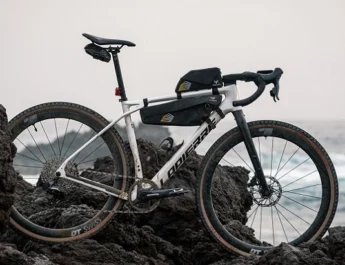
After a few years where the discipline was still finding its feet – at least in France – Gravel riding seems to be really taking off lately, and sales of specific bikes are too. With dedicated frames, wheels, tires, and even drivetrains, the best bikes combine the stiffness and responsiveness of a lightweight road bike with the stability and off-road capability of some mountain bikes. The Canyon Grail CF SLX 8.0 Di2 fully embodies the essence of this concept.
By Guillaume Judas – Photos: 3bikes.fr
The Canyon Grail CF SLX 8.0 Di2 is the top-of-the-line model in the German brand’s Gravel bike family. This range starts at €1399 with an aluminum frame and a Shimano GRX RX400 10-speed drivetrain, and is topped by the CF SLX 8.0 at €4599 for our test bike and €4899 for the Sram eTap model. In between, there are 11 other models in aluminum or carbon, equipped differently and offering excellent value for money, as always with Canyon.
The Grail CF SLX 8.0 Di2 already surprises with its weight of 8.2 kg without pedals, which is rather light for a bike equipped with such wide, knobby tires, disc brakes, a wide-range cassette, and especially a frame designed to withstand the rigors of off-road riding. And yet, it is announced at 830 g in size M, only 150 g more than the lightest road frames.
It benefits from lightweight carbon fibers of the same level as all high-end carbon frames with the SLX designation at Canyon. This does not prevent it from also being very stiff, as can be felt from the first pedal strokes on the road. The shape of the tubes, and notably the assembly formed by the down tube, the bottom bracket shell, and the chainstays, betrays this desire to offer something firm under the pedal. But the slightly arched top tube in its front part, a round seat tube, and thinner seatstays also show that comfort has not been overlooked. The rest of the recipe for good handling is mainly a matter of perfectly designed geometry.
We notice very little difference in efficiency on climbs and accelerations compared to a very good road bike.
We immediately notice very little difference in efficiency on climbs and accelerations compared to a good road bike, provided the 40 mm Schwalbe G-One tires are inflated correctly to prevent them from sagging when riding out of the saddle (a little less than 4 bar on dry terrain for us). With these tires, the Grail is not as airy as a high-end lightweight road bike, but already responsive enough to feel like you have a machine between your legs that is just asking to be pushed. On loose or greasy terrain, it is of course possible to significantly lower the pressure to 2 bar for more grip and comfort. But in this case, you lose efficiency on the road. The choice of tires, their width, and their inflation pressure are obviously essential to the good handling of a Gravel bike depending on the terrain.
A matter of size
The big trend for manufacturers with this type of bike is to increase tire clearance for more versatility and to truly differentiate a Gravel bike from a cyclocross bike, which is shorter, more responsive in terms of trajectory changes, but less versatile. The Grail CF SLX 8.0 Di2, thanks to an extended wheelbase in particular, accepts tires up to 42 mm on 700c wheels. It is offered here with 40 mm tires, but with 650b (27.5”) wheels because it is an XS size. The bike in this size and with these wheels is thus more maneuverable and better balanced than with 28” wheels, and you should be able to mount up to 46 or 47 mm tire width. The idea behind using 650b wheels is also to allow the mounting of large tires while maintaining (almost) the same outer diameter for a complete wheel as in the case of a more classic setup.
As we verified with “slick” 30 mm tires, the Grail CF SLX can, however, offer a different face, proving to be sharper, faster rolling, with more ease in maintaining a good cruising speed on the flats. This versatility makes us completely forget the need to equip ourselves with a so-called endurance bike. The position here is certainly a little more sporty (a little longer and lower), but the Grail CF SLX can do everything. This is, in our opinion, the most notable progress of modern Gravel bikes, especially with this level of equipment.
Versatility in the spotlight
The bike flows smoothly on the road, giving the sensation of not dissipating any watts transmitted by the rider, at least as long as the speed is not very high. In the wind, the tires eventually show their limits, but it is not the bike’s purpose to ride above 40 km/h on long straight roads. Their dimension and small knobs cannot be comfortable in terms of rolling and air penetration, and it is noticeable. There is also a lack of inertia here. With 650b wheels in this bike size, Canyon has chosen to optimize the maneuverability and playful side of a mountain bike at the expense of rolling. Nevertheless, accelerations are crisp, the steering is super precise, and the drivetrain is extremely quiet.
The longer wheelbase of the frame is compensated by a shorter stem, a wider and flared handlebar at the bottom to gain maneuverability, and a trail that allows for a good compromise between stability on rocky descents and the ability to maneuver to zigzag between trees. A characteristic found on steep climbs on the road when riding out of the saddle: the Grail reacts really well, proving particularly responsive, even making you want to push harder as long as you’re not out of breath.
While it finds its limits on extreme climbs compared to a mountain bike (especially modern full-suspension mountain bikes that ultimately soften the riding experience a bit), the Grail remains surprising in its climbing capabilities. The smallest gear of 31/34 is still a tad higher than that of a mountain bike, but it is sufficient for long and steep climbs if there are not too many obstacles in the middle of the path. But it is especially on singletracks with a few steps, roots, and stones that it proves surprising, riding almost like a true off-road bike. Light and lively, it reacts well to small jolts that allow it to clear bumps. It weaves through ruts and is also much more stable than a cyclocross bike on descents on harsh tracks. This bike reminds us, not without a certain emotion, of our hardtail mountain bikes from the late 90s. Today’s mountain bikers may find this funny, but there is no doubt that these capabilities will be sufficient for the majority of those who want to venture off paved roads.
An exceptional cockpit and seatpost
On this lively and stiff frame, the seatpost and cockpit – in addition to the tires – are designed to ensure rider comfort. With its particular shape – the horizontal bar is doubled, and the part that acts as a stem is connected to the lower bar – the carbon “bi-plane” handlebar benefits from the material’s absorption capabilities in its upper part to offer slight flex in this grip, for example when riding on harsh trails.
With the lower bar stiffening the cockpit, the position with hands on the hoods or in the drops is much firmer, which greatly contributes to the overall impression of liveliness and efficiency of the bike. On rolling and paved sections, this double bar also offers interesting hand or forearm placement possibilities when you manage to lean over the bike to cut through the air.
On rolling and paved sections, the double bar of the handlebar offers interesting hand or forearm placement possibilities.
The Canyon VCLS seatpost benefits from a particular concept, as it is in a way a carbon tube cut lengthwise to act as two independent blades, thus providing natural flex under the user’s weight or during bumpy sections to ensure comfort and better traction by limiting rebounds. On asphalt, you have to get used to this slight pumping effect when pedaling, and even fumble a bit to find the saddle height to the millimeter (since you have to take into account the flex under your own weight). On dry trails, with roots, stones, and hardened ruts, the absorption of vibrations and the gain in comfort are real, and obviously make life easier. The only thing missing is a system to lock the seatpost, which could offer even more efficiency on asphalt, but that’s just nitpicking.
Specific equipment
We already mentioned the 650b wheels above, Reynolds ATR also available in 700c (for the Grail in sizes S, M, L and XL), which are distinguished by their internal width of 23 mm (32 mm external) and their rim depth of 40 mm. At around 1600 g, they prove responsive off-road, but also particularly stable on the road with strong crosswinds, as we had the opportunity to verify. Their significant width therefore not only provides a good base for the tires.
The groupset also greatly contributes to the pleasure felt on this bike, whether on the road, on bike paths, on towpaths, or in the woods. Precision, ergonomics, power, silence, and comfort: there is no shortage of superlatives when talking about the Shimano GRX Di2 groupset, which we were testing here for the first time. Equivalent to an Ultegra Di2, it has specific features for Gravel riding. First, the levers. Even if aesthetically debatable (Ah, tastes and colors…), they are perfectly executed in terms of finish and ergonomics.
For us, they are the most comfortable Shimano has ever produced. The brake lever pivot is offset, which has the effect of giving more power when operating the brakes with hands placed on the hoods. The rubber of the hoods is non-slip but not aggressive for bare hands, and above all, they do not tend to rotate. Under the lever, there are no blunt or sharp parts that could injure the fingers when gripping firmly to steer or pull on the handlebars.
With Di2 functions, the precision and speed of gear changes are marvelous, just like on the road. This is made possible by the specific rear derailleur, which not only accepts large cogs (an Ultegra 11-34 cassette here), but also has a derailleur cage lock system to limit the risk of chain drops and chain slap on the chainstay. Of course, the groupset can be used with semi-Synchro and Synchro Shift functions, which allow automatic chainring changes, depending on the position of the front derailleur. This is an undeniable advantage on technical sections when you are focused solely on steering.
=> An example of how the Di2 drivetrain and synchronized shifting work.
The crankset, meanwhile, offers a unique combination of 48 and 31 teeth. A 17-tooth difference that not only poses no problem when shifting from one chainring to another with Di2, but also offers a wide range of gears while avoiding excessively large gaps between ratios. With Synchro Shift properly adjusted (customized via the E-tube app), the drivetrain is truly a joy to use.
Finally, regarding braking, the Grail in XS size and with 650b wheels is sold with 140 mm rotors front and rear, largely sufficient for the reasonable speeds reached off-road. Technical descents on narrow trails are tackled with confidence, and just like with a mountain bike, it is quite easy to lock the rear wheel to drift while adjusting speed with the front brake. On this bike, despite several wheel removals and reassemblies, no rubbing or squealing noise during braking or otherwise occurred throughout the test. A good point that validates the quality of the Grail’s development, down to the smallest detail.
A new type of bike
With a frame that has nothing to envy the best road chassis in terms of efficiency, weight, and finish, the Grail CF SLX 8.0 Di2 asserts itself as one of the most accomplished Gravel bikes of the moment. The particular geometry and practical aspects (such as the mounting points for mudguards, for example) destine this bike for adventure, for tackling obstacles, for both rolling and harsh terrain, all without forgetting the notion of speed, efficiency, and therefore pleasure. The in-house cockpit and seatpost are already great finds, to which the groupset and wheels are added, to definitively classify the bike among the highest-end in a discipline that is finally finding its audience. Ultimately, only the integration of hoses and cables at the handlebar is missing. But whether as a single bike to diversify your rides or as a second mount to escape the asphalt from time to time, the Grail CF SLX 8.0 Di2 deserves a 19/20.
| CANYON GRAIL CF SLX 8.0 DI2 |
| Rating: * Pros: Versatility, weight, maneuverability, off-road stability, climbing capabilities Frame: Canyon Grail CF SLX Disc – Fork: Canyon FK0070 CF Disc – Wheels: Reynolds ATR (650b in size XS) – Tires: Schwalbe G-One Bite 40 mm – Crankset: Shimano RX810 48-31 – Rear Derailleur: Shimano GRX Di2 RX815 – Front Derailleur: Shimano GRX Di2 RX815 -Cassette: Shimano Ultegra HG800 11-34 11 sp. – Levers: Shimano GRX Di2 RX815 – Brakes: Shimano RT800 Centerlock (140 mm in size XS) – Cockpit: Canyon CP07 Gravelcockpit CF – Seatpost: Canyon S15 VCLS 2.0 CF – Saddle: Fizik Aliante R5 – Number of sizes: 7 Weight: 8.22 kg in size XS – Price: €4599 |
| Contact: Canyon.com |
=> SEE ALSO: All our Gear Reviews
Share the post "Canyon Grail CF SLX 8.0 Di2 Review"