Share the post "Cannondale SuperSix Evo Neo 2 Review"
The iconic Cannondale SuperSix Evo is presented here in its e-bike version. With lines and handling that recall the original model, but equipped with a discreet Mahle ebikemotion X35 250W electric assist installed in the rear hub. This SuperSix Evo Neo 2 is a brilliant and fun alternative for a rider with reduced physical capacity or an occasional rider.
By Sébastien Jacquet – Photos: 3bikes.fr
An “electrified” version of a classic Cannondale SuperSix Evo road bike, the SuperSix Evo Neo 2 incorporates the characteristics of a high-end Performance model from the brand. In terms of frame geometry and position, it’s racier than a Synapse Neo, for example, which is focused on endurance and comfort. It aims to offer less spry or physically diminished riders a sporty experience, but with assistance and the ability to activate support at three levels, for those less inclined to raise their heart rate at the slightest incline, to make the effort less violent, or simply to keep up with friends when they’re on terrain that’s not their own.
“Effort”? We immediately reassure skeptics and critics convinced of a practice they don’t know, because while this type of bike goes against the pioneering idea that a cyclist must propel their machine with only their head, legs, and cardiorespiratory system, it is indeed a physical, demanding activity, still requiring these functions and a good dose of willpower to move forward. A bike of this type is designed primarily to relieve the more fragile body of all the small, most demanding and tiring actions in cycling: standing starts at traffic lights or stop signs, accelerations and jolts, and of course, climbs of all kinds… much to the chagrin of the stubborn.
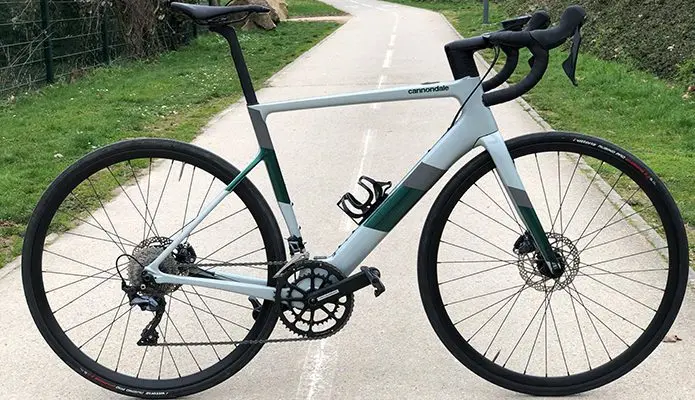
Following the launch of its new SuperSix Evo, Cannondale has introduced the electric-assist version of the brand’s flagship competition range, designated with the “Neo” term for Cannondale e-bikes. Our SuperSix Evo Neo 2 test model, picked up at the Kilomètre 0 workshops in Paris, features an intermediate, balanced build to keep the price, which quickly climbs for these high-tech objects, in check. The bike thus features a super reliable Shimano Ultegra mechanical 11-speed drivetrain, with hydraulic disc braking (160 mm rotors front and rear), a Prologo Dimension saddle (Tirox rails) with a central cutout and very comfortable seating, the elegant HollowGram SystemBar Save aero cockpit, and fairly basic Cannondale RDe 1.0 wheels, the rear of which houses the 250 W Mahle – ebikemotion motor.
The design of the frame revolves around the assist system, integrating the motor and battery, and bringing the model closer to a traditional Cannondale road bike, reinforcing the impression of offering an equivalent riding experience… give or take a few watts and heartbeats. For its SuperSix Evo Neo range, Cannondale chose a Mahle ebikemotion X35 assist system (which provides 40Nm of torque), using a 250W motor installed in the rear hub and a 250Wh battery hidden in the down tube and bottom bracket shell. Everything then depends on the chosen level of support and the terrain, which determines the effort required.
It cuts out above 25 km/h, after which your muscles must activate and take over alone. Understand that the assist intervenes when the bike computer is below this value, and when the need arises. Three assist modes are offered, activated according to a color code (Green – Orange – Red) and via an easily accessible button on the top tube of the frame, slightly set back from the stem. The default continuous indicator light (once the mode is selected) acts as a battery charge indicator.
Note that a range extender (in the form of a second 1.64 kg water bottle to carry) is offered by Cannondale (sold separately), and plugs into the charging port to provide an additional 208 Wh capacity to the main battery for a total capacity of 450 Wh. Charging is very fast, depending on the battery level, thanks to the wall charger (which can be monitored via the indicator light on the top tube or by pairing your bike with the Cannondale App if a wheel is equipped with the sensor).
While it has to contend with the integration of a battery and a motor in the rear wheel hub, the SuperSix Evo Neo frame is similar in design to the traditional SuperSix Evo model. Designed with a BallisTec carbon frame, it incorporates the aerodynamic lines and profiled tubes that recall the characteristics offered by the classic road version.
Stiffness, lightness, and efficiency on all terrains remain the model’s hallmark (with, however, changes in handling related to an overweight that changes the perception of the bike’s balance). The SuperSix Evo Neo also benefits from a geometry with dropped chainstays, integrated seatpost clamp, and the KNØT 27 seatpost to work in synergy, absorb road imperfections, and improve comfort and bike control.
The presence of the HollowGram SystemBar Save cockpit on the SuperSix Evo Neo 1 and Neo 2 models adds a touch of aerodynamics and comfort, for multiple hand positions. It also offers internal cable routing for a sleek and appealing look. While it slightly breaks the aero line of the combo, the integrated mount is very practical, allowing for the installation of all types of GPS bike computers (switching from a Wahoo to a Garmin mount in a few turns of a screw) and accessories, such as a Fabric Lumaray V2 light, for example.
Comfort is not left out, as in addition to the geometry of the rear triangle, the Cannondale SuperSix Evo Neo 2 also has sufficient tire clearance to accommodate tires up to 28 mm. As built, the Cannondale SuperSix Evo Neo 2 weighs almost 12.5 kg (without pedals), including the 3.5 kg of the Drive Pack (Motor + battery). To give you a complete idea, a SuperSix Evo Neo 1 is announced at 11.3 kg, which is within the market standards for the highest-end models (11 kg for a Wilier Cento10Hybrid, 12.2 kg for a Specialized Creo SL, 13.56 kg for a Domane+, 13.4 kg for a LOOK E-765 Optimum, a comparison to be taken with caution due to differences in integrated motor models and desired frame handling characteristics).
Assisted pedaling, moderate assist
While our experience shows that this type of motorization in the rear hub gives more of a propulsion sensation than one installed at the bottom bracket, its advantage is that it is almost instantaneous and completely frees up the latter, as the SuperSix Evo Neo 2 has a classic HollowGram crankset, double chainrings (50-34), further limiting the risk of friction/rubbing, and increasing the sensation of fluidity in pedaling at this level. Of course, you will easily understand that a standing start at a traffic light or on a wall, with the assist at the highest level, will give you the impression of being truly propelled as soon as you start, until you reach the desired effort intensity and speed of progression. On the other hand, when you adjust the selected mode according to your cruising speed and the terrain, the sensation of assisted pedaling and silent, imperceptible assist is much more striking and pleasant. And in line with what this type of machine aims to offer.
To give you an idea, even with the maximum assist level, you will still have to work hard to maintain your bike at 25 km/h on a climb. It’s not the assist that will get you there, but your legs and your breath (especially since it gives the sensation of faltering around 23/24 km/h). Climbing at 12, 14, 16 or 18 km/h with the maximum assist mode, for example, will give the impression of a very easy effort, but doing it close to 25 km/h will remain a completely different, very sporty matter. And of course, the higher the percentage, the more the assist can be felt, but the more demanding the effort to maintain a high pace will remain, naturally. The user will seek to find the right balance between their pace (heart rate) and the level of assist.
From our experience and compared to our usual riding habits, the first green mode offered by this Cannondale SuperSix Evo Neo 2 mainly compensates for and lifts the weight of the bike and rider. The second mode is intermediate and often appears to be the best alternative between assist and effort involvement. The most powerful mode will allow you to climb with the legs and heart of an Alberto Contador, but let’s be clear, this is at your pace, at your level, depending on the terrain. Always.
Climbing at 12, 14, 16 or 18 km/h with the maximum assist mode, for example, will give the impression of a very easy effort.
The SuperSix Evo character
Due to its frame geometry and overall handling, the character of a traditional Cannondale SuperSix Evo is quickly recognizable. We appreciate the more “compact” position offered, the performance qualities, the superb blend of stiffness/lightness/comfort that made the classic model’s reputation, and the aerodynamic aspect instilled in the latest edition. With the motor off, at a certain speed and on flat roads, the SuperSix Evo Neo 2 cruises along without too much resistance. However, the weight becomes noticeable as soon as you encounter even slight inclines. The assist can then become necessary to avoid the sensation of having to drag the extra kilos of the motor and battery. In this regard, the presence of the motor’s weight on the rear hub is also perceived from the start… And for a cyclist accustomed to riding increasingly lighter classic models for thirty years, this obviously modifies the overall balance of a bike and reduces its dynamic feel, especially on climbs. Fortunately, the assist is there to restore the balance.
The assist is almost immediate upon activation, and does not require a harder pedal stroke to get into rhythm (when you ease off, you sometimes even get the slight impression of a time lag before it cuts out (keep this in mind and be attentive when riding in a group or approaching a stop/traffic light). It is almost silent, especially on the first two levels. You can barely perceive a very, very slight hum at maximum assist, on a wall (and even then, this tiny sound is very often masked by ambient noise and road feedback). Let’s remember that this type of object is not intended for the spry and very sporty racer who will necessarily find little use for it (except for recovery or for fun, since their cruising speed will already be higher than what the assist can offer), but for a physically diminished body that will appreciate it. Being able to enjoy riding and their activity without feeling too worn out, at an average of 25 to 30 km/h.
Regarding range, we never managed to discharge the battery during our rides and over the 2,000 km covered during this test… before being confined. With continuous assist, Cannondale claims 75/80 kilometers of range. We completed and chained several rides of 80 to 100 km with approximately 1,000 m of positive elevation gain, with active assist mainly on climbs, without needing to recharge. Finally, don’t be too hasty when selecting the assist mode, which is quite responsive, and click with restraint to scroll through the different levels, at the risk of getting confused by the color code, which is otherwise very simple.
The SuperSix Evo Neo range at three levels
The SuperSix Evo Neo range comprises three model levels: a very high-end SuperSix Evo Neo 1, priced at €8,999, equipped with Shimano Dura Ace Di2, HollowGram SystemBar Save cockpit, and HollowGram 45 KNOT wheels. A SuperSix Evo Neo 3, which is more accessible but still costs €4,199, with Shimano 105 drivetrain, Cannondale 3 handlebar and stem, and Cannondale RDe 1.0 wheels. And the version of our test, an intermediate SuperSix Evo Neo 2 at €5,499, equipped with mechanical Shimano Ultegra, HollowGram SystemBar Save combo handlebar, and Cannondale RDe 1.0 wheels.
We find the usual excellent finish quality from Cannondale, a balanced build, for a sporty bike, very complete in its handling, stiff, performing, while being very comfortable and therefore enduring. Easy to handle and not demanding, it can suit a multitude of cyclist profiles, just like the traditional version. And it will blur the lines with the discretion of an electric assist, giving it the lines and look of a most traditional model… Enough to soften the purists who might not have understood the principle offered by such a practice?
| CANNONDALE SUPERSIX EVO NEO 2 |
| Rating: ***** Pros: Overall handling, range, weight, responsive assist, comfort, finish quality. Frame: New BallisTec Carbon, internal down tube battery, SAVE -Fork: BallisTec Carbon SAVE – Handlebar/Stem: HollowGram SystemBar Save, Carbon, 8° – Brakes: Shimano Ultegra Hydro Disc (160/160mm) – Rear Derailleur: Shimano Ultegra GS 11 spd – Levers: Shimano Ultegra Hydro Disc 2×11 spd – Cassette: Shimano 105 (11-34), 11-speed – Chain: Shimano HG601 11-speed – Crankset: HollowGram (50-34) – Wheels: Cannondale RDe 1.0 – Tires: Vittoria Rubino Pro Black Bright, 700×28 – Saddle: Prologo Dimension (Tirox Rails) Seatpost: HollowGram 27SL KNOT, Carbon – Motor: Mahle ebikemotion X35 250W – Battery: Mahle ebikemotion X35 250 Wh – Weight: 12.5 kg in size S without pedals – Sizes: SM – MD – LG – Price: €5,499 |
| Contact: Cannondale.com |
=> SEE ALSO: All our Gear tests
See all our articlesBikes
Share the post "Cannondale SuperSix Evo Neo 2 Review"