Share the post "Cycling 3.0: how good are indoor trainer apps?"
Several applications for computers, smartphones or tablets are revolutionizing the use of indoor trainers and making their practice more effective and fun. A real breath of fresh air during lockdown, when it’s impossible to ride outdoors. These applications, of which Zwift is the most famous, have their advantages and disadvantages. Could they even allow some to reveal themselves and be offered a place among the elite once they return to reality?
By Guillaume Judas – Photos: Pixabay, Elite, Zwift, RGT Cycling, Bkool, 3bikes.fr, Arkea-Samsic, ASO / DR
| WHERE TO FIND AN AVAILABLE INDOOR TRAINER? Manufacturers and importers are struggling to cope with the enormous demand for indoor trainers, especially during this lockdown period. Nevertheless, we have found a few devices still available for you:
|
During this lockdown period, indoor trainer applications are booming. And for good reason, as it’s the only way to keep pedaling. It must be admitted that while a classic indoor trainer allows you to maintain physical condition, it quickly becomes tedious when your only view is the garage door or the basement. In exchange for a relatively modest contribution (generally €10 to €15 per month, with the option to unsubscribe whenever you want), there are several applications that allow you to follow training plans, ride on virtual filmed routes, or even participate in virtual competitions with other confined cyclists around the world.

These applications are more or less fun and meet different objectives. At The Sufferfest, for example, the focus is on performance improvement with advanced training plans consisting of sessions where you ride alone, following sessions at different intensities. At Bkool, there are training plans, but you can also follow video routes, create your own routes by placing difficulties where you want them, or even reproduce a route already completed in real life (with the slope and wind conditions). It’s a similar principle at Kinomap, or at Tacx or Elite with My-eTraining. Sometimes with nuances such as the ability or inability to directly import the GPS track of a ride already completed, or the more or less easy connection of devices.

For more explanations and to find out how it works with a connected indoor trainer, see the link HERE, with the Elite Drivo II indoor trainer review.
Because obviously, there are several types of indoor trainers, from the simple roller without resistance to the hyper-realistic direct-drive interactive device, including the tripod-mounted indoor trainer with the rear wheel fixed, and whose prices vary from a hundred euros to almost 1500 (or more depending on the complete equipment or not, for total immersion).

Among the applications, finally, there are those that combine effort intensity with a digital arcade game universe, such as Rouvy, RGT Cycling, and of course Zwift, the most famous and addictive given the realistic sensations provided, but also a strong and appreciated community aspect.
In the form of a game, for better or for worse
Aware of equipment differences but capitalizing on a social aspect quite contradictory to Cycling 3.0, the developers of some applications open their platform to all types of indoor trainers, for better or for worse.
This is the case with Zwift, which allows everyone to connect, whether with a simple indoor trainer and a speed sensor, a power meter mounted on the bike, or an ultra-sophisticated device with an integrated power meter and slope simulation up to 15 or 20%.
The developers of some applications open their platform to all types of indoor trainers.
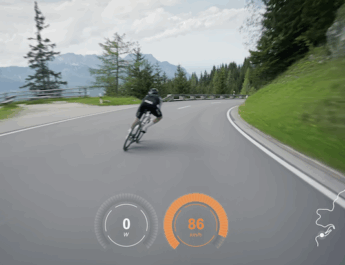
As soon as the cyclist is connected to the application, their avatar finds themselves in the middle of different virtual worlds, where they can ride in free training and navigate the different roads as they wish, follow routes with different mileages or elevations, participate in Social Rides which consist of group rides among other known or unknown cyclists, and even numerous daily competitions of different distances. Of course, on Zwift, you can also follow fairly well-designed training plans based on real or supposed power. Because that’s the strength of the application created in California in 2014, which is to offer an algorithm that deduces power based on different parameters and the type of indoor trainer used. For those who ride on an indoor trainer with an integrated power meter, or with a simpler indoor trainer connected to their own power meter, the intensity of the effort is real, although always slightly different from that on the road, as we have already explained.
For others, it’s sometimes a free-for-all, with the excesses you can imagine. Because while a simple speed sensor is enough to play on Zwift, nothing allows for comparing the resistance of different indoor trainers, the calibration of wheel sizes, or the actual weight of the user. Users sometimes cheat without even knowing it, but some performances are so stratospheric that they should still make those concerned question them. And even among connected indoor trainers with a power meter, many debates exist about the supposed accuracy, optimism, or pessimism of certain models. Moreover, with some devices, it is possible to modify the difficulty percentage.

Performances far from reality
Under these conditions, it’s difficult to credit certain performances, whether on segment records or during certain competitions. It’s a shame, because Zwift’s formula is good. Free training sessions pass more quickly, sensations are well reproduced, even when drafting is simulated (which allows you to save watts or ride faster than solo). On a session with elevation like on the ascent of Alpe du Zwift, with more than 1000 m of simulated elevation, the times and watts are consistent, provided you have a correct device or a power meter, like Warren Barguil who climbed the difficulty in 38 minutes during a virtual competition on March 29, at a power comparable to what he deploys during the Tour de France. Except that day, an unknown Zwifter beat him by three minutes! Go figure.

The same day, in another virtual competition, Bryan Coquard only took 24th place, while Lilian Calmejane abandoned mid-race, judging the competition “too difficult” and questioning the integrity of some of his opponents that day. Acquiescence from those who cannot stand the questioning of established values, and mockery or even anger from some Zwift champions, probably the same ones who are well aware of sometimes bending reality: reactions on social media were not long in coming.
In a humorous tone, former pro Romain Feillu posted a video demonstrating how easy it is to cheat on Zwift, much to the chagrin of the application’s aficionados, who sometimes become disconnected from reality and forget that real cycling is practiced IRL (In Real Life, as they say).
“There are guys who manage very well and deserve their results, even those who finish ahead of the pros,” he explains in the columns of Le Populaire du Centre. “On the other hand, there are others who can cheat. My idea was therefore to show that there are no means of control and that the tools are not necessarily very reliable and that you can send a lot of watts… without being on a bike! I wanted to show that you could connect with anything but also to de-dramatize the debates where many, especially professional cyclists, complain about cheaters. This is all the more important as we are talking about setting up official indoor trainer competitions. Naturally, with the stakes involved, there will be people tempted to cheat. I did this with a touch of irony.” The adopted Creusois tempers his remarks by specifying that Zwift competitions require particular tactics and effort management, as he wrote to Romain Campistrous, one of the best French Elite 2 riders, and very strong on the application, on social networks: “I tested Zwift and I understood that there was a technique to have, not just to push hard but to quickly close a gap to stay or get out of trouble, not to pedal on a fast descent in a group so that your avatar gets into an aerodynamic position. (…) It is certain that those who, like you, ride on it all year round, you have a well-honed technique and tactics. What I wanted to show is that, like everywhere, there are cheaters. Of course, I exaggerated the thing to the extreme, this time I was in the shoes of the cheater… But congratulations to all those who use the Zwift tool well.“
Fake or reality? The best time on the Alpe du Zwift is displayed at an average of 26 km/h.
There is indeed a safeguard to temper the results of virtual competitions on Zwift, with the site Zwiftpower.com, which lists rankings, rider categories, and applies disqualifications if certain conditions are not met (heart rate monitor, recognized indoor trainer or power meter, etc.), but it remains completely independent of Zwift. This means that not only do more or less voluntary cheaters continue to disrupt races on Zwift, but segment rankings are not verified or updated. Thus, the best time on the Alpe du Zwift is displayed at an average of 26 km/h. These excesses are not very serious in essence, and do not change much about the quality of the application for free or calibrated training, but they still end up giving the game a bad image.
A rare opportunity

The fact remains that this connected cycling not only has the virtue of keeping us busy during this difficult period of lockdown. It can, why not, reveal true champions. This is in any case the question being asked by the management of the Arkéa-Samsic team, and notably Kevin Yven, the performance analyst. “I developed an algorithm to analyze performances and highlight atypical profiles that we might need within the team, and to detect athletes who might have slipped through the net of traditional scouting,” he begins. “Coaches and sports directors have an idea of the profiles they are looking for, based on certain criteria. This begins with an analysis of physical capabilities, and therefore power output.” To do this, the team is launching an unprecedented recruitment process throughout April, based on power values. “The candidate must open an account on the Training Peaks application, which is currently the most reliable platform for analyzing training and race performances,” Kevin Yven continues. “They must synchronize their training sessions, based on a reliable power meter, and open their profile to us with all their data. This is where we will make a first selection. However, the cyclist must be of legal age.”
Then will obviously come an analysis of the results of the first selected riders in races, their technique, but also their human side, which will make it possible to unmask those who may have had the idea of falsifying their data. The most important thing to remember is that the Arkéa-Samsic team is looking to recruit athletes with particular backgrounds, who may not have had the benefit of good structures to climb the ranks and who have untapped potential. Sportive cyclists or cyclists who ride outside of any federation even have a chance. “We don’t know exactly when, given the current situation, but the goal is to then follow the selected athletes within our Arkéa-Samsic-Development structure, offer them an intern position, and why not a place among the pros,” concludes Kevin Yven.

In any case, it’s an excellent opportunity for connected cyclists to prove their worth, as they have as much chance as anyone else to be spotted, and thus to demonstrate that indoor trainer applications can have many other advantages than just being fun.
=> SEE ALSO: All our Mag articles
Share the post "Cycling 3.0: how good are indoor trainer apps?"