Share the post "Long-term test of Specialized S-Works Turbo RapidAir 2Bliss Ready Tubeless tires in 700×26 and 700×28"
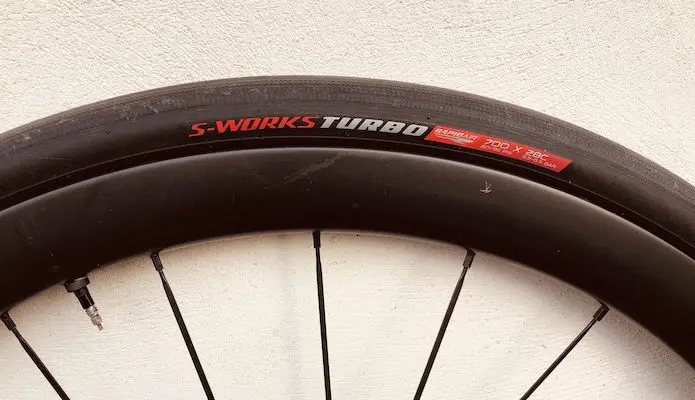
With the S-Works Turbo RapidAir 2Bliss Ready, Specialized makes a sensational entry into the Tubeless tire market, with some of the most high-performance models available today. Available in two sizes, their behavior evolves slightly according to the characteristics desired by the manufacturer. We tested both, accumulating 4000 km with the 700×26 and 700×28.
By Guillaume Judas – Photos: 3bikes.fr
Available in 700x26C and 28C, the RapidAir 2Bliss Ready Tubeless tires are the result of a long testing process at Specialized, already one of the leading brands in the field with a complete range of tires and tubulars, some of which are used by professionals. This Tubeless tire has been developed for 3 years in close collaboration with the professional Deceuninck – QuickStep team, building on the evolution of the silica-optimized Gripton rubber compound, with a completely new casing construction.

Normally, a tire’s casing extends from one sidewall to the other, overlapping the tread, with an additional puncture protection layer, which often deteriorates flexibility and thus comfort. With the RapidAir, Specialized has managed to leave a space in the center of the casing, solely intended to be filled with its BlackBelt protection strip. The RapidAir is thus more flexible, more responsive, faster, more comfortable than a tubed tire, but also more grippy and more durable than a tubular. The 120 TPI casing is complemented by a smooth tread in the middle and shoulders with small knobs for grip in corners and on wet roads.

Two slightly different models
With the RapidAir in 700×26, we were pleasantly surprised to find tubeless tires that weigh 260 g (verified) and measure exactly 26 mm in tire width on a rim with an internal width of 19 mm. In this version, the aerodynamics seem optimal, as the tire sidewall is flush with the rim. With the 60 g of sealant required by the brand, we arrive at a weight of 320 g per tire, which is not much more than a setup consisting of a light tubed tire in the same section (around 220 g) with a basic butyl inner tube (around 90 g, or 310 g in total). Of course, lighter inner tubes, between 55 and 75 g, can also be found.

For more details on Tubeless installation, you can find the Continental Grand Prix 5000 TL long-term test.
The RapidAir in 700×28 are significantly heavier, weighing in at 310 g, which seems like a lot considering the theoretical 2 mm increase in tire width. Indeed, once mounted on the same rims, we realize that they actually measure 31 mm wide. Beyond this additional width, we also learned that they have a thicker protection strip and a stronger tread, to suit a more versatile use than the 26 mm version. However, with the sealant, we reach a weight of 370 g on the scale, which starts to add up. Compared to the 26 mm setup, we add 100 g to the wheelset.

Easy installation
Both versions of the RapidAir are distinguished by their relative ease of installation. By following the instructions, which consist of properly seating the tire bead in the rim channel, it is not necessary to use tire levers to install these Tubeless tires. This is also an advantage in the event of a puncture on the road, which one of our riding companions experienced with this same model, and which required the installation of an inner tube to get back home. The operation was carried out without difficulty, unlike many Tubeless tires on the market.
Specialized provides a list of wheels perfectly compatible with its RapidAir, which does not include the Vision 40 SC of the Orbea Orca OMX. Concretely, this means that we were not able to seat the tires without the help of a compressor, whereas this should be possible with the recommended wheels. But for the rest, we had no problems with installation, resistance, or pressure loss during this 4000 km test with both versions of the RapidAir.

To complete the installation, it is necessary to add sealant to benefit from all the advantages of Tubeless technology. This is a new blend of mixed filament sealants specifically designed to instantly fill holes up to 3 mm in diameter, with little to no pressure loss, called RapidAir Tire Sealant. It is very effective, as we will see later, but it is not cheap. At €11.90 per 60 ml bottle, this adds to the €79 for the tire. It will cost you about €180 to ride with a pair of RapidAir, whether it’s the 700×26 or the 700×28.

Fast and secure
Tested from mid-December, the RapidAir 700×26 Tubeless tires advantageously replaced the tires originally mounted on the Orbea Orca OMX as part of our long-term test of this bike. Slightly smaller visually on the Vision wheels, they proved to be faster on the road, but also slightly more comfortable. Inflated to the limit of the recommended pressure in this section (7 bar), their comfort was not their primary asset, even if we immediately appreciated their grip and the fact that they did not vibrate on the road. Fast when riding at a steady pace, we also found them sharp and lively in changes of trajectory and during accelerations out of the saddle. And the grip, both on dry and wet surfaces, proved to be truly excellent, even on cold ground. The S-Works RapidAir in 700×26 are very effective but also very secure racing Tubeless tires, whatever the conditions.

The frequently wet roads did not spare the tires, as we noted numerous punctures. Exactly two in the rear and seven in the front, over 2500 km. But at no point did we need to repair anything. The sealant perfectly fulfilled its role, plugging the holes every time, and without the tire losing pressure. It was when dismounting the RapidAir that we could see that the inside showed small latex plugs, testifying to the effect of the sealant. It is unnecessary to specify, however, that the seven punctures in the front used up the 60 ml of sealant, nor that each puncture leaves an external cut that risks deteriorating the tire’s resistance.
The RapidAir were considered worn out after 2500 km, but we believe that under other conditions, in spring or summer, they should be able to reach 4000 km.

The 700×28 version immediately proved to be different, being heavier and requiring lower pressure (max 6.5 bar, but we limited it to 6). While we must admit our initial reservations given the actual tire width, a few kilometers were enough to dispel our concerns. The performance of these Tubeless tires is still excellent, although they show a little less responsiveness, but compensate with significantly superior comfort. From the first ride, we found ourselves looking for bike paths, and even some poorly surfaced road sections. If the weather had been drier, we might even have tried some well-packed dirt roads. Once up to speed, these tires perform well, remain solid, and position the bike as if on a kind of air cushion. In the rain and with disc brakes, they are reassuring and encourage taking demonic angles in corners. We never felt the slightest sensation of floating or slipping, even when pushing the limits of riding. And while the support seems a little less firm when standing out of the saddle on a steep climb than with the 26s, these “wide” tires withstood a few launched sprints without failing and without really hindering us.
While we must admit our initial reservations given the actual tire width, a few kilometers were enough to dispel our concerns.
Of course, such a volume is not favorable aerodynamically, but that is not the purpose of the RapidAir in 28, which are designed to be more comfortable and more durable than the 700×26. Moreover, after 1500 km, although the tread is already marked, it seems to us to be in better condition than that of the 26s at the same time. In any case, we only encountered one puncture, which was again instantly plugged while riding.

The verdict
With the RapidAir, Specialized achieves an almost flawless performance, as only the selling price can be an obstacle to switching to Tubeless, given that the brand shows us the best of this technology. With these two versions, it is important to keep in mind that they do not have exactly the same vocations; one is truly competition-oriented, while the other is better suited for long-distance efforts.
| Specialized S-Works Turbo RapidAir 2Bliss Ready |
| Rating: ***** Pros: rolling qualities, comfort, grip, ease of installation
Price: €79.90 per unit (+ €11.90 for sealant) |
| Contact: specialized.com |
=> SEE ALSO: All our Gear articles
Share the post "Long-term test of Specialized S-Works Turbo RapidAir 2Bliss Ready Tubeless tires in 700×26 and 700×28"