Share the post "Sporting success: the virtues of effort"
Often forgotten in our modern society, the notion of effort associated with success applies even more in terms of sports results. Everyone can set the bar where they want, but progress in cycling or triathlon necessarily involves a certain degree of involvement.
By Jean-François Tatard – Photos: All rights reserved
Let’s start with the lyrics of a song that’s been stuck in our heads lately: “Le spleen n’est plus à la mode, ce n’est pas compliqué d’être heureux…” (Melancholy is no longer in fashion, it’s not complicated to be happy…), and yet, do you hear it, my dear Angèle, this misunderstanding from the elders?: “In our time, you had to work hard to earn your keep“! A rhetoric not entirely unfounded, in sport as elsewhere. Translated differently, it means that today, success very often confronts the fact that it is necessary to put in effort before achieving the desired result. Indeed, the modern mindset is paradoxical: we want to win and succeed without making an effort! And yet, all coaches will agree! All of them make this last parameter the primary determinant of success. But then, how can we rehabilitate effort and demanding standards to engage ourselves physically and psychologically?
Success very often confronts the fact that it is necessary to put in effort before achieving the desired result.
Personal representations of the causes of success and/or failure
When we ask champions what their successes or failures are linked to, quite generally, they will associate them with four causes:
- Learning (stable and internal)
- Task difficulty (stable and external)
- Effort (unstable and internal)
- Luck (unstable and external)

This is indeed a subjective perception, and it’s not necessarily reality, but ultimately, it doesn’t matter. Because the representation they have of the cause of their successes or failures will subsequently be decisive in their mental attitude as well as for their level of commitment and perseverance.
A look at the perception of cause based on individual character
If we were to make two camps, optimists would attribute their success to internal and stable causes: “My success is the result of my hard work” and their failures to external and unstable causes: “Bad luck, it just happened today“. But virtuously, this attitude will allow them to convince themselves to persevere.

As for pessimists, they tend to associate their failures with internal and stable causes: “I’m useless“; and their successes with external and unstable causes: “Stroke of luck“. This attitude is to be avoided because it will quickly and more often lead to giving up.
The right attitude
In order to engage in a process of perseverance, and to optimize your chances of success, the attitude you should actually favor would be to attribute your success and your failure to the single internal and unstable but controllable cause: effort!
And this is subjective! Effort cannot be rationalized! It is not a scientific concept! And according to the definition, effort refers to the sense of work, fatigue, and will. But if we ask everyone to define it and to locate their limit of acceptance, there will be as many points of view as there are individuals. So, this effort, often physical at first glance, cannot be dissociated from the mental effort that underlies it.
What is the limit of effort?
It’s all a matter of perception. Effort includes a subjective dimension and a very intimate sensation of how arduousness is experienced. Nevertheless, it takes on an objective dimension when associated with describable sensations of physical pain. And it is this dimension that must be taken into account in its singularity for each individual. And the limit is crossed when arduousness takes over the action of control. Thus, the cyclist or triathlete must paradoxically be able to take into account their feelings to adjust each repetition, essential for the automation of the most perfect technical gestures and the development of their own physical condition. In practice, it is not about hastily getting rid of the task, or just getting it done. This great attention paid to posture, relaxation, foot placement, and breathing must allow for even greater efficiency in learning.
We advocate for a sustained commitment, combined with method and attention.
It is customary to say that “perfection is the repetition of the gesture“. Nevertheless, one must adapt according to one’s sensations. Thus, we advocate for a sustained commitment, combined with method and attention. Therefore, concentration! Therefore, intellectual availability!
The role of the coach
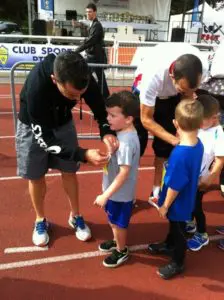
Coaches play a crucial role at all levels. But success is even more linked to the effort the athlete is willing to put in to succeed. And in reality, the coach’s job is only to create the conditions for their athlete’s successes to emerge and to guide them to reach the summit. THEIR summit! Thus, in the short term, the coach’s role will be to allow the athlete to enjoy riding and running, to measure their progress, to succeed, to experiment with different techniques, to confront opponents and varied environments. In the medium term, it is to help them give meaning to their commitment, to highlight proven progress and thus maintain motivation. In the long term, it is to help them choose, by helping them define objectives and sub-objectives and, as they go along, to plan the stages of their project.
=> SEE ALSO: Cycling or triathlon, should you get a coach?
In conclusion…
In the collective unconscious, we associate effort with willpower. With self-transcendence. With a concentration of physical and/or intellectual forces, with a view to achieving a goal. Yet, while the concept of effort is a recurring theme among coaches, scientists never talk about it. But then, the question is: can we still ask young people to make efforts to succeed in this case? And to affirm it would be to admit that it is possible to succeed without doing anything. That would still be, admit it, irresponsible (and moreover, dishonest)! So, the idea here, in this paper, is to associate three variables in a magic equation:
- Time
- Energy
- Method
Effort is the only thing that allows you to persevere to achieve a personal project, both ambitious and achievable. And finally, if cycling or triathlon are often associated with arduousness, we would like to remind you that these sports also provide a specific social framework characterized by rides, trips, friendly relationships, and more generally punctuated by successes and moments of intense pleasure and immeasurable joy!
=> SEE ALSO: All our Coaching articles
Share the post "Sporting success: the virtues of effort"