Share the post "Sigma iD.TRI Multisport Triathlon Watch Review"

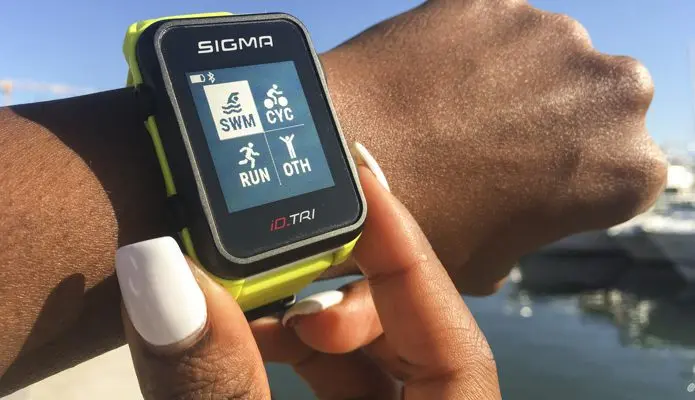
The iD.TRI multisport watch is the latest addition to Sigma’s iD.SERIES range. Developed for triathlon, it offers simple and intuitive handling, a small format, a wrist heart rate sensor, and a competition mode that allows you to plan your next event in terms of distances and disciplines, whether you’re competing in a duathlon or a swimrun.
By Pierre-Maxime BRANCHE. Photos: 3bikes.fr and Sigma

In recent weeks, Sigma’s ID.SERIES watch range has seen two new additions based on the same design: the iD.FREE, a versatile watch for great adventures, whether off-road, on the road, or on ski slopes; and the iD.TRI, specially developed for triathlon, which we tested for several weeks. Its design is simple, sleek, and discreet in its black version, but flashy in its three other colors—turquoise, red, and green—which evoke the colors and warmth of summer.
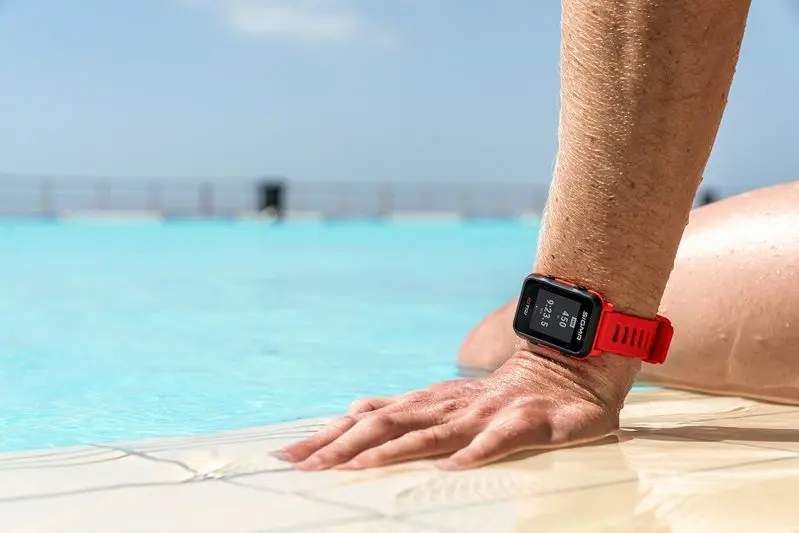
It offers Bluetooth Smart and ANT+ connectivity, allowing it to be paired with a smartphone, as well as with external sensors for heart rate, cadence, or power. Fast synchronization via USB with the Sigma Data Center software and the free Link app allows you to manage your workouts and analyze your data. On the wrist, the iD.TRI features a silicone strap that can be easily replaced with any other 20mm wide watch strap, thanks to two small click buttons. It is waterproof up to 5m, and weighs 42 grams. Sigma promises intuitive operation thanks to its four buttons, no more.
Enhance your sports experience
Several technologies are available to enhance your sports experience. For example, the Smart Light, located on the lower part of the case, displays target zones, speeds, route indications, and smart notifications via light signals of different colors. For your safety, the Crash Alert allows the iD.TRI to automatically detect falls and, if the user does not react within 30 seconds, to inform pre-registered emergency contacts via SMS, sending key vital parameters and GPS position, if and only if the watch is connected to the Link application at that moment.
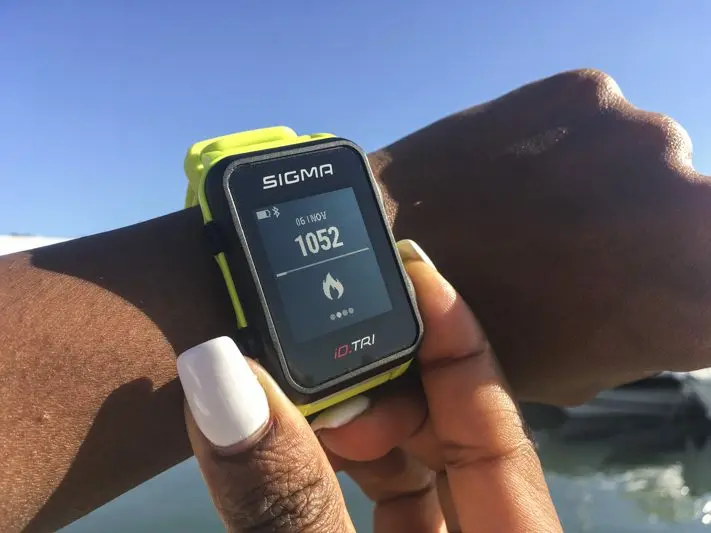
In addition to the three-axis compass, acceleration sensor, and barometric altitude measurement, the iD.TRI measures heart rate at the wrist. A chest strap can also be paired. The route navigation system allows the use of the Komoot app for cycle paths and hiking trails. Route directions are then displayed directly on the watch screen. It also includes an activity tracker with classic data (number of steps, calories burned, distance covered, sleep phases and duration, etc.) and a sleep analysis system to estimate your recovery status.
Triathlon Goal!
The swimming, cycling, and running sport profiles are predefined in this watch. Their parameters and overviews during training are fully customizable. Thanks to the Data Center or the Sigma Link application, it is possible to set up to five individual data pages with a maximum of three data points per screen. A fourth profile can also be defined for a complementary activity.
The iD.TRI allows you to program time or distance reminders so you don’t forget to refuel
The “competition” mode allows you to plan your races. Here you have the freedom to choose the order of events and distances so you can configure other disciplines such as duathlons or swimruns. Transition times are recorded. The iD.TRI allows you to program time or distance reminders so you don’t forget to refuel, both in training and in competition. Speaking of training, it has several pre-programmed interval sessions, but it is possible to add up to 36 sessions by creating them via the data center, the app, or by downloading them from third-party programs.
Intuitive Evolution
So much for the paper presentation. On the wrist, the iD.TRI is a nice little watch that, with its format, stands out from current standards displayed by Garmin, Polar, Suunto, etc., which feature much larger and rounder sizes. Here, we have a small rectangular screen, a small case, and a small, yet very comfortable, silicone strap.
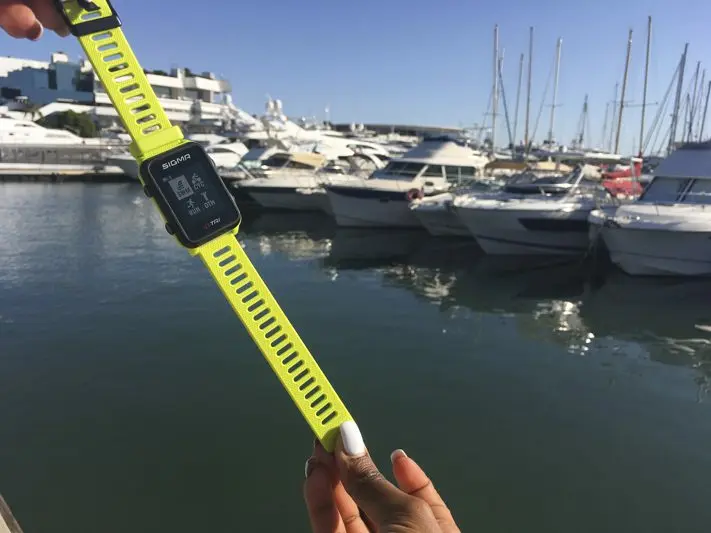
The green color we tested is refreshing, summery, and a change from the countless predominantly black watches. You either like it or you don’t; it’s a matter of taste. Externally and aesthetically, we have a watch here that looks a bit like a gadget, a bit like a toy, clearly mid-range when compared to the giants in the category, against whom it doesn’t compete anyway, let’s be clear. On the other hand, it has its lightness, its dynamic colors, and… its ease of use.
As announced by Sigma, the iD.TRI is intuitive to use. From the first time you pick it up, you won’t get lost in the menus. We were a little surprised, at first, to have to navigate with the two buttons positioned at the bottom of the case, when many of its competitors use top and bottom buttons. No matter. Once you get used to it, navigation is easy, especially since it doesn’t offer many menus and sub-menus: at the first level, you find the activity tracker with four screens of traditional data. By pressing the top right button, you enter the menu with, in order: the four sport profiles, training sessions and programs, competition mode, navigation mode with loaded routes, a memory menu, and finally the settings. That’s it. We’ll skip the few sub-menus, but frankly, the iD.TRI is very quick to get the hang of. The same goes for the Sigma Link application, which allows for numerous settings, including personalized settings for all activity screens that can display between one and three data points. A good introduction.
A faulty GPS
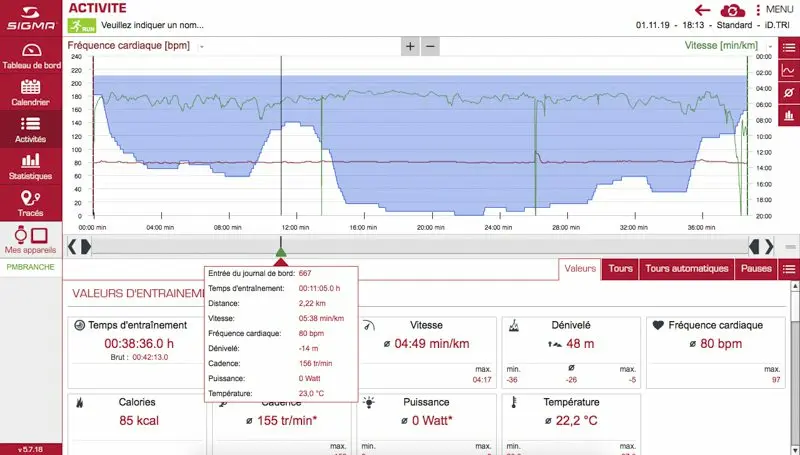
Unfortunately, things went downhill throughout our two months of testing. To date, the satellite acquisition system on this iD.TRI is not optimized. This leads to two levels of complications: firstly, for the speed of satellite acquisition; secondly, for satellite tracking during activity, which inevitably greatly affects live data and tracks.
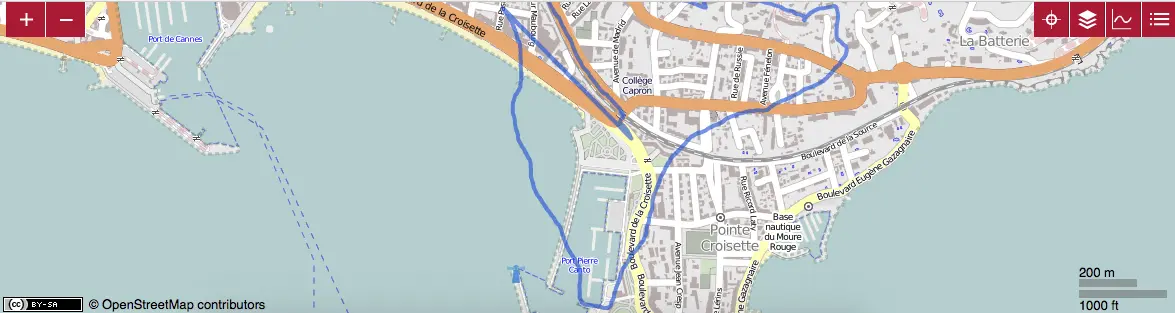
From our first running outings in mid-October, GPS acquisition proved to be long, sometimes very long, or even impossible. Compared to two competing models, the Sigma didn’t stand a chance. Honestly, we even left a few times without being able to start the watch. After a few weeks, the problem became a little clearer: on the one hand, in urban use, the iD.TRI was, in the autumn, frankly off its game; on the other hand, by the sea or in completely open areas, the problems were much less significant.
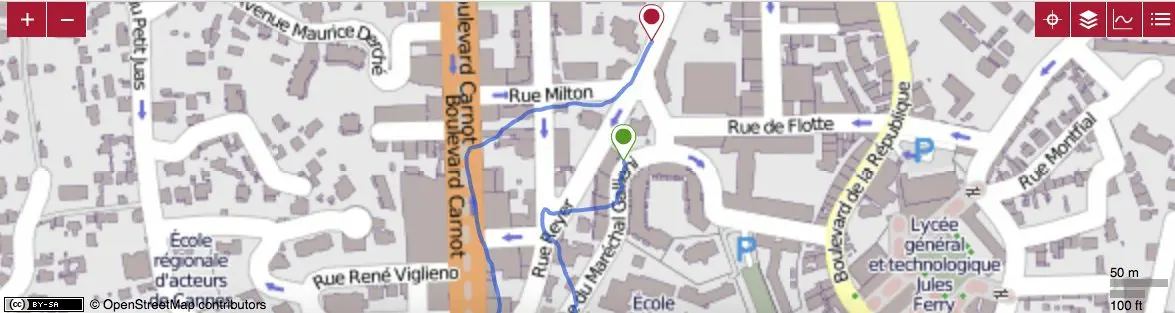
In the city, satellite transmissions are much less effective. And when the satellites are (finally) locked on, GPS tracking becomes, in fact, approximate. Consequence 1: erroneous speed and distance data, both live and in session summaries. Frankly frustrating when you’re doing interval sessions with precise paces to maintain. Consequence 2: completely inaccurate tracks and profiles in urban areas, with crossings of fully built-up areas, total errors of un-taken roads, or a distant start and end point when the actual outing was a loop.
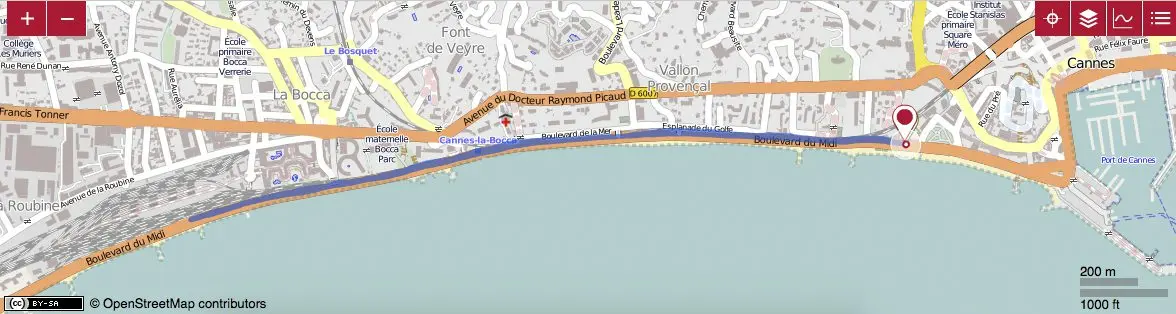
Contacted on these various points, Sigma acknowledged these major difficulties and informed us that they are in the process of resolving these data problems in urban use. It is clear that it is indeed working better, as recently, satellite acquisition has been much faster, even in urban environments, and live data is gradually recalibrating to values much more faithful to sensations and to more precise GPS tracks.
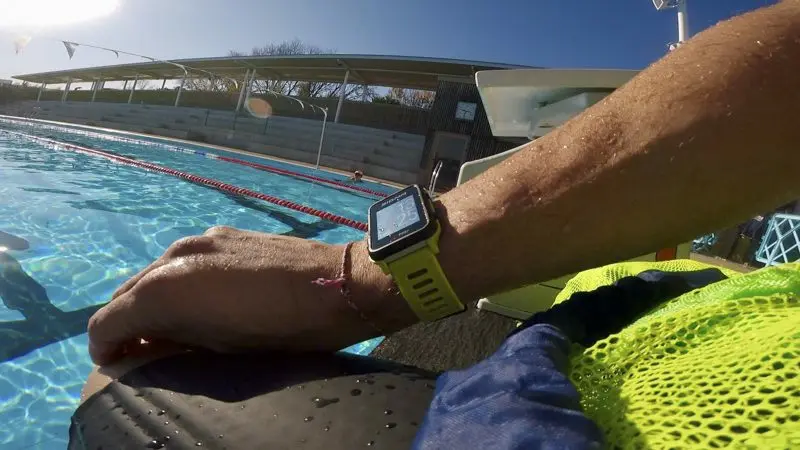
What is true for running is much less so for cycling. Practiced most of the time in open areas, live information and tracks did not pose any problems, with a few minor details. The same goes for the only two swimming sessions we were able to complete, where the GPS provided a distance consistent with the distance swum and with its competitors.
Legibility issues during effort
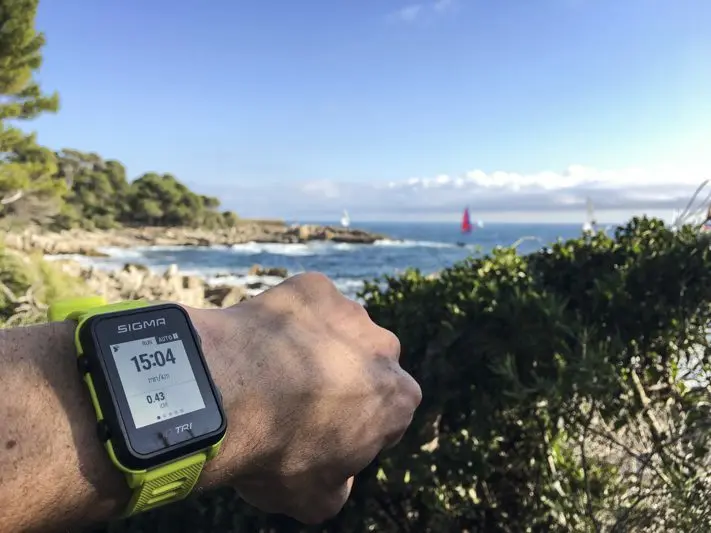
We must also point out another major issue: legibility. During activity, especially during a running session, for example, reading live data on the configured screens is not comfortable due to the size of the data display, further amplified by arm movements that make reading even more difficult. Of course, it is possible to have only one or two data points per screen so that the values are larger. But when training or competing, you need several data points to manage your effort. At least instantaneous speed, distance, and time. With three data points on the iD.TRI’s small screen, two of which appear smaller, reading, or rather deciphering, the information is very difficult.
These figures appear in black on a white background. Perhaps the inverse would have been more legible. We’ll see. Another problem: during night outings, the Sigma does not offer permanent backlighting. To read the data, you have to simultaneously press the two bottom buttons, which is already not the easiest manipulation to perform during effort, to activate the backlight which only lasts 4 seconds. Not simple enough and too short, not to mention having to decipher the data! Of course, the Smart Light is there to guide you with its system of light signals, but it is still difficult, if not impossible, to intelligently conduct a training session with only light signals.
Excellent battery life
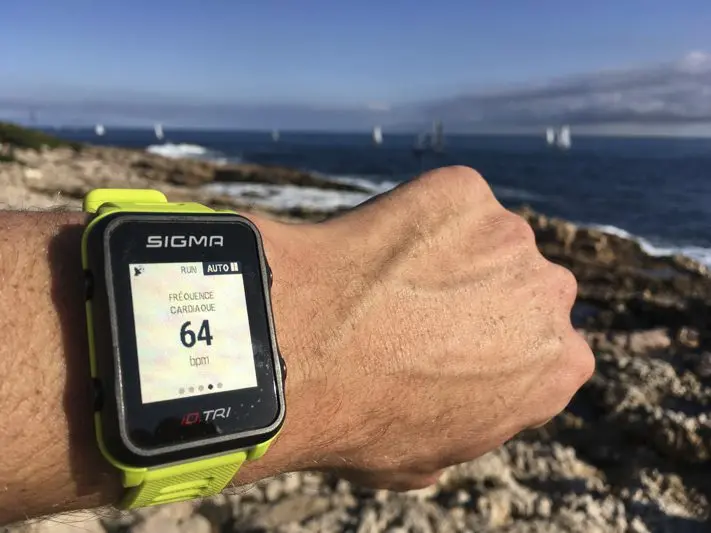
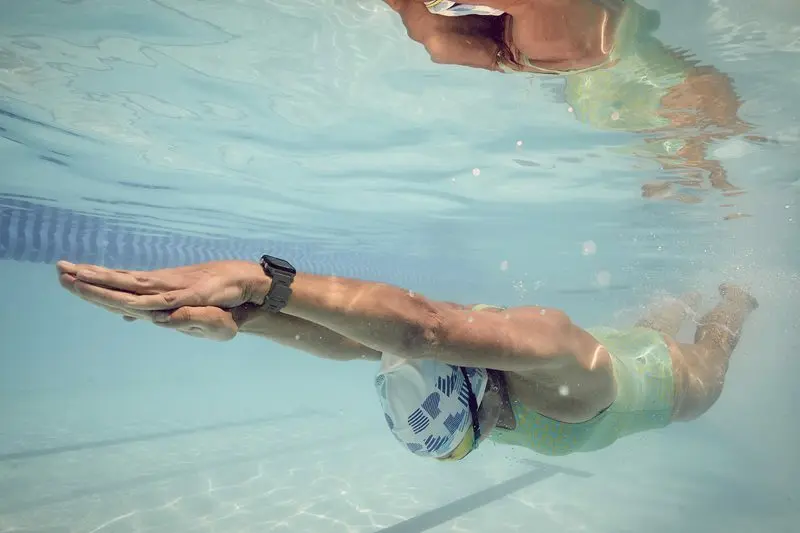
On its side, the wrist heart rate sensor displays values very close to our two reference watches, slightly higher. However, the HR analysis profiles on the Data Center platform do not show any significant dropouts. Another good point: the iD.TRI benefits from very good battery life. For three one-hour sessions per week (with GPS in normal satellite acquisition mode and not in economy mode) and five days a week of activity tracker use, we only needed to recharge it once for the entire week. Sigma claims easy use under a triathlon wetsuit. We specifically put on a wetsuit (without going swimming) to test the watch’s passage under the sleeve, and indeed, its small screen format and 12 mm thickness easily slip under the neoprene.
What remains of this iD.TRI in the end? Unfortunately, a bitter aftertaste. We liked its look, its freshness, its ease of use, its affordable price at €179.95 (bike mount included), but the major GPS glitches in urban areas and the lack of screen readability during effort are real drawbacks, at least when considering performance. Let’s hope that Sigma improves these two black spots with future updates so that this device, attractive on paper, becomes fully so outdoors.
| SIGMA iD.TRI |
| Rating: * Pros : battery life, ease of use and simplicity, price |
| Contact: https://www.sigmasport.com/fr/ |
=> SEE ALSO: All our Gear Reviews
Share the post "Sigma iD.TRI Multisport Triathlon Watch Review"