Share the post "Logbook – Long-term test of the Orbea Orca OMX #1"
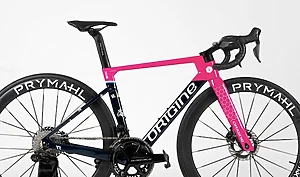
In addition to our first exclusive test of the Orbea Orca OMX at the time of its official presentation, what is this bike really worth in everyday use? The answer is in our long-term test of the Orca M20iLTD-D on our usual training routes, the progress of which you will regularly find here. First part: discovering the bike and its first rides.
By Guillaume Judas – Photos: 3bikes.fr
The first time we got in touch with the Orbea Orca OMX in the Basque Country this summer, it was with one of the top-of-the-range models. Here, we will be carrying out this in-depth test with a bike that is a little more affordable in terms of price.
You can find a bike in the exact configuration of the test here:
Orbea Orca M20iLTD-D

In-depth because it was carried out on our usual training roads, in the middle of winter, with almost daily use and sometimes not-quite-perfect maintenance. This was an opportunity to see how this bike, and its equipment, performed in real-world conditions, as the new Orca OMX is only available for disc brakes and electronic shifting.

There are four versions of the Orca OMX: at the top of the pyramid, the model equipped with Sram Red eTap AXS 12-speed, with Mavic Ksyrium Pro Carbon wheels at €9499. Then at €8999, there is the model equipped with a Shimano Dura-Ace Di2 Disc groupset, with the same wheels. Next come the Orca with Sram Force eTap AXS 12-speed with Vision 40 SC wheels at €5999 and the model with Shimano Ultegra Di2 Disc with the same wheels, at €5699, which is our test bike.
Only four versions, but at Orbea, the MyO concept allows you to customize the bike, with a system of free, upcharge, or downcharge options. You can choose your own colors for free from thousands of combinations, or define the length of the cranks, stem, or width of the handlebars, as well as the chainrings and cassette cogs. And all this without spending an extra penny.

It is also possible to choose, for an additional charge or a reduction in the final bill, from three different pairs of wheels (Vision 40 SC, Mavic Ksyrium Pro Carbon or DT Swiss ARC 1400), three saddles, to prefer an aluminum handlebar, or even tires of different widths, or to have a power meter installed.

An almost unique offer on the market, especially since the prices remain in the lower range of high-end. But even with an Ultegra Di2 bike, you can ride a customized bike, which we did minimally for this long-term test: if the paint was chosen from the three basic proposals, the bike is equipped with the desired position components (stem, handlebars and cranks in the correct dimensions) and the requested gears (53-39 and 11-28). Ideal for a long-term test in perfect conditions.
Without changing any of the basic characteristics, we simply mounted our usual saddle, not wanting to waste time finding all our benchmarks. In terms of weight, the fi’zi:k Arione R3 chosen is only 5g lighter than the Selle Italia SLR Boost offered with the bike.
The weight disappointment
When taking the bike out of the box, mounting the handlebars and installing the pedals and a bottle cage, the first reflex is to weigh the machine ready to ride. At exactly 8 kg (7.720 kg without pedals or bottle cage), it’s a slight disappointment, as the Orca OMX is supposed to be a versatile bike rather intended for climbing.

Looking closer, we realize that we can’t save much weight by upgrading to the higher-end Orca OMX models. For example, we can only save about 220g by opting for a bike equipped with Dura-Ace Di2 Disc or Sram eTap AXS, respectively €3000 and €3500 more if we take the same Vision 40 SC wheels. With a bike equipped with Sram Force eTap AXS, we even add more than 80g compared to our test bike.
At exactly 8 kg (7.720 kg without pedals or bottle cage), it’s a slight disappointment, as the Orca OMX is supposed to be a versatile bike rather intended for climbing.
The three pairs of wheels offered when choosing the bike also leave little room for maneuver. The Vision wheels are announced at 1590g, the Ksyrium Pro Carbon at 1620g, and the DT Swiss ARC 1400 Dicut 48 at 1554g.
Since the handlebars are already carbon (an aluminum version of the Orbea OC2 handlebars also exists), it’s only on the tires that you might be able to save a little weight. But at 280g per unit in the Tubeless version (+ 40g of sealant), the Hutchinson Fusion 5 All Season are not among the heaviest. Or on the size of the brake rotors, here 160mm, but which could be mounted in 140mm, to save 20g per rotor. In short, those who want to optimize the weight of their machine from an Orbea Orca OMX disc will have to play it tight.
The fact remains that, speaking of weight, it must be compared to the proposed selling price. And in this game, this Ultegra Di2 disc model at 7.7 kg without pedals is ultimately not so bad off if we look at the competition with the same technology.
Exemplary finish
The assembly and adjustment of the bike are also an opportunity to appreciate the quality of the finish. If you are not yet familiar with Orbea, we strongly invite you to visit a dealer to observe the quality of the paintwork and the care taken with certain details.

Here, you don’t fumble to find the thread of the thru-axle end, nor when installing or uninstalling the wheels on the frame. Everything inserts perfectly, and is totally aligned. The same applies to the derailleur hanger, which is perfectly aligned and, above all, clearly very rigid, judging by the precision of the gear changes and, above all, their reliability. But we’ll talk about that later. As well as the disc brakes, which are silent and frictionless, at least for the first few rides, and whose proper use also depends on the bike’s manufacturing.

Orbea has also not skimped on practical elements such as the bottle cage screws or the integrated seatpost clamp screw. It would have been easy to save a few grams here, but at the risk of losing reliability. The screws are handled with 4 and 5 mm Allen keys, and without risk of damaging the heads after several manipulations. This is reassuring.
The minor inconveniences of hydraulics
The Orca OMX cockpit partially integrates the hydraulic brake hoses, while the Di2 electric wires run through the inside of the handlebars to a connection box hidden in the stem.

The stem can be adjusted independently of the handlebars, which is a great advantage compared to integrated cockpits. The slightly rectangular and semi-open spacer system is easy to remove to lower the handlebars, as we wanted to do, for example. Once the stem is placed at the correct height, there is no need to cut the steerer tube immediately, as you can place classic spacers between the expander cap and the stem, unlike some competing bikes where everything is integrated and not easily modifiable.

But once the stem is lowered from its initial setting, and the brake levers are repositioned at the desired height, the front brake hose reaches its limit, as it is too long to simply fit the new path between the lever and the caliper. This now-too-long hose removes some fluidity from the steering, and creates a “kink” in front of the handlebars, aesthetically contrary to the initial desired integration.

Cut the hose? Unlike a normal brake cable, this will require cutting, and bleeding. This is not a simple operation, requiring either specific equipment or an appointment with a bike mechanic. Because it’s not the kind of operation that can be done in five minutes.
A very efficient bike
The first rides make you forget these details, which will be gradually adjusted. Very stiff, the Orca OMX proves perfectly efficient on our usual training roads.
Very stiff, the Orca OMX proves perfectly efficient on our usual training roads.
And yet it didn’t take long to be baptized, with daily rains since its commissioning, and constantly dirty roads during this first half of December.

The tires were the first to suffer. The Hutchinsons lasted exactly 750 km before giving us a series of three punctures on a single ride. The first, a clean cut on the sidewall, required the installation of an inner tube. Because yes, even with tubeless, it’s better to go out with a spare tube, otherwise you risk being stranded on the side of the road. Fortunately, removing the Hutchinson tubeless from the Vision wheels is not very complicated. The second on the other wheel was partially patched by the sealant. The pressure dropped to 2.5 bar, before no longer moving. A trip home to reinflate, but another puncture of the same type 10 km further on. It was no longer safe to go far.

Weakness of the Hutchinson Fusion 5 All Season Tubeless, riding through a “minefield” due to the condition of the road in December, or just a bad run? It’s a shame, because the performance of these tires is decent, and above all their grip is perfect on the wet and greasy roads of December.
An opportunity for us to remove them and install new Tubeless tires to test.
We will talk about this in the next part of this logbook very soon.
Total kilometers ridden: 951 km
=> SEE ALSO: THE CONTINUATION WITH THE SECOND PART OF THE LOGBOOK
=> SEE ALSO: All our Gear articles
Share the post "Logbook – Long-term test of the Orbea Orca OMX #1"