Share the post "How to improve your pedal stroke?"
Even if we learn to ride a bike at a very young age, pedaling well is more complex than it seems. To be both efficient and economical over short or long distances, pedaling technique requires a minimum of learning, to pedal smoothly or to change gears at the right time.
By Guillaume Judas – Photos: 3bikes / SP / PEdALED / Pxere.com / Shimano
It seems there’s nothing simpler than pedaling: you just push alternately on both legs to turn the crankset. Yet, apart from other technical gestures that allow you to master a bike well, good pedaling is first and foremost essential not only for efficiency, but also for economy. This allows you to ride faster and longer, which seriously broadens the field of possibilities.
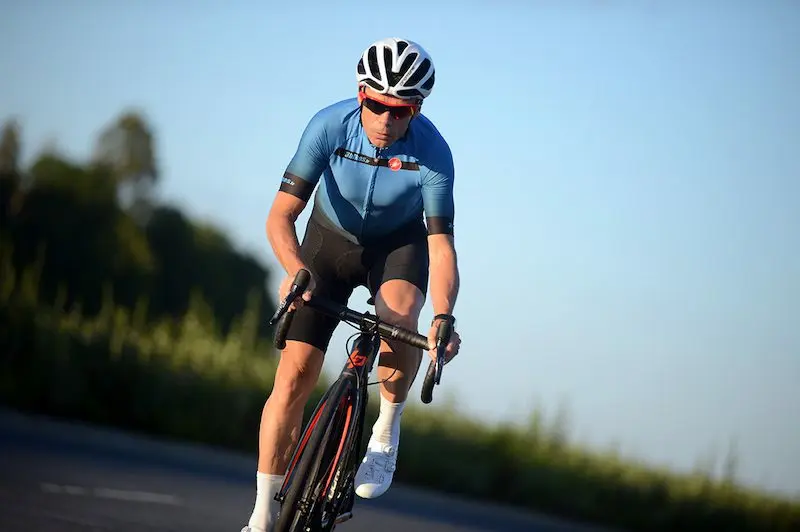
What does it mean to pedal well? First, it means knowing how to use your muscles, and if possible throughout the entire pedaling cycle, that is, both when the pedal goes down and when it comes up. This is no small feat. It requires good coordination.
Secondly, it means making good use of the gears available to you, in a way, the bike’s “gearbox” so that the engine (you) operates at the right speed.
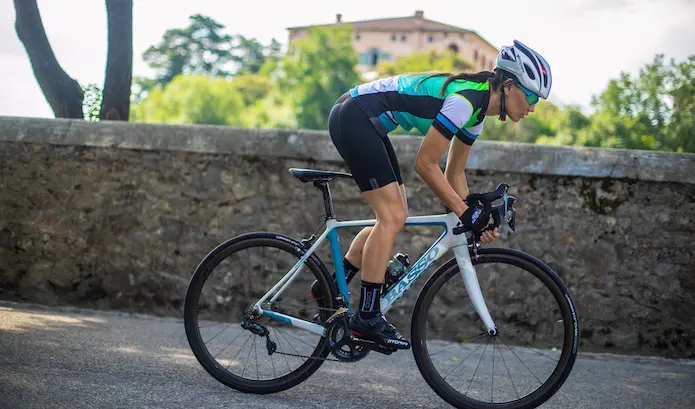
Finally, it means being comfortable with the “out of the saddle” position, which consists of lifting your butt off the saddle and standing on the pedals to accelerate, relaunch, or simply relax. All these gestures and reflexes are natural for those who have been cyclists for a long time, but can be problematic for those who are starting late.
First, the position
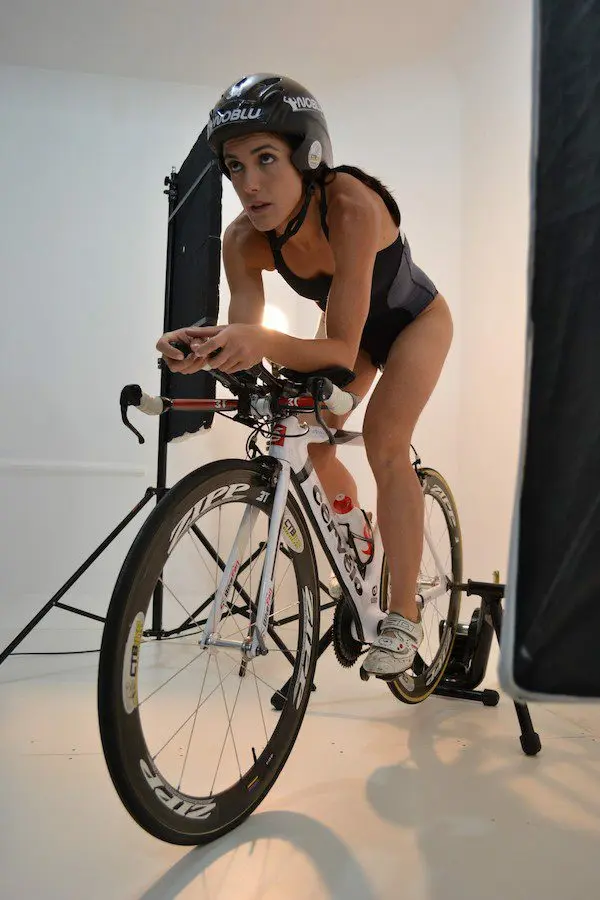
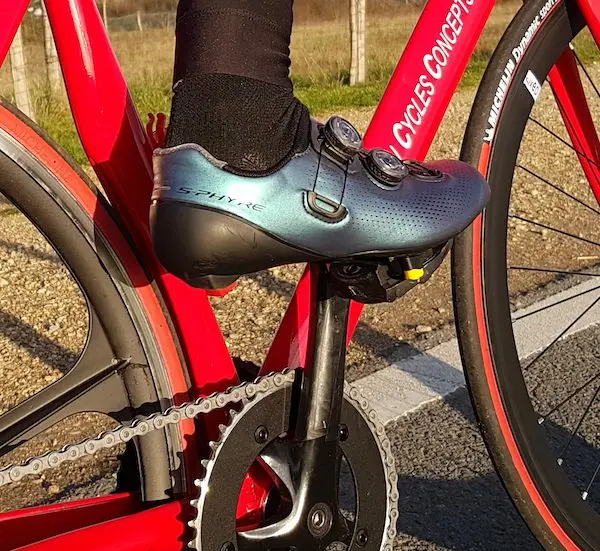
Again and again, but it often needs to be repeated, to pedal well, you must start with a good saddle position. This seems obvious, but this is often where many of the difficulties you may encounter with pedaling technique come from. The saddle must be neither too high nor too low, so that the leg is sufficiently extended to develop maximum force, while leaving the ankle free to rotate around the pedal axle, and without swaying your hips. It is also important to be very precise when adjusting the cleats under your shoes.
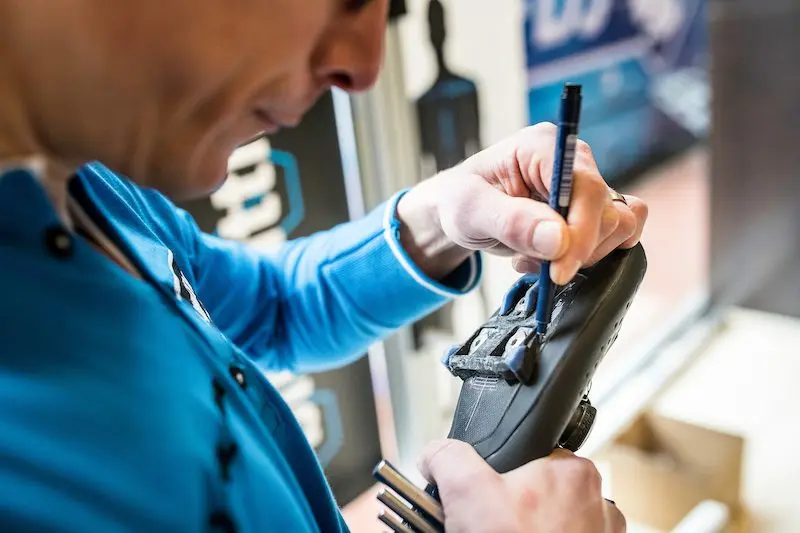
Cleats not only allow you to be fixed to the bike while ensuring a certain safety in case of a fall or an impromptu stop (by simply rotating the ankle outwards to unclip the foot from the pedal), but also to pull on the pedals during the leg recovery phase of the pedaling cycle.
=> SEE ALSO : How to adjust your position on the bike?
We can add an essential element: crank length. Generally, cranks for the crankset are 170, 172.5, and 175 mm, or even smaller or larger. These cranks must be adapted to your height, and therefore to your leg length. The longer the cranks, the more force you can develop with each pedal stroke, but the more difficult it can be to turn them, especially at high pedaling frequencies. Adaptations are possible, depending on your joint or muscular flexibility. But you often have to start with the crankset supplied with the bike.
The pedaling cycle
It consists of four main phases: the pushing phase (between 1 and 5 o’clock if we take a clock as reference), the pulling phase (which is in opposition to the pushing phase of the other leg, so between 7 and 11 o’clock) and finally what are called the top and bottom dead centers of pedaling, when it is necessary to transfer the push to the pull (or vice versa, i.e. between 5 and 7 o’clock, and between 11 and 1 o’clock).
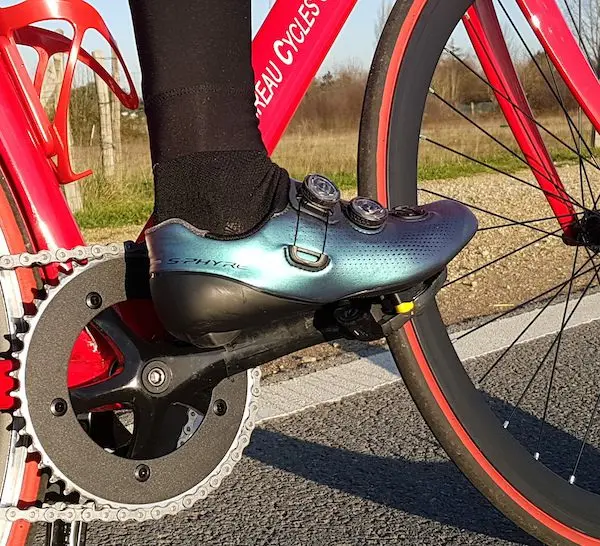
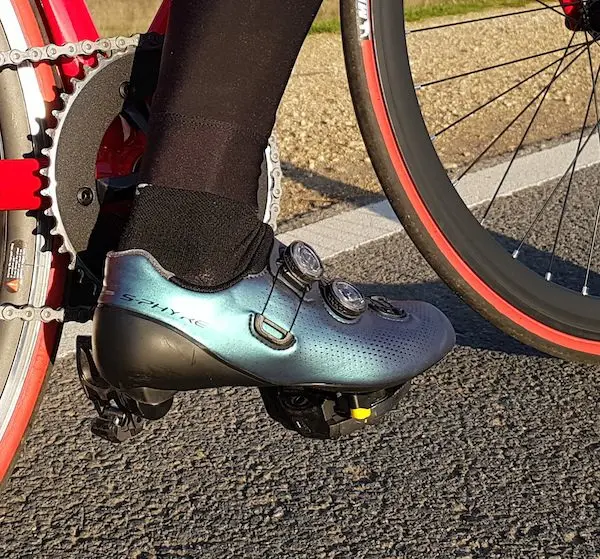
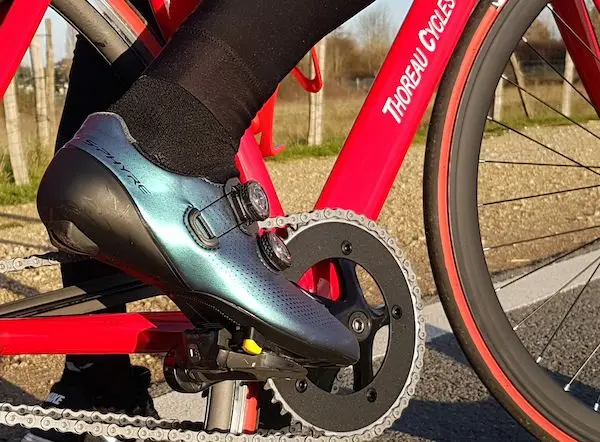
The simplest thing, of course, is to push; everyone knows how to do that. But on the one hand, too energetic a push is very costly in terms of muscle, because the anterior muscles of the leg are loaded with fast-twitch fibers, which are effective but tire quickly, and on the other hand, the weight of the other leg, if it is inert, is often enough to hinder the efficiency of the movement.
Pulling the pedal with the opposite leg at the same time as pushing helps relieve pressure while engaging the posterior leg muscles, which are richer in slow-twitch fibers, and therefore more economical in the long run.
Two drills can help improve in this regard. The first consists of riding alternately for a few hundred meters with only one foot clipped to the pedal. On a slight uphill false flat, you will quickly feel the need to pull on the pedal, or else you will move in jerks. The second consists of breaking down the pedaling cycle into two phases: the first with the left leg pulling at the same time as the right pushes, the second by doing the opposite. This requires having the pelvis well fixed on the saddle (without swaying), and remembering to pull with the top of the foot in the shoe when it is in the bottom dead center phase of pedaling.
For passing the two dead centers, it is facilitated if the cleats under the shoes are well adjusted longitudinally, that is, with the mark aligned with the metatarsal bones, or very slightly behind.
=> SEE ALSO : Price, weight and features, how to choose your pedals?
Choosing the right gear ratio
Bikes are generally equipped today with 11 or 12 cogs at the rear and two chainrings at the front, which should provide a range of gears for riding well on both flat and uphill terrain. Different combinations are possible depending on your level, because the first limiting factor in effort is your power. And this power is not brute force.
=> SEE ALSO : Power in cycling
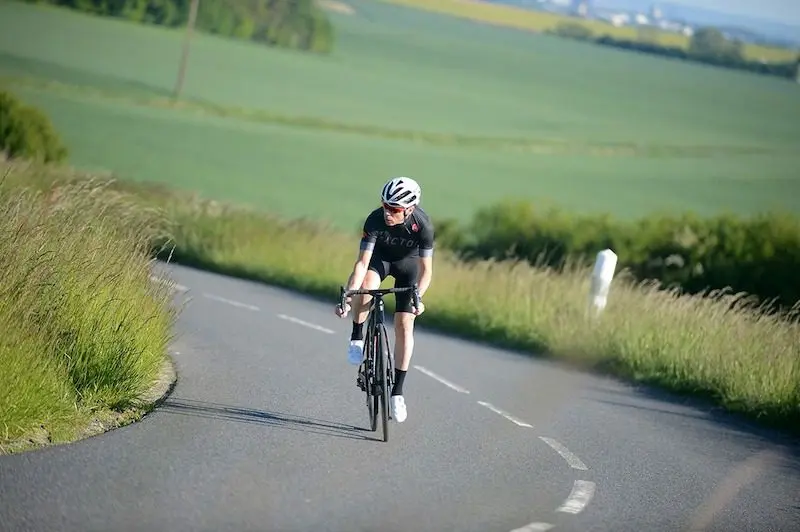
The right compromise for efficient pedaling while allowing muscle fibers to relax between each contraction is around 90 revolutions per minute on the flat, and 70 revolutions uphill. There are cyclists who are more or less agile, who naturally adopt a slightly higher or lower pedaling frequency depending on the circumstances, but this is a general guideline. Power is the force applied to the pedals, multiplied by the speed at which they are turned. And since many are limited in terms of strength gain (by genetics), it is better to maintain a good pedaling frequency. This involves good technique, as we saw above, but also targeted training where you force yourself to pedal very fast with a small gear.
=> SEE ALSO : Why and how to ride with cadence?
Initially, if it’s unusual, you may feel a disconnect with the cardiovascular system, and therefore a feeling of breathlessness. However, a properly trained cyclist sees their heart rate increase with the power they develop, but not with a higher cadence or force developed. On the other hand, over-insisting on force pedaling increases muscle tension, and therefore limits the expression of power in the long term, at the end of a ride for example. To pedal well, you should not hesitate to use the derailleur frequently, in order to constantly stay within the right cadence range depending on the wind or the terrain’s topography.
=> SEE ALSO : How to choose your drivetrain group?
Knowing how to ride out of the saddle
For many novices, riding out of the saddle is strenuous, causes an acceleration of heart rate, or even cramps or soreness in the arms or upper body. In short, it’s more energy-consuming, whereas on the contrary, this posture should allow for greater efficiency for a short time, or to relax to avoid muscle tension. This is due to poor technique and poor preparation beforehand. A cyclist’s body is not just trained legs; it’s also a well-sheathed torso and toned arms.
Hence the need to supplement cycling with gymnastics exercises (Pilates, abs, muscle strengthening, etc.) when starting out, and also to dedicate some time to specific, but not necessarily fast, training sessions.
To be more comfortable out of the saddle, it is necessary to supplement cycling with gymnastics exercises (Pilates, abs, muscle strengthening, etc.) when starting out.
By practicing, for example, climbing several hills out of the saddle, or for several minutes without sitting down, in order to properly record the necessary coordination between the lower and upper body to swing your bike from left to right while taking advantage of your own body weight to press on the pedals. Keeping the pelvis suspended above the saddle allows you to pull on the pedals at the same time as you push them, and only the bottom dead center of the pedal stroke is a little longer than when seated.
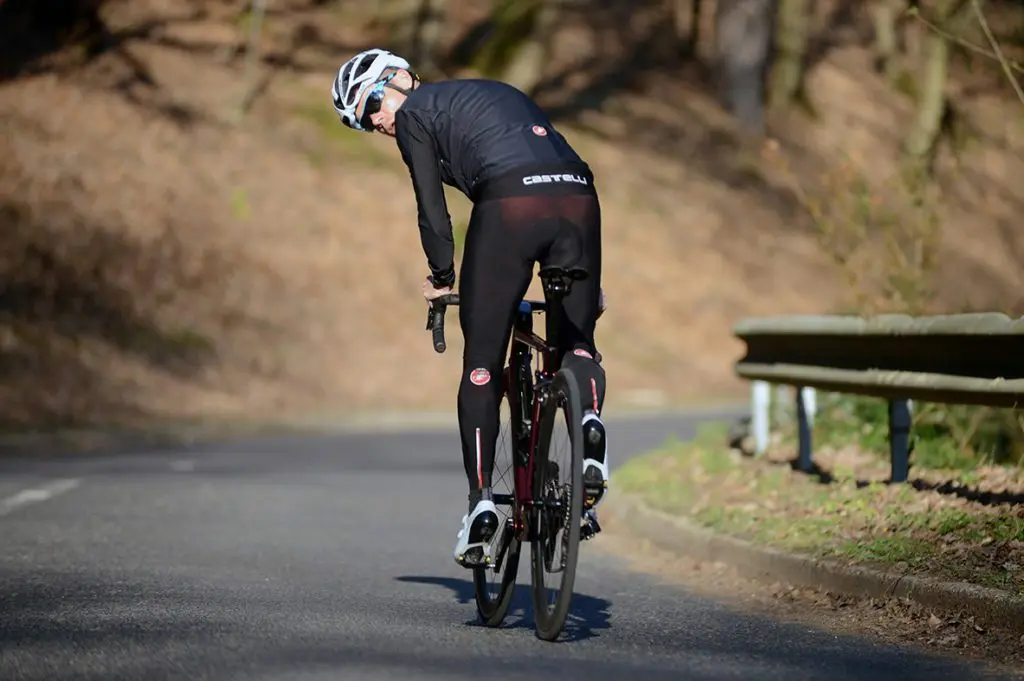
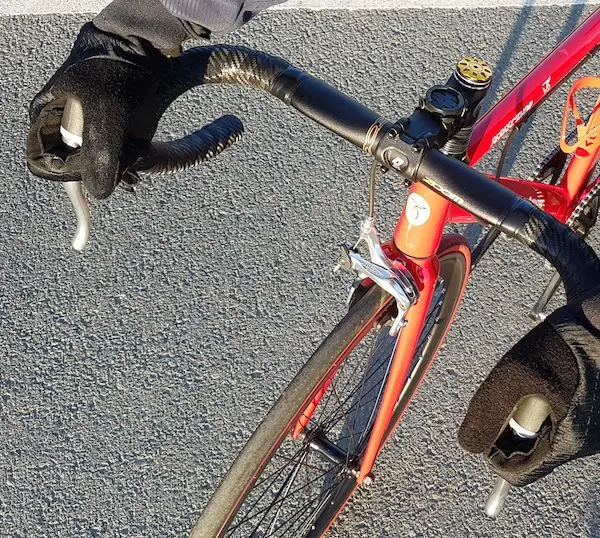
Initially, use a slightly higher gear and adapt your pedaling frequency. Also consider adjusting the handlebar angle and brake levers to find a firm but comfortable grip, with wrists aligned with your forearms. When the movement becomes fluid, there is no increase in heart rate. This is, of course, provided that riding out of the saddle is only used to relax and pedal in a different position. Because if you stand on the pedals to accelerate, to relaunch, or to tackle a steeper slope by taking advantage of the superior explosiveness of the anterior leg muscles, and more particularly the thigh, you will obviously expend more energy.

In short, pedaling well is a sum of details and technical improvements that will ultimately allow you to become one with your bike and fully express your potential. It’s worth the effort.
=> SEE ALSO : All our Coaching articles
Share the post "How to improve your pedal stroke?"