Share the post "Sram Red eTap AXS Groupset Review"
By Guillaume Judas – Photos: 3bikes.fr / All rights reserved
For once, we started with a full test of the latest in the range, the Sram Force eTap AXS, before finally getting our hands on the Red, the American brand’s flagship. It was a matter of opportunity at the time and an occasion for us to ride for a little over two weeks with this groupset, which was introduced just after the Red and has the same features, but with less high-end materials and a lower price.
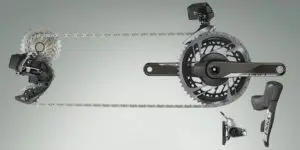
At an official price of €3618 (and €3518 for the rim brake version), the complete Sram Red eTap AXS disc groupset is not cheap. It plays in the same league as the Shimano Dura-Ace Di2 or Campagnolo Super Record EPS, but with different and innovative features. We were finally able to form an opinion on this groupset, which is already very successful with manufacturers (many bikes are offered equipped with it) and consequently with consumers, by riding a bike whose geometry we know perfectly (Pinarello Dogma F12).
=> SEE ALSO: All road groupset weights and prices
What’s new
With eTap technology, Sram had already developed its answer to Shimano’s (Di2) and Campagnolo’s (EPS) electronic transmissions several years ago. The Sram Red eTap already stood out for its ergonomics (a paddle on the right to shift down a cog on the cassette, a paddle on the left lever to shift up, and a simultaneous impulse on both to change chainring), as well as for its ease of assembly due to the fact that levers and derailleurs operated wirelessly. This was already a feat, much appreciated by many users.
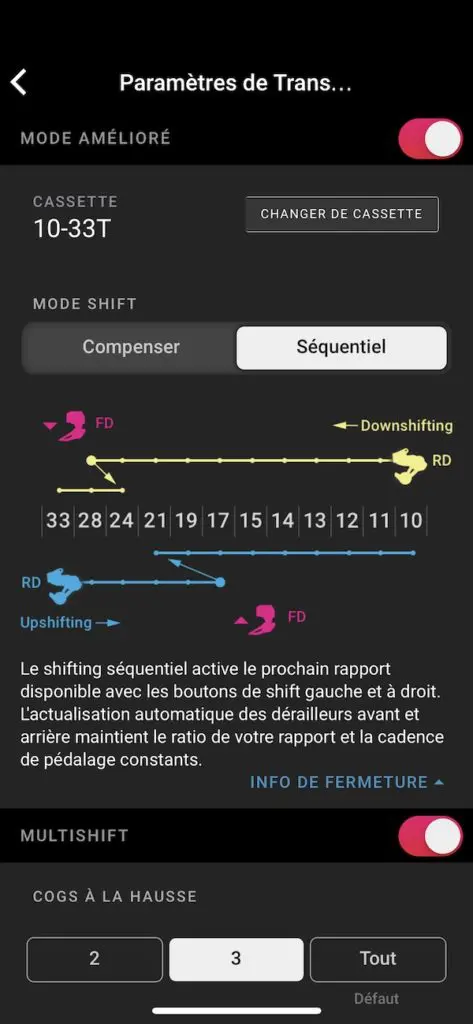
The new Red and Force eTap groupsets retain the same ergonomics for gear changes, but add a twelfth cog to the cassette and an application that allows sequential and compensation modes to be set. As with Shimano’s Synchro-Shift system, it is now possible for the front derailleur to actuate automatically depending on the chain’s position on the cassette, or for the rear derailleur to automatically compensate for the selected gearing when changing chainring.
Many users will, however, be content with a relatively basic operation, but with 12 speeds. Sram did not just add a cog to existing combinations, as the brand took the opportunity to reinvent the range of available gear ratios. First, by adding a 10-tooth cog at the bottom of the cassette, then by reducing the number of teeth on the three chainring combinations on the Red groupset (only two on the Force groupset). The idea here is to slightly increase the gap between the extreme gears, while tightening the differences between each cog.
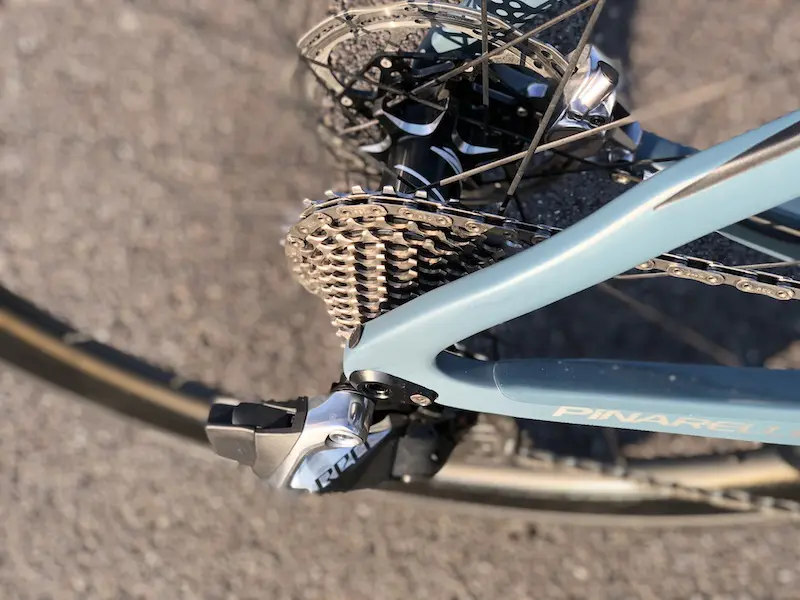
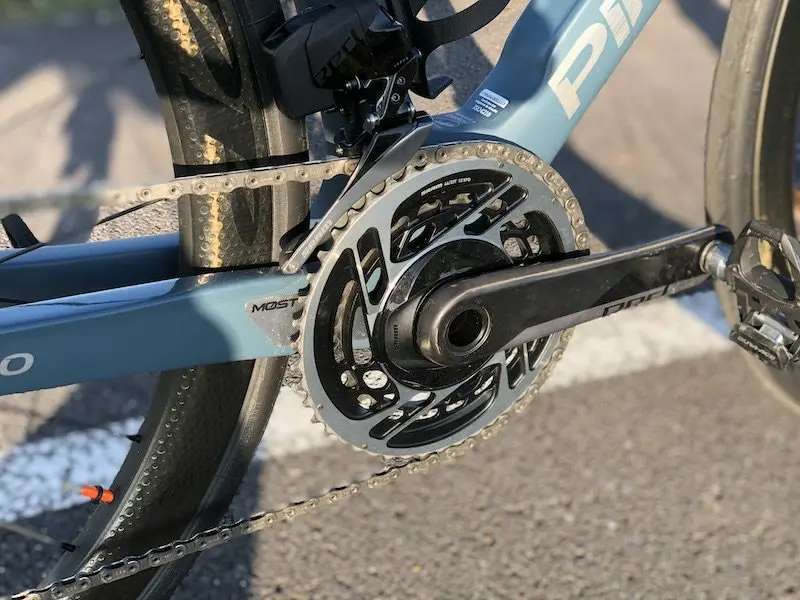
Thus, the Sram Red eTap AXS is available with three chainring combinations (50-37, 48-35 and 46-33) and three different cassettes (10-26, 10-28 and 10-33). But it can also be ridden with a single chainring, whether for road or time trial. In all cases, the gear ratios can be easily calculated by dividing the number of teeth on the chainring by the number of teeth on the cassette. Thus, 50/10 is the same gear as a 55/11, and therefore reserved for pros and even then, only in certain conditions. At the other end of the chain, a 33/33 is a 1:1 ratio, equivalent to a 34/34 from the competition. Enough to climb trees, or at least tackle long, difficult climbs even when physical condition is not at its best. On our test bike, the 46/10 is slightly higher than a 50/11, and the 33/26 is a tiny bit higher than a 34/27. But unlike an 11-speed drivetrain, there are still 14 different ratios between these two extremes (16 in total across the entire drivetrain if overlaps are avoided, compared to 14 or 15 in 11 speeds). Note that a new XRD freehub body is required to accommodate the cassette with a 10-tooth start.
An optimized drivetrain
To ensure smooth 12-speed drivetrain operation, Sram relies on Sram X-Sync chainring technology (with wide teeth paired with narrow teeth for good chain control). Note that all AXS cranksets can optionally be fitted with a Quarq power meter. The new chain has been completely redesigned, with a special link shape to make it both thinner and lighter while increasing its strength.
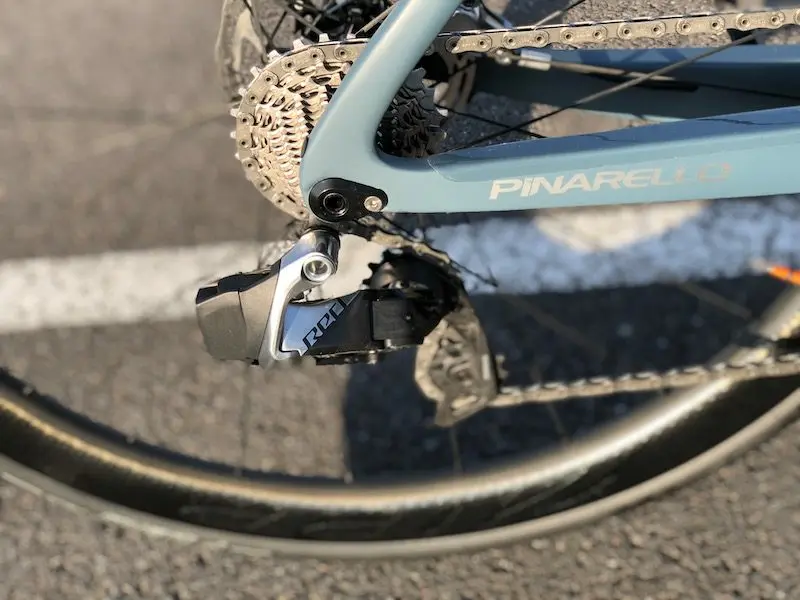
The Orbit chain management technology of the rear derailleur offers secure shifting regardless of the terrain. In addition to faster pulleys, bearings, motors, and communication to improve cog shifting speed, the Orbit system is a kind of hydraulic clutch that provides optimal chain tension, limits friction noise, and minimizes the risk of chain drops.
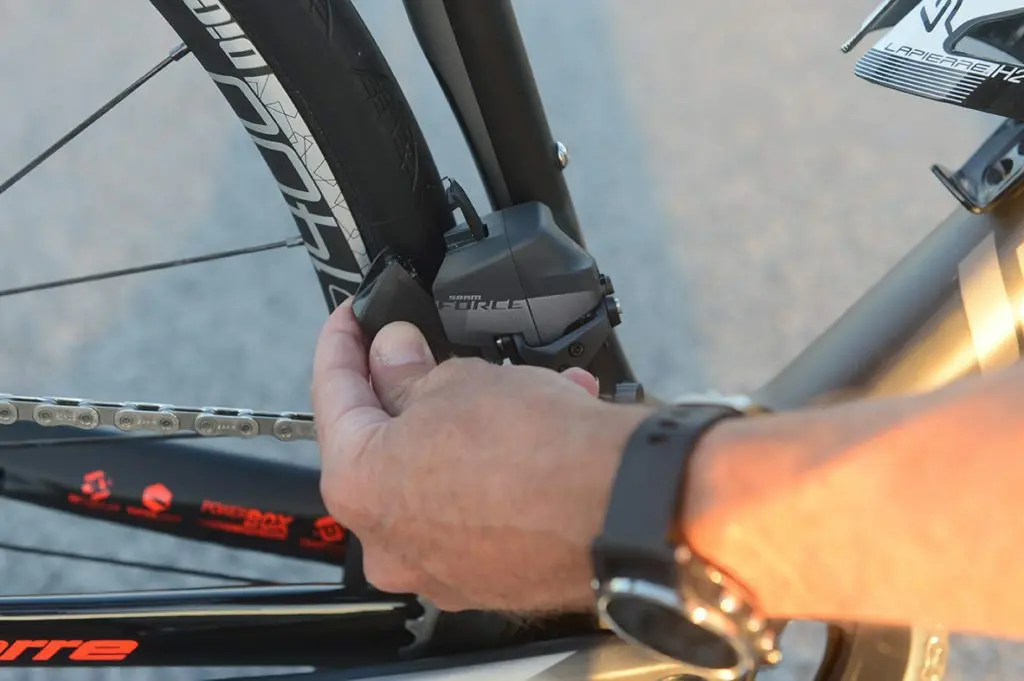
Finally, the front derailleur still benefits from Yaw technology, which is supposed to eliminate the need for micro-adjustment of the cage regardless of the chain’s position on the cassette. It also offers greater clearance at the rear to allow for the use of wider rear tires. Like its rear counterpart, it is compatible with Sram Red eTap 11-speed batteries, which recharge approximately every 1000 to 1200 km by removing them from the bike.
Effective braking
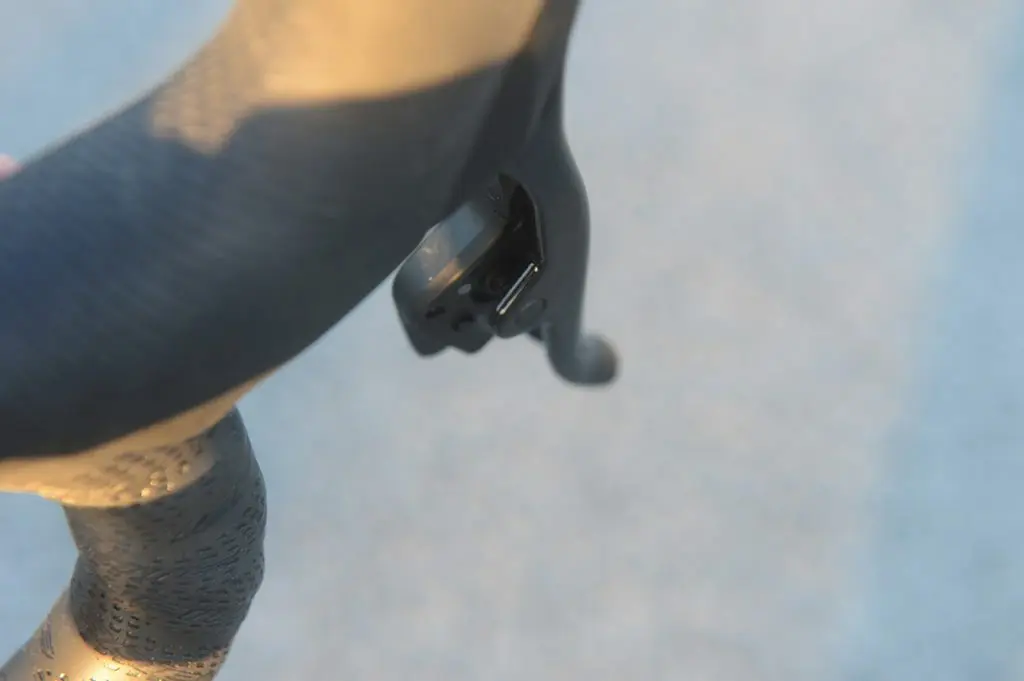
The Sram Red eTap AXS is available for both disc brakes and rim brakes. According to Sram, this is not about to change, as the American brand still wants buyers to have a choice between the two systems. We tested the first version, with levers that are still prominent to house the hydraulic system. But as with the Force groupset, these levers are “customizable,” first in terms of brake lever travel, then in terms of the contact point between the brake rotors and pads (for a more or less direct feel), and finally in terms of the action of the shift paddles, which can be reversed, for example, via the very easy-to-access AXS application.
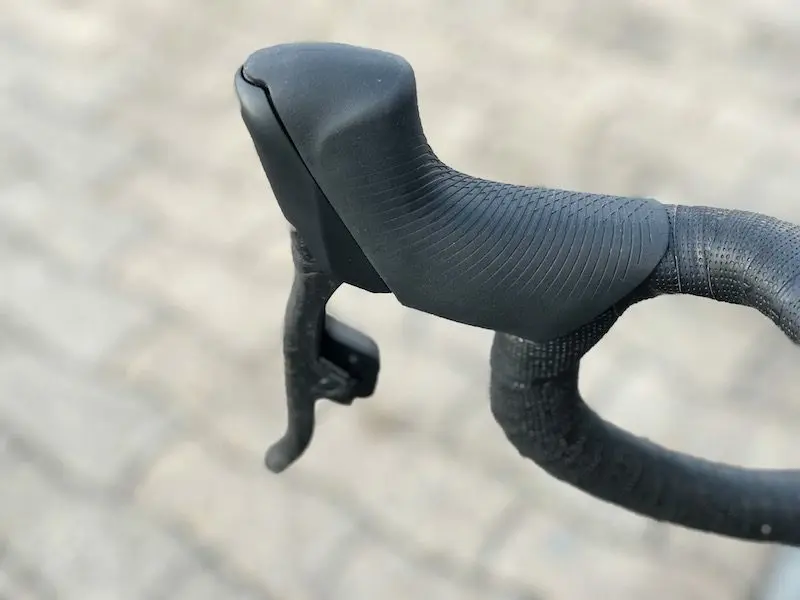
Despite a revised rubber texture for comfort and grip, the Red AXS levers still have the same flaw as the Force AXS, namely a plastic and sharp part at the actuation mechanism, where the index finger rests when gripping. This is uncomfortable and can even be painful depending on the circumstances.
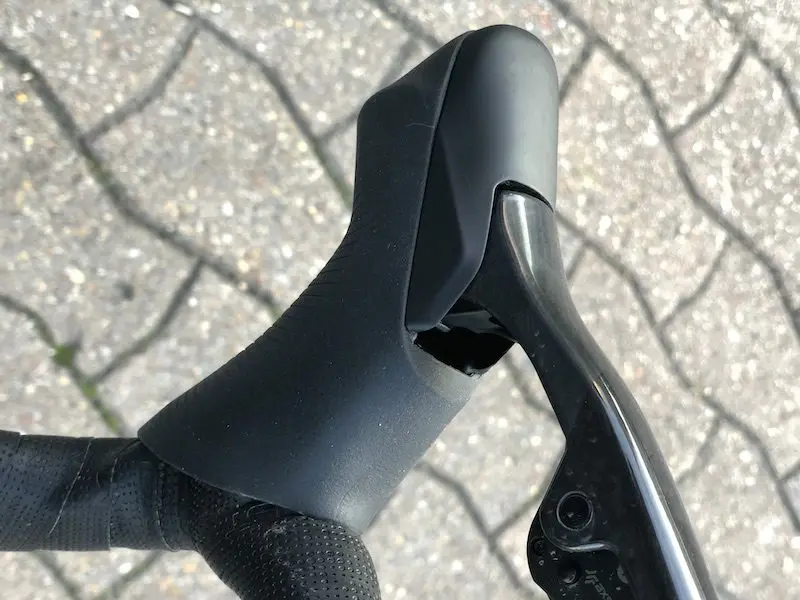
Regarding the brakes themselves, these are monobloc calipers, available in Flat Mount or Post Mount versions. The brand’s new flagship also benefits from a new Centerline XR rotor for theoretically quieter braking with a new braking surface and a more aerodynamic profile.
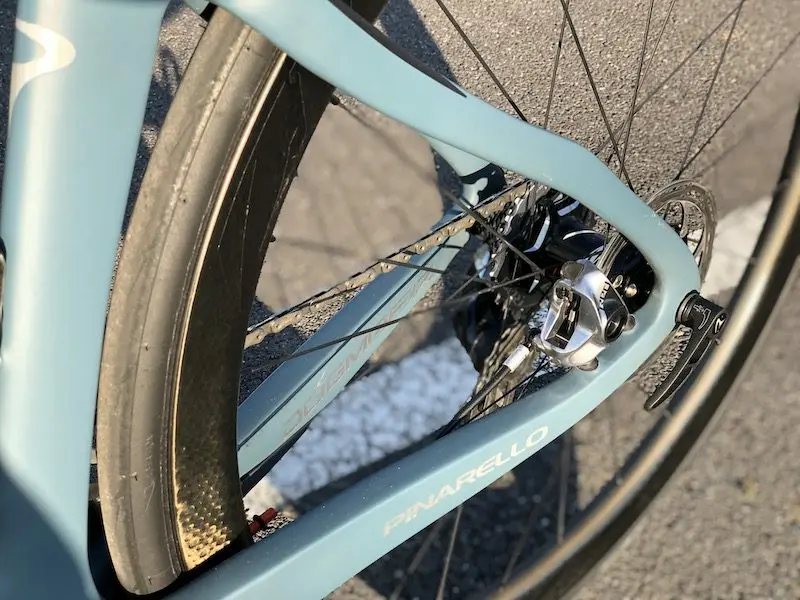
Rotors are of course available in 160 and 140 mm. The 160 mm version is often mounted on Sram-equipped bikes, but on our test bike we benefited from two 140 mm rotors, theoretically less powerful than 160 mm but which also limit the risk of wheel lock-ups.
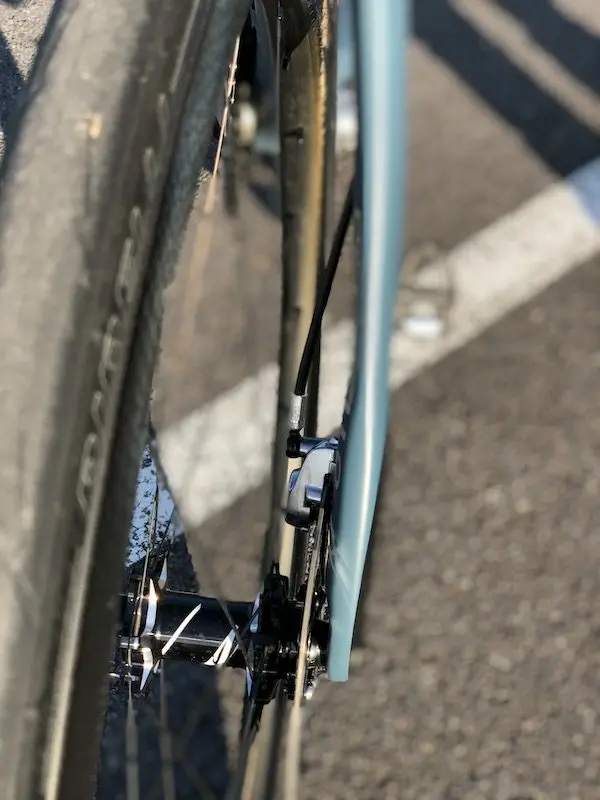
Mounted with two Torx screws, the calipers are not easy to adjust. During our first contact with the bike, we had to remove both wheels and put it in the car trunk. When we took it out, we noticed that the pads had tightened a bit in the calipers and that the front had moved. It took us a good hour to get everything back in order, finding the right trick to avoid friction when not braking.
On the road
Fortunately, this rubbing seemed to disappear after a few hundred meters on the road. Mountain bikers might retort that road cyclists are too picky or too obsessive, but we shouldn’t forget that we’re riding a €13,000 bike for the occasion! And that the first impressions lead us to believe that we’re overcomplicating things for not much. Especially since the braking, here with 140 mm rotors, let’s remember, is not excessively biting. Let’s say that on dry roads, it’s on par with good rim brakes. The lever action is quite firm, however, and we can clearly feel the pad contact point, which we believe allows for the best modulation.

However, it’s once in the cold rain that you fully appreciate Sram disc brakes, which offer performance equivalent to what you experience on dry roads. Braking distances therefore seem much shorter than with rim brakes in the same conditions. It’s truly reassuring. This choice of diameter is ultimately a very good point for us, at least with our weight (less than 60 kg) and for use outside of mountainous terrain.
This type of braking in the rain also avoids the grinding noise between the pads and the rim, as well as rapid wear of the latter. Nevertheless, other rather unpleasant noises quickly appear, with sand getting between the pads and the rotors, and a rather loud squealing of the brakes, still in the rain. It takes several hundred meters the next day and on dry roads for everything to clear up.
In terms of the drivetrain itself, there are no complaints about the speed of gear changes. Some talk about a difference with Di2, but frankly, that’s not our view. It’s fast, always precise, and maintaining pressure on the paddles allows you to sweep through the entire cassette. On the other hand, it’s difficult to avoid chain rub on the front derailleur cage in extreme cross-chaining. From the second-to-last cog on the cassette, it touches, and it gets worse on the last one. And there’s no adjustment possible to improve things, at least while riding.
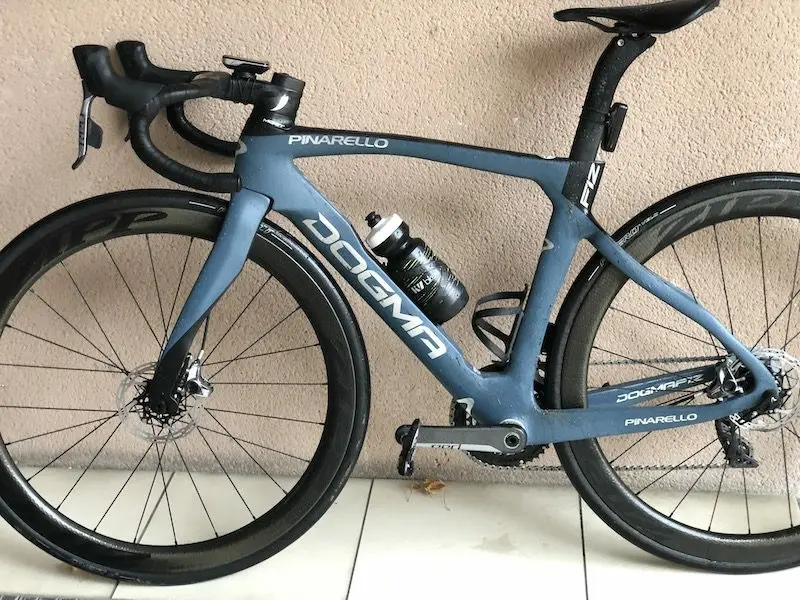
Regarding the gear combinations, the tooth-by-tooth progression of the first eight cogs should not overshadow the enormous difference felt between the 10 and 11-tooth cogs, which creates a significant gap even with a “mere” 46-tooth chainring. This is surely a matter of getting used to it, and especially regarding gear management when riding in a group, as you always find yourself slightly out of sync with your riding companions. However, you quickly appreciate using the 46-tooth chainring almost like a single chainring, at least in our hilly, but not too hilly, region.
This groupset is the lightest high-end electronic disc brake groupset.
There is still some noticeable friction, which is quite unpleasant again, as soon as you move away from the chainring axis. Basically, the drivetrain seems fluid from 14 to 21 (on the 10-26 cassette), but snags a bit, rubbing on the cage on the 23 and 26, and completely lacks fluidity below 15. It’s as if the chain is always a bit dry and lacks oil. There is no doubt that the small cogs do not favor the best chain wrap and the best efficiency, but we attribute this general feeling to the Orbit retention system, as we had already experienced similar sensations on an 11-speed Force 1x drivetrain with a derailleur that had strong retention to limit chain drops.
This high-end groupset thus offers many interesting features, and it is also the lightest high-end electronic disc brake groupset. A great performance that undoubtedly contributes greatly to its success, even if we regret some finishing details (on the levers), noisy braking in the wet, delicate adjustments, and a chain that seems to lack a bit of fluidity.
| SRAM RED ETAP AXS DISC |
| Rating: * Pros : 12 speeds, braking in the rain, fast gear changes, removable derailleur batteries, easy-to-access AXS application for settings, gear range
Crankset available in 165/167.5/170/172.5/175/177.5 mm. Chainrings available in 46-33/ 48-35/50-37. 12-speed cassette available in 10-26/10-28/10-33. Crankset with Quarq power meter option (+ €500). Single chainring option (36, 38, 40, 42, 44, 46 and 48/50 aero) and aero mounting (approx. -400g and -€400). |
| Contact: sram.com |
=> SEE ALSO: All our Gear articles
Share the post "Sram Red eTap AXS Groupset Review"