Share the post "Riding faster by being more aerodynamic"
Aerodynamics is at the heart of manufacturers’ concerns, both for equipment and apparel. The same should apply to all riders, cyclists or triathletes, who want to ride faster for the same energy expended. Here’s why.
By Guillaume Judas – Photos: Tino Pohlmann – Swiss Side / Shimano / @3bikes.fr
Immenstaad an Bodensee, in the very south of Germany, on the shores of Lake Constance and a stone’s throw from Switzerland and Austria: this is where the Airbus “wind tunnel” hosts Swiss Side regularly for testing and development sessions. The company specializes in aerodynamic research, particularly in Formula 1, as Jean-Paul Ballard, its co-founder, worked seven years at Sauber. According to him, the approach is identical with cycling. Moreover, Swiss Side offers its own range of carbon wheels, intended primarily for triathletes and time trial rouleurs.
Swiss Side has also collaborated with Cube and Pinarello on the design of bikes that have distinguished themselves at the Ironman World Championship in Hawaii in recent years. Or with Team Ineos, both for rider positioning and for fine-tuning equipment choices. Swiss Side also works with DT Swiss, a dynamic brand in the specific field of wheels, with the aim of jointly researching the last details that can make a difference in terms of both performance and bike control. Note that while we were able to witness advanced tests in Immenstaad an Bodensee, other wind tunnels exist and are used in the same way by other brands, with the aim of improving the performance of positions, outfits, helmets, bikes, and wheels. Because if you have to make compromises depending on your practice, it’s by accumulating a sum of small gains. “Marginal” as the Ineos team managers would say…
Beyond received ideas
Over an entire mountain course, aerodynamics is more important than weight for saving time. According to Swiss Side, if you compare two pairs of wheels (one aerodynamic at 1700 g, the other light at 1200 g) over a 276 km course with 7031 m of elevation gain, the gain would be 4’50” in favor of the aero wheels, for an average cyclist power of 200 watts. Still according to Swiss Side, aerodynamics would be preponderant over weight below a 7.5% gradient for a professional, while the limit would be around 4.5% for an average sportive rider. We could also talk about a speed of around 19-20 km/h.
To be convinced that air resistance is already significant at these low speeds, one only needs to observe the tactics of pro riders in climbs when they benefit from the shelter of their teammates, or that of very high-level marathon runners, who run in a pack on foot. And if in the bike industry all measurements are taken at 45 km/h, the time saving is even more significant at lower speeds because you spend more time on the bike. Amateurs are therefore the primary beneficiaries of aerodynamic gains, contrary to popular belief.
The weight of the wheels in the measurement
In terms of aerodynamic drag at 45 km/h, 75% of the resistance comes from the cyclist on their bike, and 25% from the complete bike, including 8% for the wheels and even 6.4% for the front wheel alone. Between 45 and 50 km/h, nearly 90% of the power developed by the cyclist is used to cut through the air. It is therefore of course the cyclist’s position on their bike that must be prioritized, but also their outfit.
In terms of position, a gain of up to 70 watts at 45 km/h can be observed between two extremes (between hands on the brake hoods and a triathlete’s position with extensions), for an athlete of average build. For the outfit, a difference of up to 10 watts can be observed between a fitted jersey and a slightly looser outfit, with even greater gains with the wearing of a skinsuit (but which is not always practical depending on the case). Finally, a gain of 10 to 15 watts can be expected between a ventilated lightweight helmet and a time trial helmet.
Then there’s the equipment, with an average of 17% aerodynamic resistance at 45 km/h for the bike without the wheels. Between a frame with aerodynamic tubes and integrated cables and a round-tubed mountain-type frame, count up to 30 watts difference, still at 45 km/h. For a cockpit, it can be a matter of 5-6 watts, or 3 watts with or without exposed cables in front of the head tube, and even 3 watts there too with disc brakes compared to rim brakes.
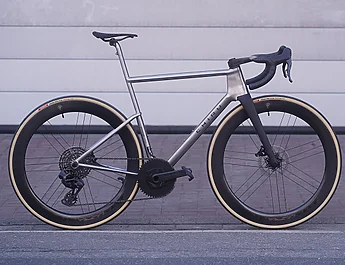
Wheels are a bit like the icing on the cake. The gains are relatively small compared to what is announced above, especially if you consider the necessary investment. We are talking about 10 watts of gain between basic low-rim wheels and very aerodynamic wheels. There is always an interest in gaining a few watts here, but without forgetting the primary function of the front wheel, which is to steer the bike. The work of Swiss Side and DT Swiss shows that in a headwind, 48, 62, and 80 mm deep rims are equivalent in terms of aero drag. But the more you face the wind at an angle (which almost always happens), the more high rims gain the advantage because they create what is called negative drag. A “sail effect” in other words, which pushes the cyclist and helps them ride faster.
The more you face the wind at an angle, the more high rims gain the advantage because they create what is called negative drag.
The cyclist must also contend with a crosswind, and therefore constantly correct their trajectory more or less. This is all the more sensitive the deeper the wheels are. Swiss Side therefore looked at the power losses incurred by these small corrections: when you instinctively sit up to control an unstable direction, you lose watts and concentration each time. How to reconcile the sail effect that boosts performance and these jerks in the steering that are, on the contrary, counterproductive? Precisely by working on the stability of the wheel as much as on its drag. This results in numerous details such as the profile, width, and depth of the rim, the number and shape of the spokes, or the integration of the spoke nipples, with the goal not of annihilating the lateral thrust of the wind (which is impossible), but of making the wheel’s reaction progressive and predictable.
Wheels must evolve to face two types of aerodynamic resistance, transverse and rotational. According to Jean-Paul Ballard: “up to 25% of a wheel’s resistance comes from this ‘rotational drag’, and no one until now has been interested in this area. Deeper wheels reduce this resistance (-0.27 watt between 80 and 48), as does a 23 tire compared to a 25 (-0.3 watt) or integrated spoke nipples (-0.5 watt).”
Tire width also studied
Most modern wheels are now only available for tubed or tubeless tires. Not only is customer demand for tubulars extremely low, but tires are now more efficient in terms of rolling resistance and aerodynamics than tubulars due to the tubular shape of the latter and the transition between the tire and the braking surface. If pros still ride tubulars, it is only because this type of tire is less dangerous in a peloton in the event of a puncture, and they allow riding a few hundred meters on the rim while waiting for assistance, which a tire does not allow.
Many modern wheels have an internal width of 19 to 21 mm to accommodate 25 to 28 mm tire widths. A large tire width seems favorable in terms of rolling resistance and comfort, at least below 35 km/h. Above that, aerodynamics takes over, and it is with a 23 mm tire at the front and a 25 at the rear that the best aero-efficiency-comfort compromise is found, made possible with wheels that have an internal width of 17 mm. This is why not all wheel manufacturers offer all their models with very wide rims. Because while a wide rim is more stable, it ultimately “costs” energy beyond a certain width and speed of travel.
Tire designs have also been studied by Jean-Paul Ballard’s team, with a preference for Continental Grand Prix 4000 S II tires, which are the most aerodynamic models tested by Swiss Side.
A sum of details that ultimately matter
The choice of rim depth depends on the terrain and external conditions, depending on the importance given to weight or speed. Still, well-designed wheels are studied in every detail, as is the rest of the cycling equipment when it has a performance goal. For example, at DT Swiss, the entire ARC 1100 Dicut range is equipped with slimmed hubs to reduce aero drag (gain: 0.4 watt). Disc models are equipped with thru-axles from which the lever can be removed (gain: 0.9 watt). DT Aerolite spokes save 1.5 watts compared to round DT Champion spokes, because they are elliptical and symmetrical at the hub, and asymmetrical at the rim. Tests that we were able to witness live and which show the engineering required for the development of high-end equipment. And a search for the smallest detail to go very far in improving performance.
=> SEE ALSO: All our Gear articles
Share the post "Riding faster by being more aerodynamic"