Share the post "Kask Utopia Review"
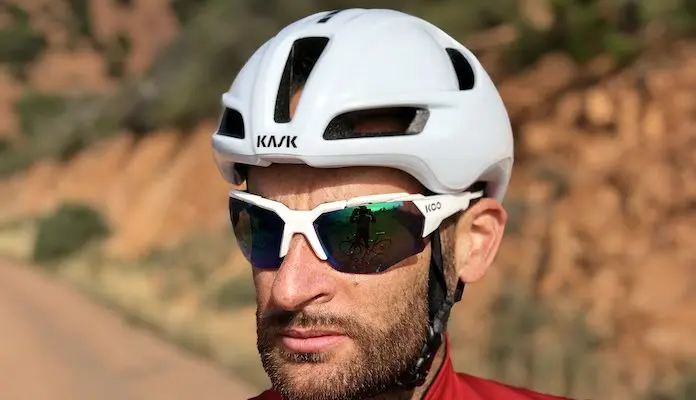
Developed with Team Sky (now Ineos) riders, the Kask Utopia helmet is claimed to be one of the most aerodynamic road models on the market, while remaining lightweight, airy, and comfortable. We tested a helmet that could save up to 6 watts at 50 km/h.
By Guillaume Judas – Photos: @3bikes.fr

Among the high-end models from the Italian brand Kask, the Utopia is on par with the Valegro and the Protone, even if it is slightly more expensive to buy. The Valegro is a very light and highly ventilated helmet with 37 vents, while the Protone is the versatile model in the range. Designed in collaboration with the riders of the team specializing in marginal gains (Team Sky, now Team Ineos), the Utopia is intended for flat courses where aerodynamics are paramount. This category of helmets has been very successful in recent years, both on the road and in triathlon, especially when one realizes the energy savings possible with this accessory.
To create the Utopia, Kask claims to have based its design on the shape of the ten best aerodynamic helmets on the market, before recreating them in 3D for computational fluid dynamics (CFD) simulation. The different models were then tested at various speeds and angles, before arriving at the final shape of the Utopia, which is supposed to be more energy-efficient by up to 6 watts at 50 km/h.

We can already hear you smiling and thinking that 6 watts, especially at that speed, is almost nothing. Except that these “marginal” gains can accumulate with others, and ultimately, with the same training and physical abilities, you can ride really faster by adopting the right equipment. And if your average speed is lower, you certainly gain fewer watts, but you ultimately save more time over the same course, because you spend more time on the bike. It’s mathematical.
With the same training and physical abilities, you can ride really faster by adopting the right equipment.
Of course, since we don’t have the means to verify Kask’s figures, we have to fully trust the brand on this point. And to test the other more visible characteristics of the Utopia.
A light weight
At 244 g in size S, the Utopia is barely heavier than the Protone in the same size (220 g) and slightly above the Valegro (186 g). But it remains light for an aero helmet whose ogive-shaped profile and limited number of openings are not conducive to weight saving. Once on the head, the difference is completely invisible from this point of view anyway, and is not an argument when choosing.

There are nine air inlets, to circulate air over the head. Their placement and orientation promote air movement over the skull, to prevent overheating in unfavorable weather conditions. The ventilation is sufficient at high speeds to be noticeable even when it’s cold. Below 10°C, a cap or skullcap is necessary to avoid getting cold. We are far from true time trial helmets which can be real pressure cookers in certain conditions.

Inside, the helmet features breathable and quick-drying padding, with a 5mm layer of a material called Resistex, designed to wick moisture away from the head and move it towards the shell. Based on activated carbon, this material offers various features such as dispersion of static electricity accumulated in the environment during effort, skin friendliness, protection against bacteria and allergies, and assistance in maintaining temperature.

For head placement, the Kask Utopia benefits from several adjustment systems. First, there’s a micrometric tightening dial for occipital retention (Octo Fit). This retention can also be adjusted in height using a rod over 5 cm long with 26 notches. Additionally, on each side of the dial, two supports are adjustable via three other notches. They position themselves at the base of the skull to stabilize the fit regardless of head shape. Finally, there are two independent straps that are not length-adjustable. However, the hypoallergenic and washable eco-leather chin strap allows for adjusting the tightness under the chin. These features are common to the Valegro and Protone, and contribute significantly to the success of these Made In Italy helmets, with their impeccable finish.

Available in white, orange, black and red and several variations of black, the Utopia, however, lacks a bit of “character” in the white version, especially when viewed from the side, where it almost appears too understated from our point of view. A purely subjective observation.
Fast and versatile
Even if we couldn’t test the Kask Utopia in very hot weather, our training conditions in recent weeks have been varied enough to get an idea of its comfort and ventilation level. On the head, the helmet’s positioning seems a little less natural than that of the Protone used almost daily, probably due to the wide central channel intended for air circulation, and above which the two long Resistex foams rest. In short, the first contact is not as “soft” as with the Protone, especially with very short hair.

Nothing to say about the sizing, nor the occipital retention, which is flexible and adaptable enough to suit all head shapes. You can even slip a cap or skullcap underneath to combat the cold, and adjust the helmet by loosening the Octo Fit or adjusting its height. The synthetic leather chin strap, however, is a little more difficult to loosen because it’s stiffer than a simple strap. And while it’s much higher quality than most helmet straps on the market, we note that it’s a bit difficult to keep it flat against the neck, due to the stiffness induced by the buckle. This characteristic isn’t really bothersome on a Protone or a Valegro, but it’s more annoying on an aero helmet like the Utopia, knowing that a flapping strap can ruin everything in terms of aerodynamics.

On this point, it’s impossible for us to verify the data provided by Kask. But the helmet still seems to help you cut through the wind, and without any parasitic noise. The ventilation is very good… provided you ride fast. In these conditions, you can really feel the air circulating over your head, which even requires wearing a cap when it’s cool, as we mentioned earlier. However, at low speeds below twenty degrees and during a slow climb, the Utopia is less ventilated than a helmet designed for that purpose, that’s obvious. You gradually feel less ventilation or “breathing” and the helmet quickly appears heavier than it is.

And it’s also in these particular conditions that it may be necessary to move your glasses away from your face, to avoid sweat in your eyes or falling inside the lenses. With many helmets, it’s easy to place the arms of your glasses in the ventilation holes to hold them during the climb. But not here, where this Kask Utopia cannot accommodate the arms of glasses on top, whether they are Rudy Project, Oakley, or even Koo brand glasses, from the same company as Kask.

This is not a deal-breaker, but it does limit the Utopia’s scope of action a little. This helmet is intended for competition or fast training on flat or slightly hilly terrain. If you are a sportive cyclist planning to climb Alpe d’Huez next summer, there are other more suitable models from the Italian brand for that.
| KASK UTOPIA |
| RATING: ***** Pros : aerodynamics, adjustment, finish, versatility In-Molding construction |
| Contact: www.kask.com |
=> SEE ALSO: All our Gear articles
Share the post "Kask Utopia Review"