Share the post "5 mistakes to avoid when training on an indoor trainer"
The indoor trainer is a good fallback solution when the weather is bad or the days are too short. It can even be fun and motivating when you subscribe to apps like Zwift or Bkool. But excessive use exposes you to a number of disadvantages detrimental to progress and performance.
By Guillaume Judas – Photos: Tacx / DR
| WHERE TO FIND AN AVAILABLE INDOOR TRAINER? Manufacturers and importers are struggling to meet the enormous demand for indoor trainers, especially during this lockdown period. Nevertheless, we have found a few devices still available for you:
|
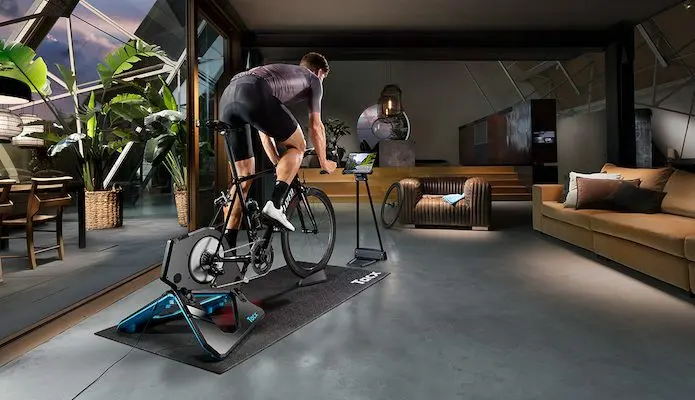
The indoor trainer is one of the essential tools for those who are taking charge of their physical condition or progress. It is especially helpful for all those who cannot get out during the day in winter, and who have no other solution than to pedal indoors in the evening. But doing too much would be a mistake. Here’s why.
- Riding the indoor trainer too often
Pedaling in place is nothing like a real ride. First, because on an indoor trainer, there’s no coasting, no scenery, and no traffic. The session therefore seems much longer. And since an endurance ride on the road can never truly be replaced by an indoor trainer session, the only way for it to be effective is to schedule specific exercises. These are most often performed in an uninspiring environment: in the evening or early morning, in the basement or garage, with dim light, or indoors in the house or apartment but with too high a temperature.
Riding too hard without experiencing the sensations of efficiency on the road is very taxing on long-term motivation.
Riding too hard without experiencing the sensations of efficiency on the road is very taxing on long-term motivation. When managing a season, it’s a bit like having a bag of 100 marbles. Each time you impose something morally difficult on yourself, you lose marbles, but you recover them fully or partially when you have satisfactions. This could be a rest day, a good meal, a ride with friends, or climbing a hill faster than the previous time. By pushing yourself too hard morally and physically, you’re worth nothing when confronted with the reality of the terrain. Because the idea is to keep marbles in the bag until the end of the season.
=> SEE ALSO: 8 indoor trainer workouts
- Riding the indoor trainer for too long
Pedaling in place and indoors does not provide good ventilation and causes heavy sweating. Up to one liter per hour, while the body cannot assimilate more than half that amount of liquid in the same time. You therefore find yourself in a state of dehydration. But not only that, because with sweat, you also lose a lot of minerals. Their lack can lead to fatigue, cramps, or other dysfunctions. Also, muscular or tendon injuries, which can make your life miserable for many weeks. A fixed position on the saddle can also cause perineal injuries. The minimum is therefore to hydrate with an isotonic drink (which improves the assimilation rate) and an energy drink with vitamins and minerals during and after the session. A well-conducted session can last from 40 minutes to a maximum of one hour. A longer and exceptional session can be considered, but you must weigh its benefits against the risks involved.
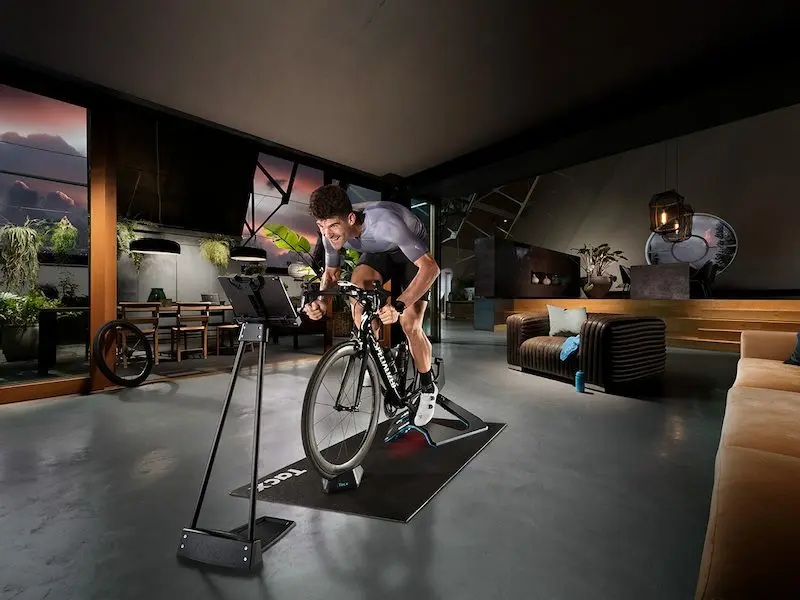
- Imposing too difficult a workout
Exercise series, cardio, watts, it’s all good, but in small doses. If your training is based only on intensity, since endurance is not really worked on an indoor trainer compared to the road, you won’t progress. Added to the factors mentioned above, you sink into a state of permanent fatigue, and moreover, you work in conditions that are far from optimal. Many cyclists impose a grueling indoor trainer workout on themselves in winter, with intensities that no pro would want, and especially without the necessary endurance training. The result: they don’t exceed the level of a Pass’Cyclisme rider.
Instead, consider practicing other complementary activities as long as you cannot do sufficient road training.
Instead, consider practicing other complementary activities as long as you cannot do sufficient road training. Don’t hesitate to shift your preparation and focus instead on developing your athletic abilities before your cycling ones, by running, swimming, with gym or strength training, team sports, in short, anything that can be practiced at night or when the weather is bad, without getting stuck in a predictable pattern. And if you fear humidity and cold for weekend rides, equip yourself with a mountain bike or a gravel bike instead. You’ll come back dirty, but you won’t be cold.
- Pushing too hard on the indoor trainer
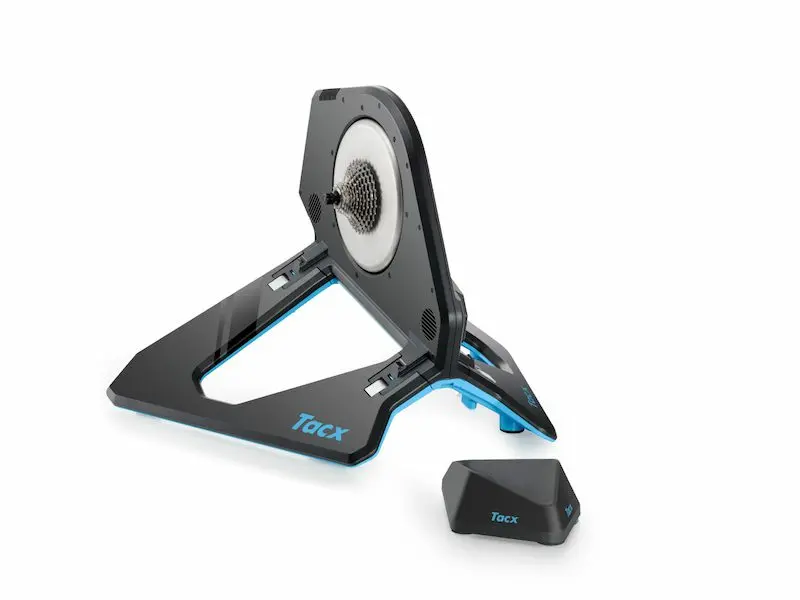
Depending on the type of device you use, it can damage or even break your bike. This is because too violent an effort in terms of strength or power subjects the frame to stresses that do not exist on the road, and for which it was not designed. Sweating can be very corrosive to the bike, especially around the cockpit. Clothing, shoes, and heart rate belts can also be damaged by prolonged exposure to sweat. The best solution is to keep an old bike for indoor trainer use, or to stick to sub-maximal intensities.
=> SEE ALSO: How to choose an indoor trainer?
- Expecting too much from indoor trainer practice
The indoor trainer is only a last resort for road or mountain biking. Devices where the rear wheel is fixed do not faithfully reproduce the movements of the bike on the road or trails. And that changes a lot of things on a muscular level. Thus, when doing strength training on an indoor trainer, the legs only have to endure longitudinal stresses, but not lateral ones as is the case on the road where you also have to more or less steer the bike. In terms of cadence, it’s the same thing since the pelvis doesn’t have to take into account the oscillations of the machine. Rollers remain the best way to reproduce the balance and movements of the bike as faithfully as possible. But they make it difficult to apply certain types of training, such as high cadence or strength. In short, rollers allow you to maintain a very good pedal stroke, but are not enough to progress between two road rides. Moreover, since they practically prohibit riding out of the saddle, you can quickly experience perineal discomfort.
Some people use indoor trainers hoping to lose weight: this is just an illusion!
Some people use indoor trainers hoping to lose weight: this is just an illusion! In reality, you need to burn about 8600 Calories to lose one kilogram of fat (the equivalent of a bottle of oil). A normally active person burns between 2000 and 2500 Calories per day, and a Tour de France rider between 3000 and 5000. But that’s without counting the intake of that same day. However, to lose weight, the balance between input and output must be in deficit.
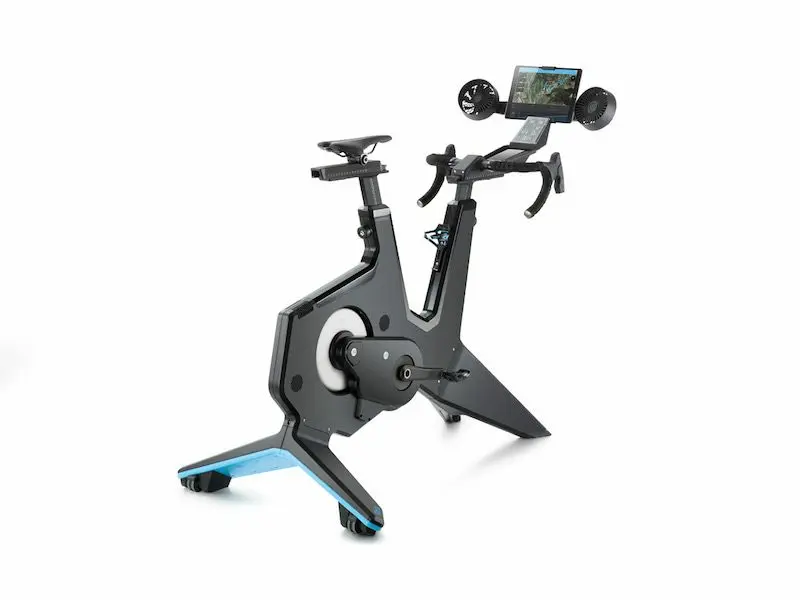
If you lose a kilogram quickly, it’s not a kilogram of fat, but a kilogram of various other elements, such as food residues (which are evacuated by going to the toilet), glycogen (the energy store in the form of sugars stored in muscles and liver), proteins (due to muscle catabolism if needs are not met), and especially water through perspiration or that stored with glycogen. Going to a sauna also makes you lose weight, but it’s not fat. When using an indoor trainer, the only real impact on weight concerns the calories actually burned during the session, roughly 400 to 800 depending on its intensity. It therefore takes between 10 and 20 indoor trainer sessions, and on the condition of not consuming more calories than on a day without physical activity, to lose one kilogram. Road or mountain biking are always more productive in this regard.
The right balance
The indoor trainer is an interesting tool when used wisely. It should be practiced as a means of maintaining fitness rather than trying to break records, and in addition to other aerobic physical activities such as running, swimming, and of course outdoor cycling whenever possible. The right balance is around two sessions per week in winter, lasting forty minutes to an hour maximum, with a few exercises to get the heart rate and watts up but without aiming for exhaustion.
=> SEE ALSO: All our Coaching articles
Share the post "5 mistakes to avoid when training on an indoor trainer"