Share the post "Which tires for winter cycling?"
The only contact between the bike and the road, tires are crucial for grip, efficiency, and comfort. While compromises can be made for everyday use, winter conditions demand specific characteristics that, when met, provide greater safety and peace of mind. Let’s explore the advantages of specific winter tires.
By Guillaume Judas – Photos: SRAM, Balint Hamvas, CyclePhotos / Irmo Keizer, Shimano / 3bikes.fr
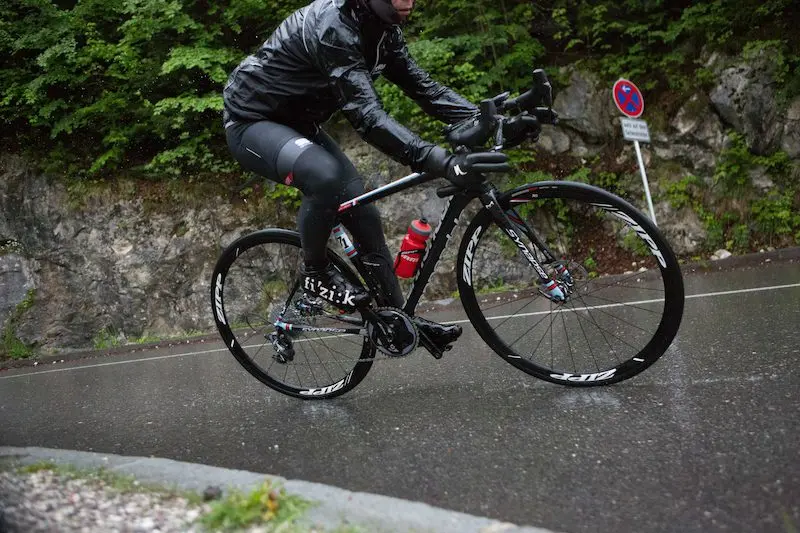
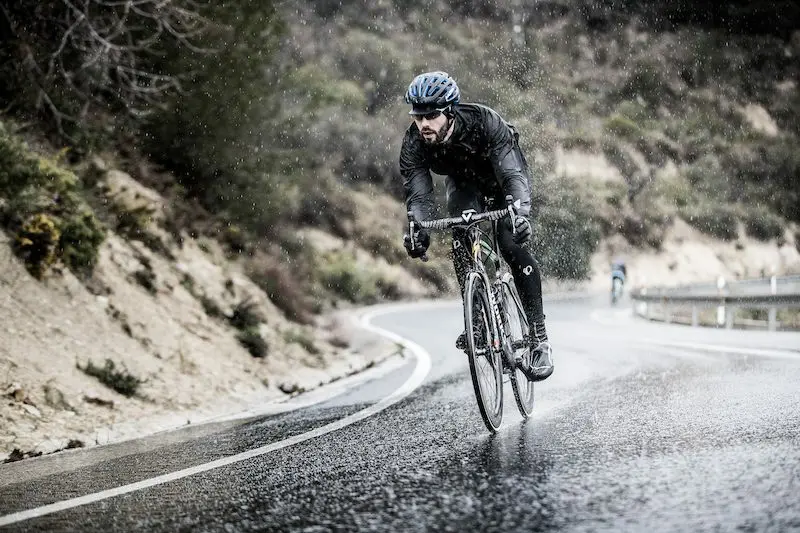
In some countries, such as Germany, Austria, and Italy, fitting winter tires is mandatory between November and March for all four-wheeled vehicles. These tires ensure optimal grip on cold and/or wet surfaces, below 7°C. This is not yet the case in France, nor for cycling, but the benefit of dedicated tires is undeniable once you’ve experienced them. Because a bike tire is almost as technical as a car tire: it has to cope with much lower speeds, but it is also much thinner and lighter while ensuring your balance on two wheels.
A story of rubber compounds
As with wheels, the perfect tire doesn’t exist. Factors include rolling resistance, grip, durability, puncture resistance, tire width, weight, even comfort, and for the most discerning, aerodynamics, and of course, price. Some qualities are very difficult to combine. An entry-level tire is often affordable and very durable, but lacks dynamic qualities. As for a performance-oriented tire, it is light, with low rolling resistance and sometimes excellent grip, but it is also expensive and fragile. A good tire must also assist disc braking, as the power induced by this system often reveals the limits of the tread’s grip.
=> SEE ALSO: Disc braking for road bikes, the state of play in 2019
When looking for the best compromise, we often focus on the market’s reference models, which are certainly not cheap, but we know they are without unpleasant surprises, such as the Continental GP 5000, Pirelli PZero Velo, Michelin Power Road, Vittoria Corsa, Hutchinson Fusion 5 Performance, or Mavic Yksion Pro. Their versatility is achieved through a very complex blend of rubber and various other elements – and often secret – that make up the tire tread, which itself can be composed of several types of rubber compounds. This is how durability and/or low rolling resistance are achieved with a hard compound in the middle of the tread, and grip with a softer compound on the edges.
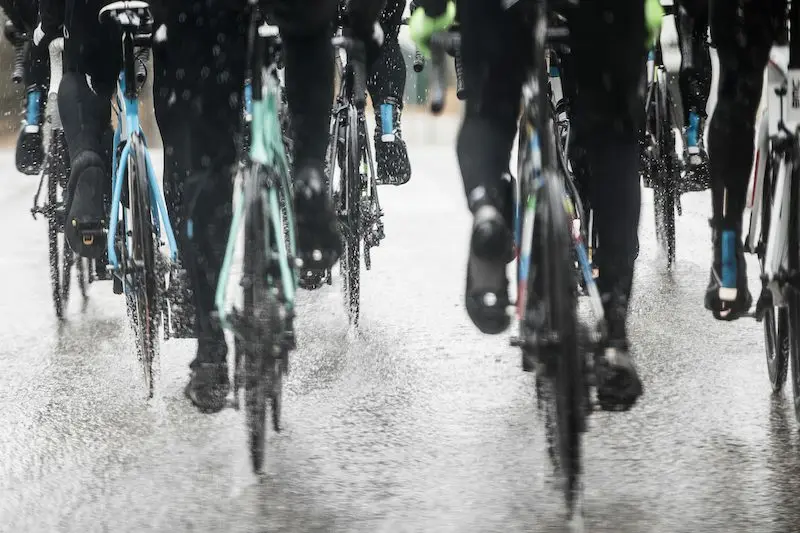
Like what is used in automobiles, this famous compound delivers its best performance above a certain temperature. This is particularly true in terms of grip for tires of the type mentioned above. They lose their effectiveness on cold and wet ground, in addition to seeing their puncture resistance compromised by more frequent use on dirty asphalt. This is where it becomes necessary to equip yourself with winter or “all-weather” tires.
Resistance and safety
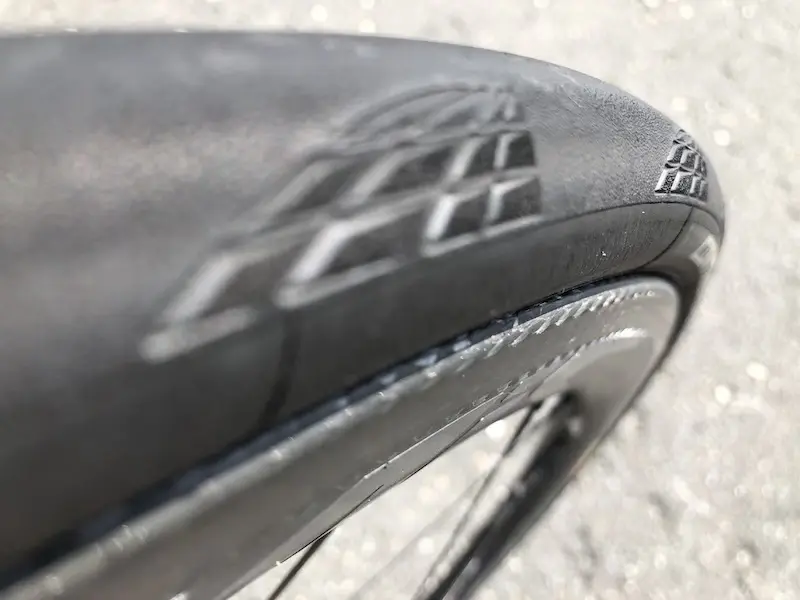
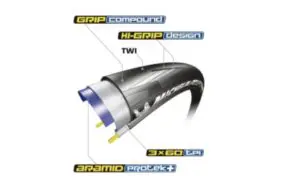
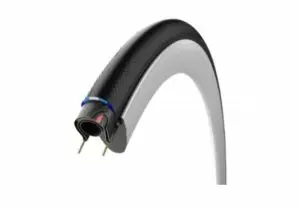
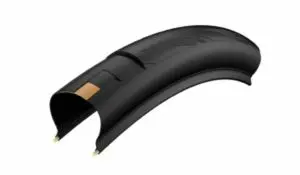
Underneath a tire’s tread, you’ll find a carcass of varying thickness and a puncture protection layer. The thickness of the carcass plies is inversely proportional to the TPI count (threads per inch – 2.54 cm). A low number of thick threads is sufficient for this surface, while more small threads are needed to fill it. These smaller threads are also thinner, making the carcass finer, lighter, and more responsive. While denser carcasses (above 60 TPI) are more elastic, they are also more fragile, requiring an additional puncture protection layer just beneath the tread. This reinforcement affects the tire’s performance and weight by making the tread less flexible.
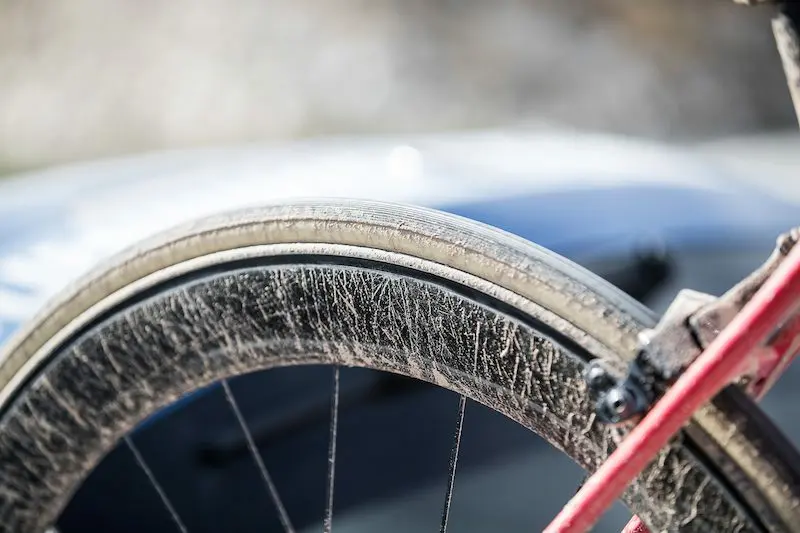
Thus, depending on the desired behavior and type of use by the manufacturer, the reinforcement covers more or less surface laterally. Winter conditions, with cold, slippery, and dirty ground, therefore require tires that meet two main criteria: a rubber compound that offers the best compromise between grip and durability at low temperatures, and a puncture protection layer that covers the top of the tread but also the sidewalls. The best models of this type provide decent performance without being too heavy. As for the patterns on the tread, one should not rely too much on them. They are often there to reassure, as there is no risk of aquaplaning with a bicycle.
Limits of use
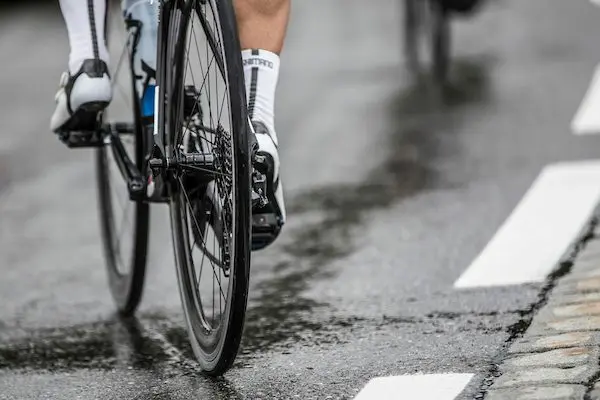
Misleadingly named “4 Season”, “All Season” or “All Weather”, these specific tires for rain and cold have rubber compounds designed to “work” at low temperatures. Their durability is more erratic when used above 10°C, even if they remain extremely safe in the rain. Dry and hot ground has an abrasive effect on their rubber. The wide puncture protection remains an advantage, but it limits the responsiveness and comfort of the tires, even when under-inflated. However, rest assured: if you limit yourself to winter use, you can keep them for at least two seasons without any problem.
If you limit yourself to winter use, you can keep these all-weather tires for at least two seasons without any problem.
Tire width
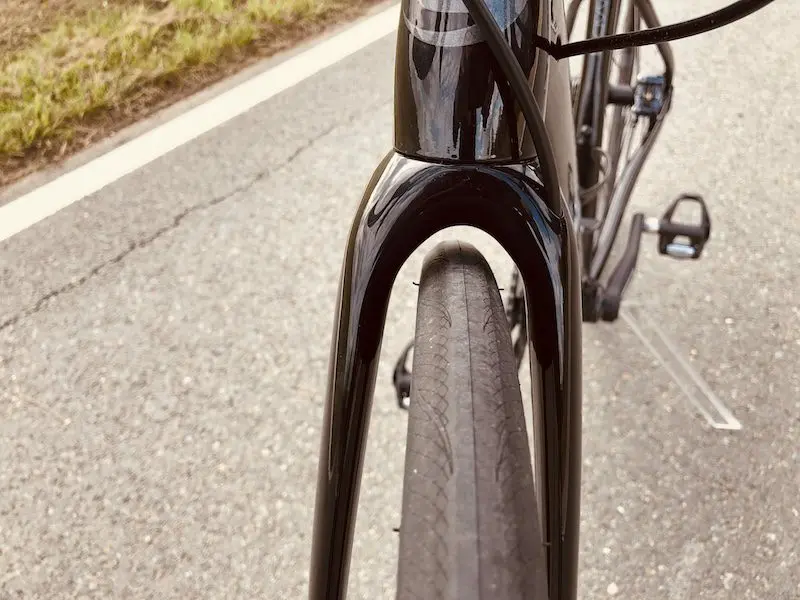
The actual tire width, not just what’s indicated on the sidewalls, depends on the rim width. The correct tire width is primarily when it ensures good continuity between the tire’s sidewalls and the rim’s sidewalls. Mounting a tire that is too wide on a rim that is too narrow creates a “balloon” effect that is detrimental in terms of steering precision and tire drift when riding out of the saddle. With a 21 mm wide rim (at the braking surface), a 23 mm tire is the most suitable. With a 24 mm rim, a 23 mm tire will actually measure 25 or 26 mm, but you also have the choice of a 25 mm tire, which offers the advantage of a wider tread, and therefore better grip in corners. A 28 mm tire is reserved for rims of 27 mm and wider, but you must then check that the brake calipers allow for clearance (for rim braking). This larger tire width provides a gain in comfort, especially since it offers equivalent performance to a smaller tire width by slightly reducing inflation pressure. And it limits drift when mounted on a rim that provides it with good support.
What about Tubeless?
Sometimes presented as the miracle solution, Tubeless faces the same problem, namely a rubber compound that interacts with the asphalt depending on the temperature. Nevertheless, this tubeless technology allows riding with lower inflation pressures for identical performance, which theoretically favors grip on wet ground. Regarding puncture resistance, Tubeless is mounted with a sealant whose purpose is to ensure its airtightness but also to fill very small cuts while riding. The fact remains that in the event of a larger cut, roadside repair can only be done by slipping a spare inner tube into the tire, sometimes with enormous difficulty in unseating it from the rim, especially with cold and wet hands as can be the case in winter. And since there are still too few different Tubeless models on the market, the choice is still limited when opting for a more resistant tire for winter.
In conclusion, there are a few reference models of tires (with inner tubes) that offer both good grip on wet ground, excellent puncture resistance in difficult conditions, decent performance, and very good durability if used on cold ground. If you live north of Avignon, you should definitely not deprive yourself of them in order to ride in the best safety conditions this autumn and winter.
| High-end tire models that ensure durability, grip, and performance in winter conditions: Continental GP 4 Season: in 23, 25, 28 or 32 mm. Weight from 230 to 320 g. Price: approximately €56
Michelin Power All Season: in 23, 25 and 28 mm. Weight from 230 to 300 g. Price: approximately €43
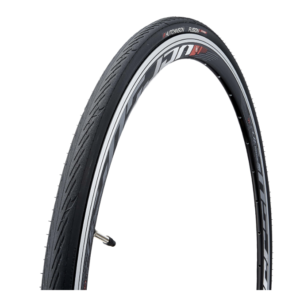
Hutchinson Fusion 5 All Season 11Storm: in 23, 25 and 28 mm, tubed or Tubeless. Weight from 200 to 325 g. Price: approximately €46
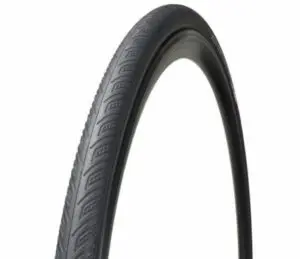
Specialized All Condition Armadillo Elite: in 23, 25, 28, 30, 32 mm. Weight from 285 to 430 g. Price: approximately €41
Vittoria Rubino Pro Control : in 23, 25 and 28 mm. Weight from 290 to 340 g. Price: approximately €40.
Pirelli PZero Velo 4S: in 23, 25, 28 mm. Weight from 205 to 250 g. Price: approximately €46.
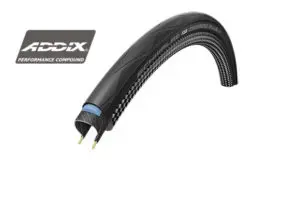
Schwalbe Durano Plus Performance: in 23, 25 mm. Weight: 380 g. Price: approximately €48
|
=> SEE ALSO: All our Gear articles
Share the post "Which tires for winter cycling?"