Share the post "TOUR DE FRANCE 2020: the route"
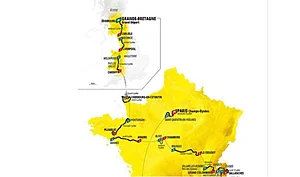
ASO today presented the route of the 2020 Tour de France at the Palais des Congrès in Paris. Here are some details on each of the stages.
Image: @ASO

An original route in more ways than one, first because of the location of the Grand Départ, around Nice on the weekend of June 27 and 28. The event promises to be particularly difficult with a hilly route from the first week of racing, a slight lull going up from the Pyrenees to the Centre-West before concluding in style in the Alps and then in Eastern France with an unprecedented time trial to the summit of the Planche des Belles-Filles the day before the finish.
The Tour de France is moved forward by one week compared to usual, due to the Tokyo Olympic Games, which will take place from July 24 to August 9. The men’s individual road race is scheduled for Saturday, July 25, and the time trial for July 29, six and ten days after the Tour’s finish, respectively.
The 2020 Tour de France Route
June 27 – Stage 1: Nice – Nice (156 km)
A hilly first stage in the Nice hinterland, but which could conclude with a sprint.
June 28 – Stage 2: Nice – Nice (187 km)
A quick start to the action, with a mountain stage that will accumulate almost 4000 m of elevation gain. Riders will tackle the Col de la Colmiane (16 km at 6.3%), then the Col du Turini (15 km at 7.4%) and finally the Col d’Eze (7.8 km at 6.1%). Note that this will also be the route of the Étape du Tour sportive, which will take place on July 5.
June 29 – Stage 3: Nice – Sisteron (198 km)
Another slightly hilly stage leaving the Mediterranean coast to venture into the hinterland before descending to Sisteron, where the most resilient sprinters should be able to battle for victory. Unless a breakaway group from afar reshuffles the general classification established the day before.
June 30 – Stage 4: Sisteron – Orcières – Merlette (157 km)
The stage that could be described as medium mountain, crossing the Massif du Dévoluy, should be nervous, with a finish at over 1800 m altitude in Orcières – Merlette after 7 km at 6.7% average gradient.
July 1 – Stage 5: Gap – Privas (183 km)
The Tour riders will turn their backs on the Alps before returning later, crossing the Rhône Valley, which could expose them to the wind. A sprint finish is likely, on one of the few stages favorable to sprinters.
July 2 – Stage 6: Le Teil – Mont Aigoual (191 km)
An almost unprecedented finish at Mont Aigoual, only used once by the Tour de France in 1987. The final consists of an average gradient of 4% over 14 km, preceded by the difficult Col de la Lusette (11.7 km at 7.3%) for a total of 34 km of climbing.
July 3 – Stage 7: Millau – Lavaur (168 km)
A hilly stage, as found on the Tour de France when it moves through the southern part of the country, but which could be called a transition stage. It should conclude in a sprint after a long breakaway by a few riders.
July 4 – Stage 8: Cazères-sur-Garonne – Loudenvielle (140 km)
The Pyrenees will rise before the peloton at the end of the first week of racing. The Col de Menté, Port de Balès, and Col de Peyresourde will follow one another before the descent to Loudenvielle on a short and nervous stage.
July 5 – Stage 9: Pau – Laruns (154 km)
A second day in the Pyrenees that should be tough, after a very intense first week and just before the rest day in Charente – Maritime. The Cols de la Hourcère (11 km at 8.8%) and Soudet (3.8 km at 8.5%) will follow one another, before a finale passing through the Col de Marie Blanque (7.7 km at 8.6%).
July 6 – REST DAY
July 7 – Stage 10: Île d’Oléron (Le Château d’Oléron) – Île de Ré (Saint-Martin-de-Ré) (170 km)
A completely flat stage normally destined for sprinters, but beware of the wind.
July 8 – Stage 11: Châtelaillon-Plage – Poitiers (167 km)
After the first week of the Tour, rich in difficulties, a second consecutive stage that should be promised to the sprinters.
July 9 – Stage 12: Chauvigny – Sarran (218 km)
The longest stage of the 2020 Tour will lead the peloton to Sarran, on slightly hilly terrain that could suit breakaway riders far down in the general classification.
July 10 – Stage 13: Châtel-Guyon – Puy-Mary (191 km)
The stage will feature a very leg-breaking medium mountain profile, all climbs and descents, with 4400 m of elevation gain. Among the difficulties, the Col de Ceyssat, the Col de Guéry, the Montée de la Stèle, the Côte de l’Estiade, the Côte d’Anglards-de-Salers will precede the Col de Néronne and its 3.8 km at 9.1% average just before the final climb of the Pas de Peyrol, and its 5.4 km at 8.1% average, with the last two kilometers at 12%.
July 11 – Stage 14: Clermont-Ferrand – Lyon (197 km)
Another hilly stage with some difficulties not challenging enough to disrupt the general classification leaders, but sufficient to allow strong breakaway riders to win.
July 12 – Stage 15: Lyon – Grand Colombier (175 km)
The Grand Colombier will be the decider (17.4 km at 7.1%) with its irregular and difficult slopes from Culoz, but also spectacular with its sometimes very tight hairpins which should provide us with beautiful aerial images. This climb will conclude a difficult day with the Selle de Fromentel (11 km at 8.1%, including gradients between 11.5 and 22% over the last three kilometers) and the Col de la Biche (7 km at 8.9%).
July 13: REST DAY
July 14 – Stage 16: La Tour-du-Pin – Villard-de-Lans (164 km)
The Tour de France begins its final bouquet in the Alps the day after the rest day, with a medium-altitude stage through the Chartreuse and Vercors, with a climb via Saint-Nizier-du-Moucherotte before the final ascent to Villard-de-Lans. This finish saw Laurent Fignon win solo during the famous 1989 Tour, which he ultimately lost by 8 seconds to Greg Lemond.
July 15 – Stage 17: Grenoble – Col de la Loze (168 km)
This stage, considered the Queen Stage of the 2020 Tour de France, will cross the Madeleine and finish at the summit of the Col de la Loze, an unprecedented climb. A road only opened last spring, which ends at 2300 m altitude. At the end of the 21.5 km ascent at an average of 7.8%, riders will face a succession of walls at nearly 20% which should provide an epic finale. And why not decide the overall winner in Paris.
July 16 – Stage 18: Méribel – La-Roche-sur-Foron (168 km)
A stage that should again be very tough with a big sequence of cols: Cormet de Roselend (1968 m), Saisies (1657 m), Aravis (1486 m), Plateau des Glières (1425 m), with relatively modest altitudes that do not in any way indicate their difficulty.
July 17 – Stage 19: Bourg-en-Bresse – Champagnole (160 km)
A hilly stage, but one that could benefit the sprinters.
July 18 – July 20: Lure – La Planche des Belles-Filles (36 km)
The only time trial of this 2020 Tour de France will be contested over 36 km with a finish at the summit of the difficult climb of La Planche des Belles-Filles in the Haute-Saône department, but without the spectacular final section used in a road stage of the 2019 Tour de France. This is the first time that a single time trial will decide the final victory and the podium in Paris.
July 19 – Stage 21: Mantes-la-Jolie – Paris (122 km)
A classic final stage, a parade to the entrance of Paris on the Champs-Elysées, before a grand finale that should not escape a sprinter.
=> SEE ALSO : All our MAG articles
Share the post "TOUR DE FRANCE 2020: the route"