Share the post "How to start running without getting injured?"
If you’re a cyclist, you need to “learn” to run before starting winter run training, or before getting into triathlon. You’re moving from a supported sport, which means no trauma, to a sport that causes a plantar shock with every stride. Here are our tips for a smooth transition.
By Bruno Cavelier – Photos: Brooks, Mizuno, Hoka, Flickr.com / DR
=> SEE ALSO: Should you cut back on training during the off-season?
The first equation you need to learn to manage is the relationship between the benefits of regular training, the fatigue your body experiences from a new effort, and the risk of injury, particularly to the Achilles tendons. When you run, you have to absorb up to four times your body weight with each stride. For a cyclist or swimmer whose frame is not used to being “shaken” with a certain violence, and especially, who has no running experience, it is advisable at first to exercise extreme caution and to alternate running sequences with walking sequences for breaks to practice stretching. After his cycling career, Laurent Jalabert took up marathon running, then triathlon. He shares his advice: “There’s a first time for everything! With 3 training sessions a week and after one or two months, you’ll be able to run 10 km without stopping. To achieve this goal, don’t try to run fast. On the contrary, start slowly, and when fatigue begins to appear, you’ll have reserves to maintain the same pace.”

=> SEE ALSO: Ironman 70.3 World Championship, Laurent Jalabert crowned
Learn to run without stopping
Don’t imagine putting your bike away and, the next day, going for an hour-long jog… You’d be heading straight for disaster. In the best-case scenario, it would take you a week to recover from persistent leg pain, and in the worst-case scenario, your triathlon dream or your winter based on running would turn into forced rest due to injury.
Before being able to run a few kilometers comfortably, start by walking and occasionally run at a moderate pace. Since muscles forget quickly, it’s wise to do many short running outings instead of just one long weekly jog. Let’s say that effective progress involves three outings per week, even short ones. Depending on your free time, these outings will initially be between 30 and 45 minutes.

During your first outing, you should start by walking and then do repetitions of slow running sections, controlling your pace and making sure not to exceed 75% of your maximum heart rate. Over time and with more outings, you will naturally find that you can gradually increase the duration of the running sections at the expense of the walking sections. With experience, you will learn to build real training sessions by trying to predetermine the total duration of your outing, the number and duration of each running section alternating with walking sections. One day you will have been out for 1 hour… and will have barely walked. On that day, you can celebrate your first ten kilometers run at a speed of 10km/h.
=> SEE ALSO: The different training intensities
Warm up before running
Running slowly or doing stretching exercises is not enough to warm up. When muscles are cold, the first structures that accumulate the stress of the shockwave from your strides are your tendons. The solution is to alternate global exercises with walking for 4 to 6 minutes to gradually increase muscle temperature, blood and heart flow, while actively mobilizing the key joints involved during your outing. For example, take large lunges forward, make large arm rotations in one direction then the other, make large hip rotations (as if with a hula hoop), walk only on your heels.

Beware of plantar shocks
In terms of plantar shocks, 60 minutes of walking is equivalent to 10 minutes of running. The difference in plantar collisions between moving at small steps and running is enormous and directly linked to the mechanical stress imposed by the running motion: the stride. It is therefore imperative to reduce body weight: when walking, heel strike determines an impact close to 80 to 100% of body weight. For jogging, this plantar counter-shock corresponds to a force of 3 to 5 times body weight (300 to 500%) depending on the profile, the nature of the terrain and the runner’s weight. The impact of the foot on the ground, partly absorbed by the shoe (depending on its quality), is nevertheless transmitted directly to the leg and back. Thus, the slightest mechanical anomaly (collapsed foot, shorter leg) which, when walking, will go completely unnoticed, can turn into a real injury when running. You must prioritize shoes designed for running and, if necessary, adopt Sorbothane® anti-shock heel pads.
In terms of plantar shocks, 60 minutes of walking is equivalent to 10 minutes of running.
During each road training session, your body absorbs an enormous amount of shockwaves that fatigue and wear out your joints and muscles. To minimize them, remember to regularly check the condition of your shoes and change them if necessary: too often we see occasional runners (like cyclists in the off-season, for example) dragging around old, worn-out pairs of running shoes, in which they feel good because they have molded to their feet.
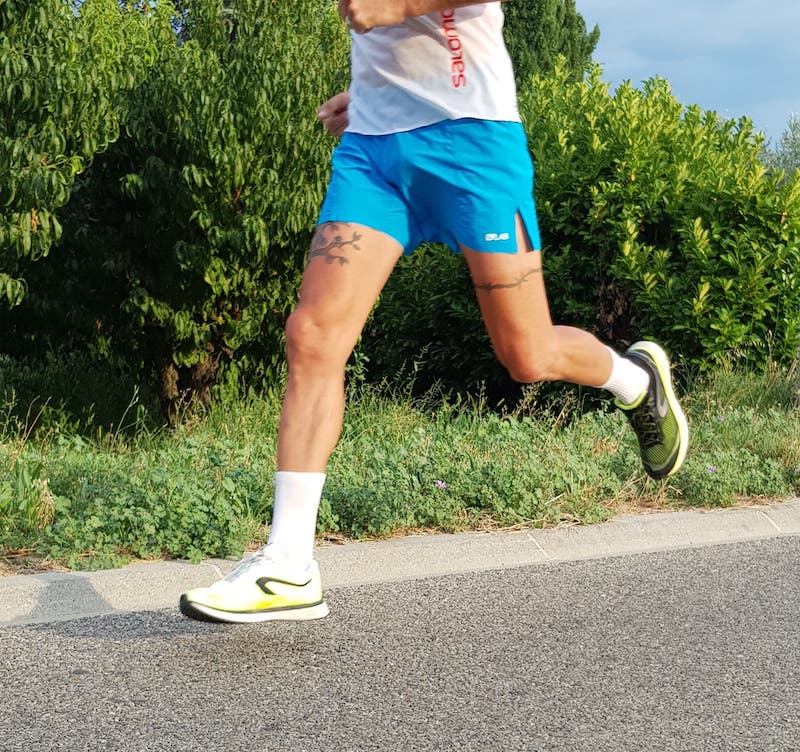
The problem is that they have completely deformed, lost their cushioning power, and no longer protect against injuries. If you plan to run regularly for several weeks, get quality shoes that are adapted to your foot; ask for advice from a specialized salesperson. Another way to protect yourself as much as possible is to avoid exclusively running on paved roads. With a little searching, you will find another route on softer terrain (dirt, grass, etc.), where you will escape exhaust fumes (pity your lungs!) and on which you will have a better chance of being able to run for a long time without debilitating pain.
| Smart tip: take care of your feet Running puts a lot of strain on your arch, as opposed to cycling which is done with rigid soles and, of course, swimming. It is therefore important to take care of them and maintain the quality of your muscle tissues. For example, with a self-massage exercise using a ball. |
Achilles tendon = sensitive point…
In running, the Achilles tendon can become a real weak point or Achilles heel… If the symptoms of tendinitis are not taken into consideration from the first pains, they then tend to take a more or less persistent form and one risks “dragging one’s leg” for a long time. It has been perfectly demonstrated that informed and experienced runners were much less subject to all the troubles – minor or serious – that can occur during a sustained effort.
=> SEE ALSO: Cyclist’s Tendinitis
| Our advice Stretching the triceps surae muscle (gastrocnemius + soleus) after exercise ensures better relaxation and “recovery” of the Achilles tendon. |

In 60% of cases, the Achilles tendon becomes painful due to training errors. Overuse is related to a sudden or prolonged increase in effort: too rapid progression, too long courses, abrupt changes in training rhythm, uneven terrain, steep ascents and descents, difficult surfaces: hard, sand, snow, mud, gravel… To avoid any overload, you should only gradually and slowly increase the distance covered, not exceeding 10 to 15% more per month, and practice stretching before, but especially after each outing. Stretching should be preceded by a light jog or gymnastics exercises to increase muscle temperature. All extension or flexion movements should be performed slowly, deliberately, and without jerking. Relaxation after each stretch should be gentle and last for a duration equivalent to the tension phase. Stretching is important to keep muscles long in order to maintain optimal stride amplitude and maintain muscle elasticity qualities.
We hope these few tips for caution and implementation will help you approach your running debut or return to running well, especially if you use this discipline as an alternative practice during the off-season.
=> SEE ALSO: All our Coaching articles
Share the post "How to start running without getting injured?"