Share the post "Road bike frame stiffness: what are we talking about?"
There are two types of deformation for a frame: lateral and vertical. As a general rule, for any frame, regardless of its range level, manufacturers seek to gain lateral stiffness without necessarily increasing vertical stiffness too much. Why, and what are the implications for handling and performance? Here are some explanations.
By Pierre-Maxime BRANCHE. Photos: 3bikes.fr, Specialized, Orbea/Antton Miettinen, Pxhere, Pixabay, Origine Cycles.
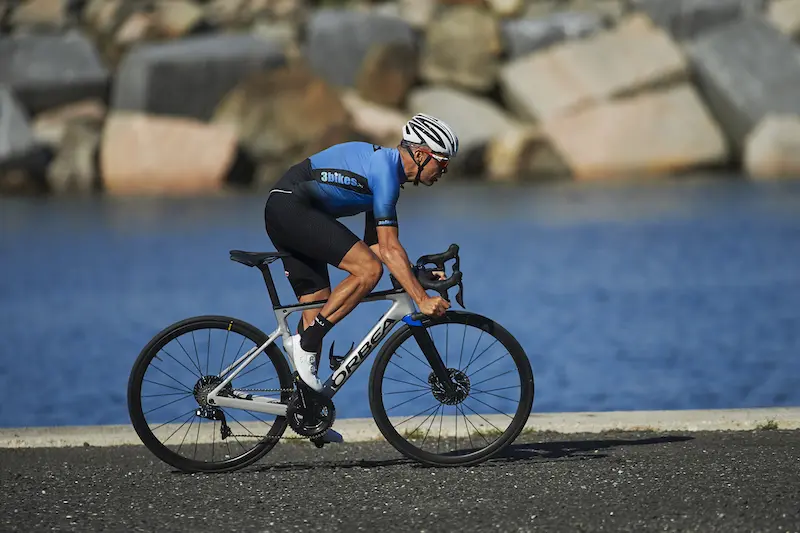
Lateral stiffness is necessary because when the cyclist pedals, they apply force to the chain, which slightly twists the rear wheel and pulls on the right chainstay more than the left chainstay, since the chainrings and cassette are positioned only on one side of the frame. Thus, to have good transmission of the power developed during pedaling, a frame must be as stiff as possible in lateral deformation (and the rear wheel too). On the other hand, one should not necessarily seek the greatest vertical or frontal stiffness, because a slight deformation in this direction provides comfort by filtering vibrations and absorbing small irregularities thanks to a slight frame flexibility.

Power Transmission
A frame that is too stiff and without distinction of deformation offers good power transmission, but it is also a tiring “piece of wood” to ride and uncomfortable over long distances. The stiffest frames are those for track cycling, especially for sprint, because they must withstand extreme stresses during starts, especially on wooden tracks that have no irregularities. Therefore, very high lateral and vertical stiffness can be achieved, as there is no comfort constraint since riding is on perfect surfaces and for very short efforts. As soon as one moves to asphalt, with the possibility of riding on more or less good sections, one can maintain high lateral stiffness but reduce vertical stiffness to absorb vibrations and offer a certain comfort.
A frame that is too stiff can prove demanding in certain conditions, especially in cases of excessive fatigue or when physical condition is lacking.
Adapted Frames
Some brands deliberately choose not to over-stiffen the frames of certain models, to make them more physically accessible. Indeed, a frame that is too stiff can prove demanding in certain conditions, especially in cases of excessive fatigue or when physical condition is lacking. A frame that is a little more flexible laterally requires less energy to accelerate on difficult climbs, and a slight elastic effect also allows the rider to use their full body weight to propel the bike forward. This is not the case with a very stiff frame, which is absolutely more efficient in all conditions, but requires very good motor coordination in pedaling to perform at its best. Everything is often a matter of compromise, depending on your level and your goals.
Finding the Secret Formula
With current technologies, it is possible, depending on the orientation of the carbon fibers, to achieve a 20 to 25% difference between lateral and vertical stiffness, for a less demanding and more comfortable bike. A tube is always manufactured by superimposing several sheets of carbon. The internal sheets of the tube are always unidirectional. Only the outer sheet is either unidirectional, which is called UD, or multidirectional, which is called woven. This means that each sheet has a very precise orientation. However, a carbon sheet has lateral flexibility; you can twist it, but you cannot stretch it. This is the particularity of carbon: it is not stretchable. If you pull very hard, for example, if you attach it to a truck on each side, the carbon will never stretch; it will tear or, at worst, break. On the other hand, it is extremely flexible in the other direction. A carbon sheet is composed of thousands of filaments, all in the same direction. So if you put a carbon sheet at 0°, then three layers at 45°, and finally a last layer at 90°, you obtain a certain flexibility and stiffness. It is by playing with this secret formula that more or less stiffness or flexibility is given to a tube.
For aluminum, steel, or titanium, everything depends on the natural deformation capacities of the materials and the thickness of the tubes according to the expected stresses. Cheaper to produce, frames with metal tubes are nonetheless very technical.
The Importance of the Head Tube
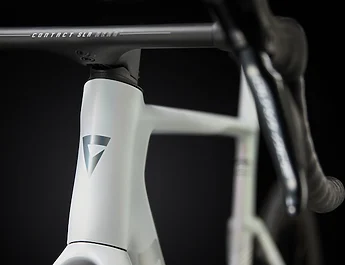
Thus, it is possible to manufacture a carbon frame knowing where to reinforce stiffness and where to add flexibility. On a frame, the bottom bracket shell needs the most lateral stiffness, especially the junction with the right chainstay. Another interesting area is the head tube, because the stiffer it is, the greater the steering precision. This is an undeniable performance lever because the more stable your bike is, the more confident you feel, and the more you can push your limits, especially when descending a pass, for example. At the seatstays, on the other hand, the goal is to filter vibrations. This is why they are often very thin, with fibers oriented in the direction of vertical flexibility to absorb shocks and vibrations. The same goes for the fork: it must be laterally stiff, but frontally, we seek to maintain a certain flexibility so that it can absorb micro-vibrations and road irregularities.
And after a fall?
The stiffness of each tube and each zone (bottom bracket shell, rear dropouts, head tube, fork, etc.) is measured and recorded. In the event of a fall, these measurements can be recalculated by the manufacturer to determine, for example, if the fork steerer tube is cracked or completely broken, or if the frame structure is damaged. The original stiffness is then compared by entering the frame number to retrieve the stiffness measured at the time of production. If certain internal layers are delaminated, these measurements will immediately reveal it.
=> SEE ALSO: All our Coaching articles
Share the post "Road bike frame stiffness: what are we talking about?"