Share the post "PRO Vibe Superlight Handlebar Review"
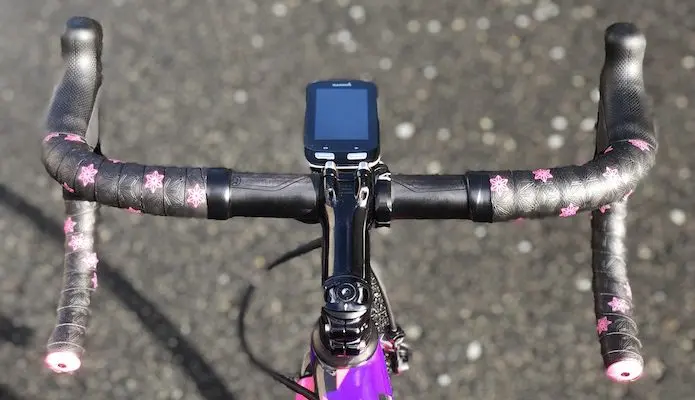
PRO’s latest high-end handlebar is light, stiff, and comfortable. 3bikes.fr tested the Vibe Superlight for you.
By Guillaume Judas – Photos: 3bikes.fr/All rights reserved
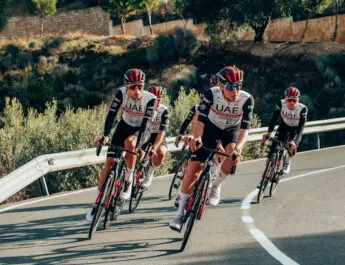
The PRO components brand is gradually establishing itself among the benchmark manufacturers, notably by equipping World Tour Teams Deceuninck – Quick Step, Groupama – FDJ, and Sunweb. This real-world laboratory and media exposure allow the accessory manufacturer to progressively assert itself against the competition when it comes to optimizing bike equipment, both for performance and comfort.
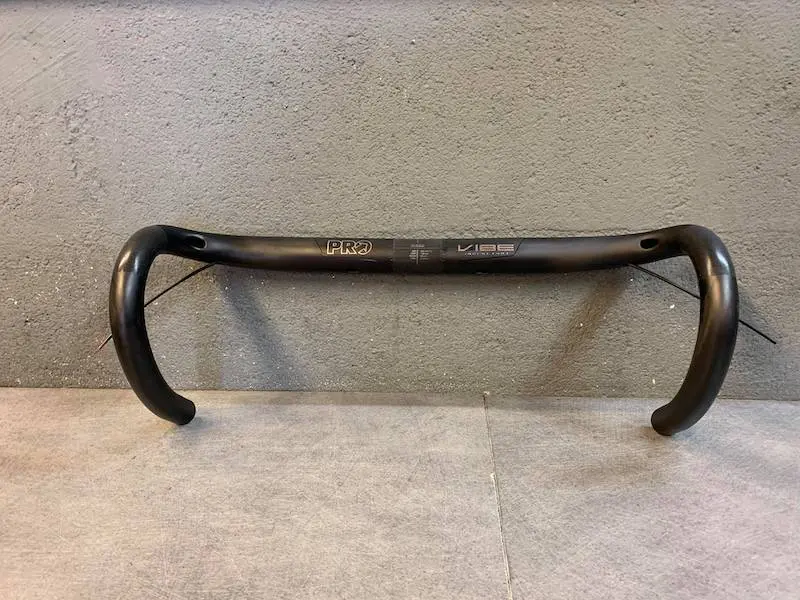
The PRO Vibe Superlight handlebar sits at the top of the manufacturer’s range, alongside the Pro Vibe Aero, which is slightly heavier but has different shapes. It is one of the lightest handlebars on the market at 185g for a 42cm width, thanks to a monocoque construction using T800 unidirectional carbon fibers and M4075 high-modulus carbon fibers. To put things in perspective, 185g is 100g less than a mid-range aluminum handlebar, or 60g less than a high-end handlebar with aerodynamic shapes like the Vibe Aero (used by sprinter Arnaud Démare). This feature is interesting when looking to save weight to counteract the additional weight of disc brake groupsets.
Stiffness and strength
The PRO Vibe Superlight is certainly not the first lightweight handlebar on the market, but it is undoubtedly one of those that offers the best balance between light weight and stiffness. Until now, one of the main criticisms of this type of product was a certain flexibility during heavy loads or violent efforts, when the rider firmly grips the handlebar, especially in its lower part. Furthermore, a lightweight handlebar was rarely drilled to accommodate brake cables or derailleur cables, as it was necessary to reconcile internal routing with a minimum of resistance.
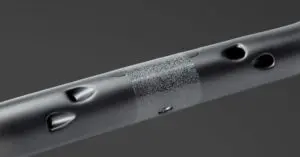
On the Vibe Superlight, special fibers called Innegra inside are integrated. They are designed to improve the handlebar’s resistance in case of a fall, without increasing the product’s weight. Combined with unidirectional and high-modulus carbon fibers, they promote overall stiffness, in correlation with the stiffness of most current bikes at the head tube. To offer an impeccable finish for the bike’s cockpit, the Vibe Superlight allows Di2 and brake cables to be routed internally.
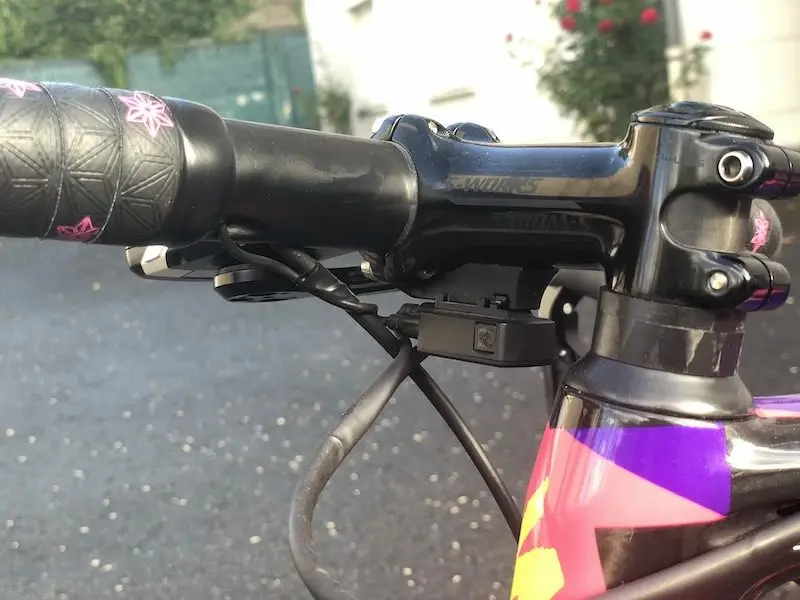
Careful ergonomics
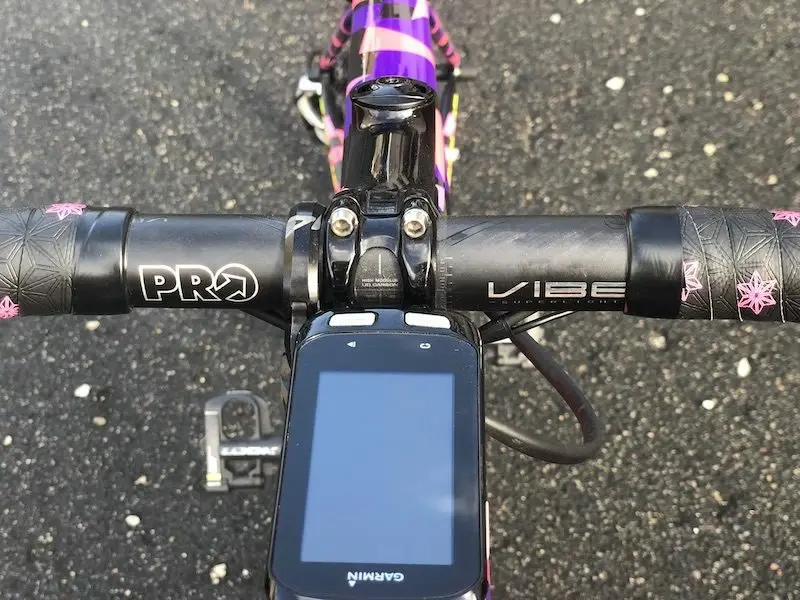
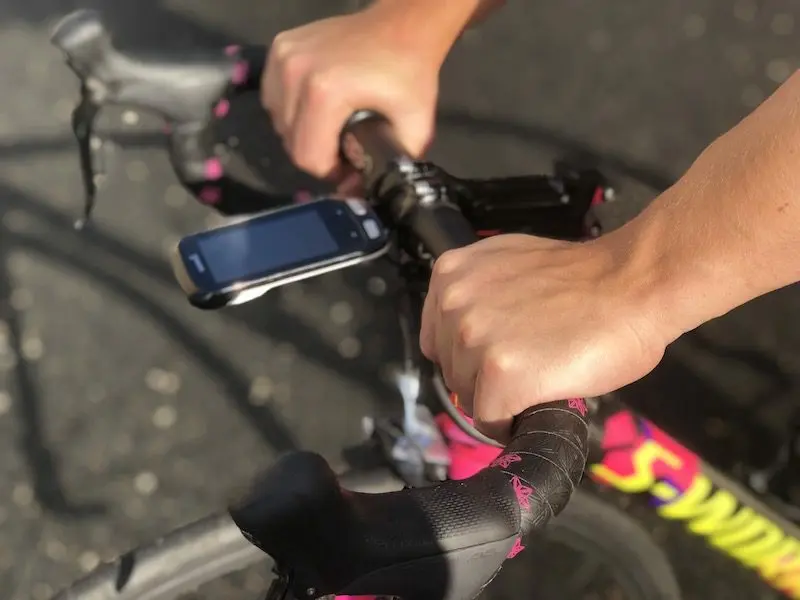
This handlebar also stands out for its oversized design on the upper part, ensuring very effective ergonomics intended to limit arm and hand fatigue. It provides a very comfortable grip with hands on top of the handlebar, during long climbs for example. This diameter is not unrelated to the perceived stiffness and ensures a perfect connection with the bike. The round and semi-compact shape offers a variety of positions with hands on the drops or hands on the brake hoods. Finally, the rounded shape that ensures the transition between the upper part and the placement of the brake levers prevents the forearms from hitting the handlebar in a sprint position.
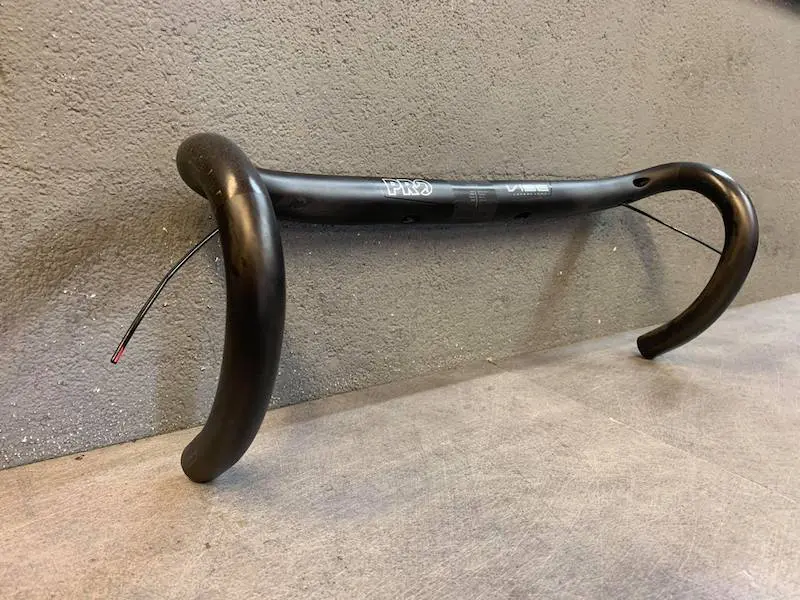
The Pro Vibe Superlight is not a true compact handlebar due to its dimensions. While the reach (the distance between the top of the handlebar and the furthest forward part) is 80 mm, which is a very classic dimension for a so-called compact handlebar (there are shorter, but also longer reaches), the drop is 130 mm. This is the height difference between the top of the handlebar and the bottom part, provided that this bottom part is set horizontally with the ground. A “true” compact handlebar is generally around 125 mm.
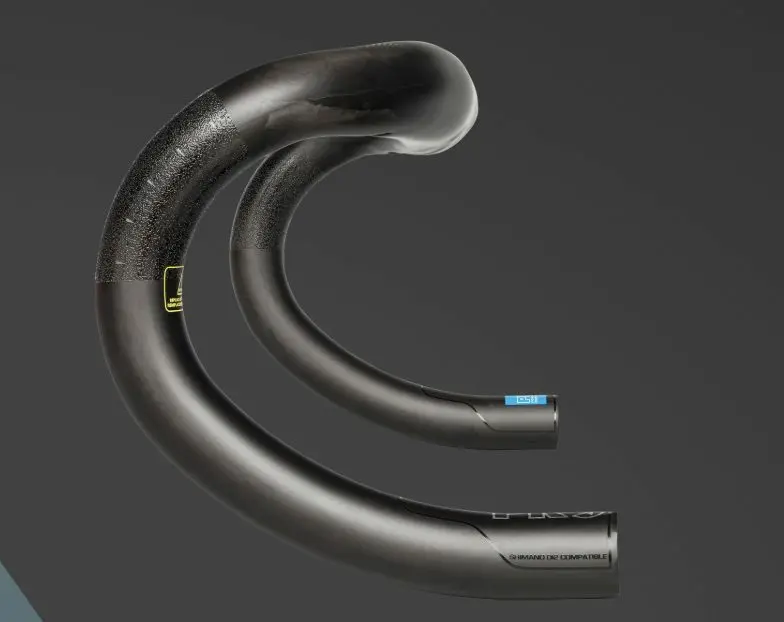
This mainly means that depending on the handlebar’s inclination, it will be more or less compact, and will create a greater or lesser difference between the hands-on-top and hands-on-drops positions. This does not change the handlebar’s resistance or stiffness characteristics, of course, but when talking about comfort, its orientation must necessarily be associated with it to take into account the ideal position. In short, the PRO Vibe Superlight, even when properly adjusted, is less closed in its lower part than other compact handlebars. Moreover, with its less angular shapes and smooth transitions between each curved part, it allows for a multitude of possible hand positions.
=> SEE ALSO: Handlebar and stem, how to choose?
Lighter steering
Thanks to the weight savings on the cockpit, the bike’s steering feels lighter from the first pedal strokes. The performance gain is not easy to quantify and is probably very small by saving a few tens of grams. However, during accelerations, out-of-the-saddle efforts, and changes of direction, the sensations are improved. For the rest, we appreciate the stiffness of the Vibe Superlight, which is very noticeable when gripping the brake levers, as well as its comfort. Because with equivalent stiffness, this carbon handlebar seems to transmit fewer vibrations with hands on the drops than the previous setup with a more basic aluminum handlebar. Finally, although assembly is longer and more delicate, the internal routing of cables and housing frees the cockpit from certain constraints when placing the hands, which adds comfort to the aesthetics and neat appearance.
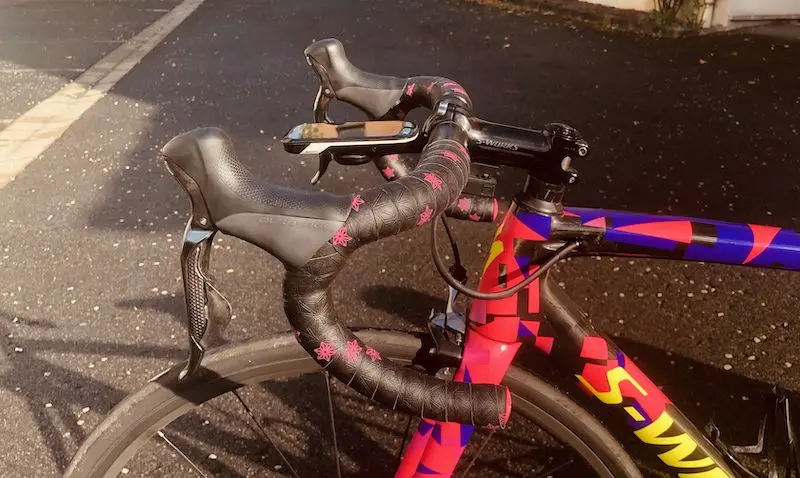
The PRO Vibe Superlight handlebar therefore has many advantages which, even if they are not absolutely essential for performance, improve the bike’s overall quality. You just shouldn’t rely on the compact designation, which is a bit misleading given the product’s dimensions. Note, however, that at PRO, all carbon handlebars have the same characteristics, whereas you have to look in the aluminum handlebar range to find more compact models, with dimensions of 128/75 or 125/70.
| PRO VIBE SUPERLIGHT |
| RATING: ***** PROS: Finish, weight, stiffness, internal routing T800 UD and M4075 HM carbon, Innegra inside fibers |
| Contact: pro-bikegear.com |
=> SEE ALSO: All our Gear articles
Share the post "PRO Vibe Superlight Handlebar Review"