Share the post "Tour de France climbs: the Foix Prat d’Albis climb"
An unprecedented climb in the last Tour de France, the ascent of Foix Prat d’Albis, climbed on July 21st during the 15th stage, revealed Frenchman Thibaut Pinot as a possible successor to Bernard Hinault in the Grande Boucle’s palmarès. Having never ridden our bikes on this slope, we followed in the footsteps of the Groupama-FDJ rider to discover this mysterious, wild, and demanding climb.
By Pierre-Maxime BRANCHE. Photos: 3bikes.fr

When he stood on his pedals and dropped all the general classification favorites, including future Colombian winner Egan Bernal, Thibaut Pinot rekindled in the hearts of all French people the hope of a French winner on the Champs-Élysées and a possible successor to Bernard Hinault. Already a winner the day before at the summit of the mythical Tourmalet, Marc Madiot’s rider strove, in the fog and under the showers, to make up for precious time lost a few days earlier in a cursed echelon. Above all, he asserted himself as a true contender for the final victory.
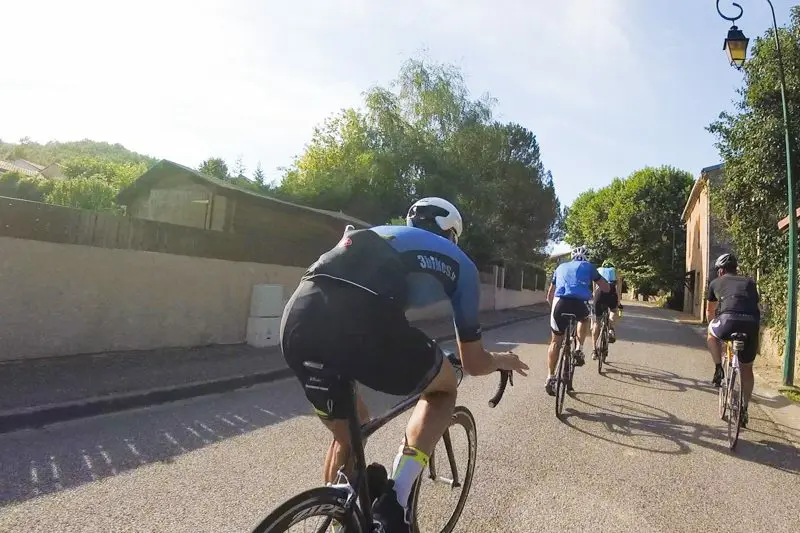
At 3bikes.fr, this climb intrigued us. Passing through the Ariège region for a few days this summer, near Pamiers, it didn’t take much for me to get pedaling, well accompanied by some local riders, and discover this mysterious climb.
What is the General Council doing?
For our part, a bright August sun greeted us in Foix, prefecture of the Ariège department, which has just under 10,000 inhabitants (9,721 at the last census in 2014), making it one of the smallest prefectures in France. It is even the second largest city in the department after Pamiers, its sub-prefecture.

The climb doesn’t start from the city center. After admiring the castle and passing the Town Hall, turn left at the roundabout onto Avenue Lakanal (D21), then turn left again onto Rue Raoul Lafagette where you can admire the pretty Chapel of Notre Dame de Montgauzy (above). A little further up the same street, the “Prate d’Albisse”, as it is pronounced, announces itself. A General Council sign indicates an average gradient of 6.5% and a maximum percentage of 9%. Let me tell you right away: don’t believe it for a second! Some sections reach 14 or even 15% according to our data. It makes you wonder where and how this information was obtained.

The ascent of Prat d’Albis in 3D HERE
Steep gradients
The road climbs gently from the center of Foix and the first kilometer from the sign still serves as a warm-up, with an average of just under 5%. As soon as you leave the town, the road narrows, the surface is grainy and will not improve until the top. Very quickly, the vegetation is dense, although you can see the antennas at the summit for a while. A decoy in reality, as the summit of the climb is even higher behind, invisible from these first kilometers.

The serious climbing then begins with an average of 6% over 2 km, followed by a 4th km averaging over 10% with short sections exceeding 14%, particularly in a right-hand hairpin. The road winds its way up. Through the foliage, you can see yourself quickly rising above Foix.

After this difficult 4th km, the gradient softens to an average of 7.5% before a slight “S” shaped descent that allows the quadriceps to relax and the muscles to reoxygenate. Take advantage of this to drink and cool down if the mercury and body temperature are rising. A new kilometer with an average of over 10% is coming, with new sections at 13 and 14%. Make the effort, these are the last difficult moments of the climb.

Horses, cows and sheep
After a large left hairpin, the 7th km marks a sudden change of environment. The vegetation is gone, and the view opens up to Foix and its castle.

For 3 km, the 6-7% gradient is softened by the beauty of the landscape. On one side, the Ariège and in the distance the Toulouse region; on the other, the Pyrenean peaks.

We are not alone. Horses, cows, and sheep accompany us on the road. They are at home and are not worried by your passing. In fact, it is up to you to adjust your trajectory. Indeed, the Prat d’Albis, along with the Urola Erdia site in the Basque Country, is one of two experimental zones for the virtual fencing system of the Franco-Spanish collaboration project “e-pasto”. The objective is to allow breeders to locate and interact remotely with their animals while respecting the ecosystem and the different users of the summer pasture.


800 m of positive elevation gain
The last two kilometers, at 5% then 3%, are easily completed. After 11.5 km of climbing, the grassy plateau of Prat d’Albis appears.

A large expanse, almost devoid of any construction: only a small stone house stands a little higher up. On the day of our outing, horses and sheep, far more numerous than the courageous cyclists, were basking peacefully in the meadows. Our road ends at the sign announcing the 1,205 m altitude of Prat d’Albis.

Foix being located at just under 400 m altitude, this climb still offers a nice positive elevation gain of about 800 m (from the center of Foix). These slopes can be easily conquered by the strongest riders on a 39-25, with a reserve cog of 28 teeth. Others should plan for a small chainring of 36 teeth maximum to be comfortable, and large cogs at the back to spin their legs. With a 34 in the front, it’s full insurance.

THEY CLIMBED THE PRAT D’ALBIS WITH US
Damien, triathlete, 33 years old.

« It’s a beautiful climb, not too long. I appreciate that the gradient is irregular, that you start from the center of Foix, so from an urban environment, and that you quickly find yourself on a not-too-wide, wild road, which offers beautiful views in its upper part and where cars are quite rare. It’s a climb where you have to regularly accelerate out of the saddle, the terrain lends itself to it. After the starting sign, the first kilometer is quite easy, then you quickly find yourself in a complicated 4 km segment. On the most difficult slopes, I go all the way to the left, but these sections are never very long. I think there are still 12 or 13% in some places, even if they are not announced on the official sign. Once out of the wooded section, the road climbs much less, you can drop two or even three cogs. On the last kilometer, it’s even possible to go back to the large chainring. The gradients and paces are varied, that’s why it’s an effort I like. »
Jean-Pierre, sportive cyclist, 64 years old.
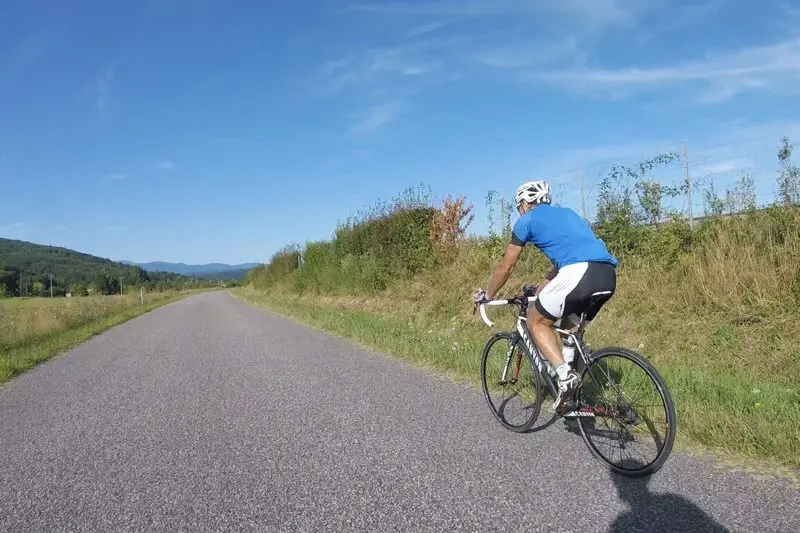
« The Prat d’Albis is a climb I know well; I’ve been riding it about three times a year for the past fifteen years or so. I like this ascent because it offers many opportunities to accelerate to regain some speed. It’s not monotonous. The first six kilometers are difficult, but varied, and that’s what I find very pleasant. There’s a bit of everything: straight lines and hairpin bends, steep gradients and gentler slopes, lots of trees in the lower part, then beautiful open panoramas. In the difficult sections, I climb on a 34×28, calmly, trying to spin without forcing. Then, I switch to the 25 and 23 teeth. I especially try to save some energy because after 6 km, the gradient is less steep. At that point, the view of Foix is magnificent. I could ride faster on the first part, but I don’t think I would be able to accelerate at the end. I prefer to have a progressive acceleration. But be careful, even if it’s easier, the end is still tiring. From Foix, the asphalt isn’t perfect, it’s very grainy, but I think that adds to the bucolic charm of this 11 km climb, a perfect mid-distance for me, neither too long nor too short. Afterwards, we know that everything depends on the day’s program: if you only do that, the Prat d’Albis is fine; if you’ve already done two or three cols and you finish on it, it’s harder… Today, I climbed it in 51 minutes by managing my effort well, it’s my best time. In the area, I also like the Port de Pailhères and, conversely, I’m not a fan of the climb of Beille, where you’re always pushing without the possibility of easing off or accelerating. That exercise suits me less than here. »
Cyril, sportive cyclist, 47 years old.
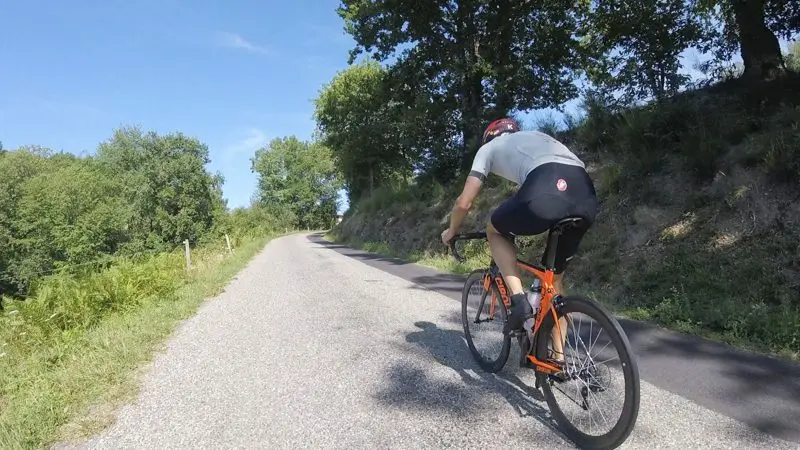
« I’ve climbed the Prat d’Albis twice. The first time in early summer and the second in mid-August, both times in very good sunny conditions. For now, it’s a climb I still find difficult to tackle. I find the first four kilometers really tough; it’s a section that demands a lot of effort from me and wears me out for the rest of the climb. I have to go all the way to the left, I climb with a 34-28, but even with that gearing, I’m pedaling with force. I might need a 30-tooth cog to be able to spin my legs a bit more. Once out of the wooded section, you enjoy a beautiful view of the surroundings of Foix, you cross paths with horses or cows in summer pasture. That helps you forget the pain. Even if the gradient becomes less steep, I feel in difficulty because I had to push myself into the red from the very first kilometers. It’s really not my favorite climb, because I expend too much energy on it for now to truly enjoy the last kilometers. »
| IN BRIEF Start: Foix Department: Ariège (09) Road: D421 Distance: 11.8 km (from Foix exit) Arrival altitude: 1,205 m Positive elevation gain: 765 m Average gradient: 6.9% (according to our data) Max gradient: 15.3% (according to our data) Massif: Central Pyrenees Tour de France passages: 1 (2019, victory by British rider Simon Yates, Mitchelton-Scott) 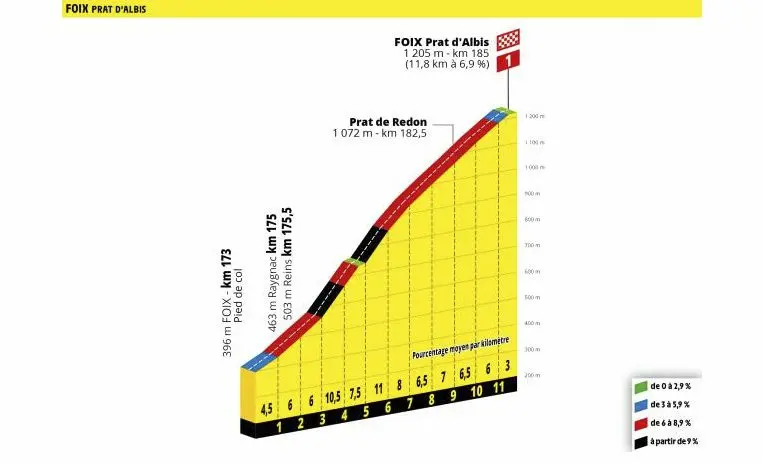 Photo credit: ASO / TDF2019 |
Share the post "Tour de France climbs: the Foix Prat d’Albis climb"