
Share the post "KOO Orion Glasses Review"
With a binocular frame, ultra-sleek structure, adjustable temples, and adjustable ventilation system, KOO Orion glasses offer several innovative mechanisms to make your rides more comfortable and secure. Not to mention undeniable lens quality.
By Pierre-Maxime BRANCHE. Photos: 3bikes.fr

Koo is an innovative signature of high-performance eyewear developed by Kask, an Italian brand founded in 2004 and specializing in the development of cycling, ski, and equestrian helmets. All products are entirely designed and manufactured in Italy. Today, the cycling range includes four models: the Open Cube and Open, which feature a mask-type lens; the Orion, with its binocular system; and finally, the California, which, despite a much more urban and casual look, presents certain details made for competition.
You now know the first particularity of this Orion: a double-lens design on an open polycarbonate frame. This choice allows for a very sleek, more curved structure than a mask, to be closer to narrower faces. It offers both a wide field of vision and extensive eye protection. Note that corrective lenses are compatible.
One size, multiple sizes
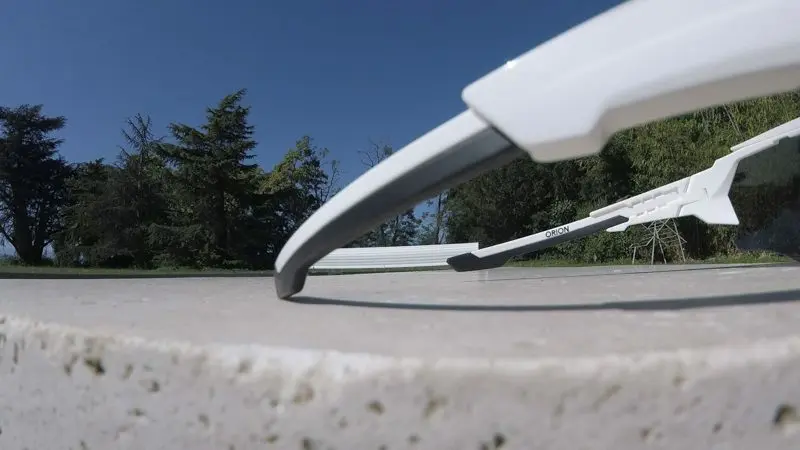
Second particularity, and unlike other models in the range, the Orion is only available in one size: M. Why? Because it offers adjustable temple length. On the inside of each temple, a three-notch system allows the length to be adjusted by 15 mm. This system is completely hidden, even when the temple is set to its longest length. This allows the frame to be positioned taking into account both the fit on the nose and its proximity to the face, the fit on the temples, and finally the passage of the helmet straps. These temples also feature a long anti-slip rubber insert on their lower part to promote stability.
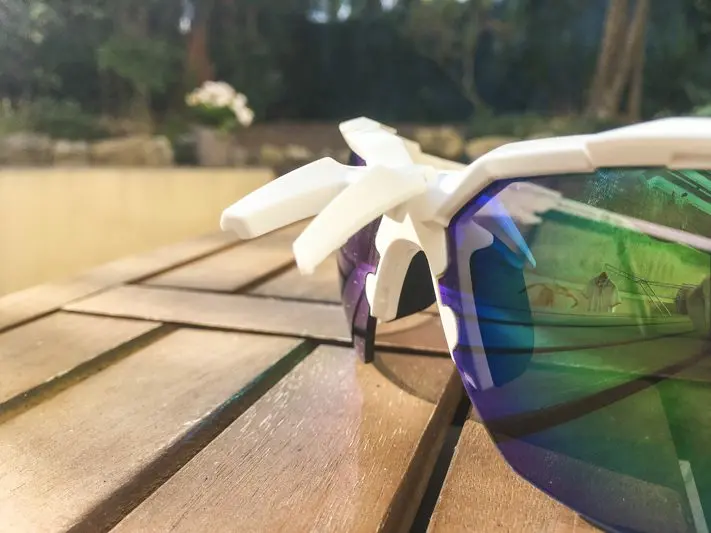
Third advantage: a quick but secure lens change mechanism. This technology works in two steps: first, you have to open the nose bridge to access the lenses and disengage them from both the bridge and the frame at the beginning of the temple. KOO thus ensures that this system is always locked on the road and prevents any problems with the lenses, especially since, even if the nose bridge is open, the lenses remain engaged on both sides in the frame.

Fourth added value, the Orion has a removable ventilation system. Above each lens is a polycarbonate piece that slides on a rail and opens or closes two small openings. When open, these allow airflows to pass between the frame and the lenses to maintain a perfectly clear view. In addition to creating an aggressive design, this system is customizable because these two pieces are available in different colors to create a unique look with multiple combinations.

Quality lenses
Like the other models in the range, the Orion is designed with high-performance German Zeiss lenses. These lenses are available for all terrains, all light levels, and offer a VLT (visible light transmission) index between 14 and 27%. All protect 100% from UV. In addition to the precision of road details and colors, Zeiss lenses offer anti-scratch technologies for durability, and anti-reflective coating on the front and back of the lens, which prevents, for example, seeing one’s own eye reflected in the lens in certain light conditions. This also optimizes contrasts and reduces eye fatigue.
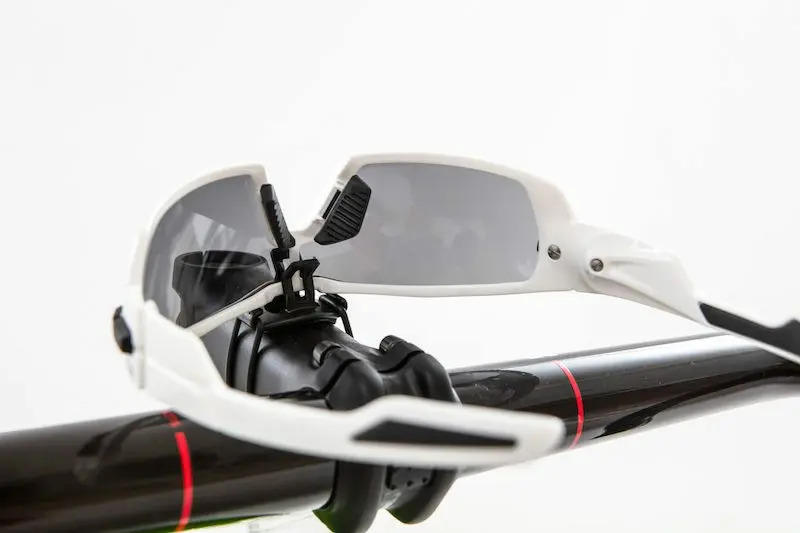
Good to know, the Orion is compatible with the Billy clip (4 g), KOO’s small glasses holder. Billy attaches to the stem or handlebars, providing a convenient place to store glasses when not in use while riding, rather than on the helmet or in a pocket, for example when it’s very hot on a climb, when the light fades, or simply during a coffee break.
Launched at the end of 2018, this Orion is available in 14 colors, offered with 7 different lenses (categories 2 and 3) including a clear lens (category 0), weighs 31 grams for a price of €169.

On the road
Despite the one-size-fits-all, it is very easy to find the right positioning. The temple length adjustment system is quick. Simply unclip the temple, slide it into the next hole, and reclip it. A few seconds are enough, and this mechanism ensures that the temple is completely secured and does not move an inch.
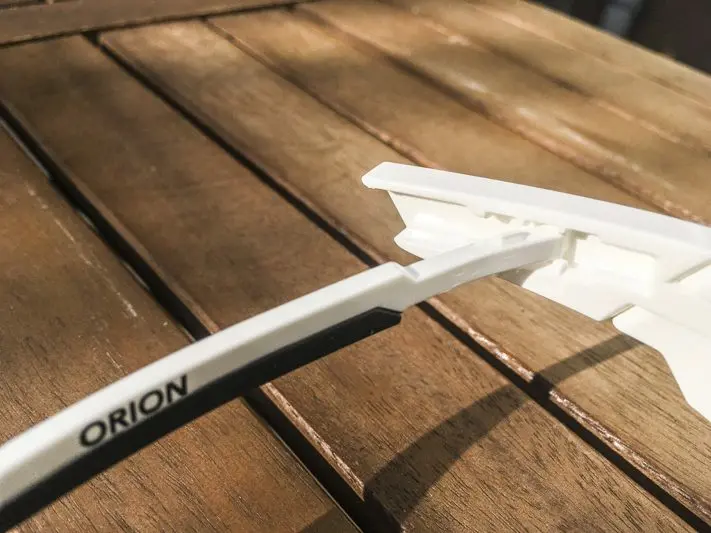
After changing the position for several weeks for the needs of our test, we noticed that the temples, designed in a flexible material, no longer position themselves exactly in line with the non-removable part of the temple, thus revealing a small offset of barely 2 millimeters. This is minimal, visible when not wearing the glasses on the nose but in no way bothersome, in terms of comfort, when wearing them.
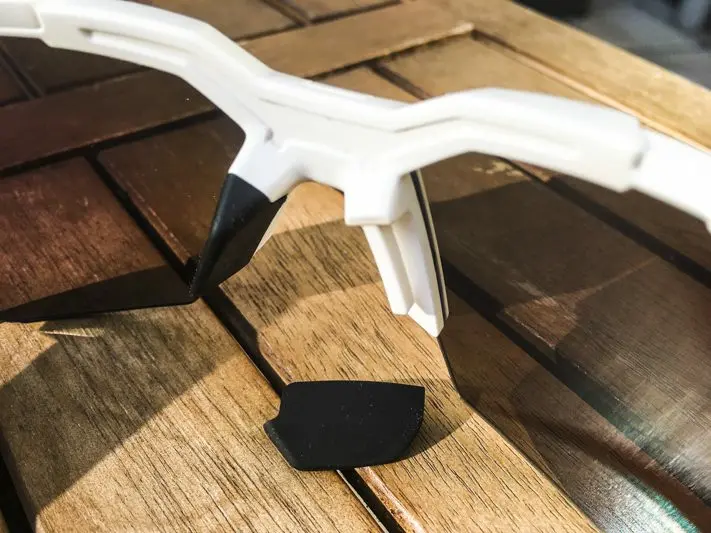
Non-adjustable pads
Once adjusted, the structure remains perfectly in place thanks to the rubber inserts on the temples and the nose pads. These have two drawbacks: they are not adjustable and do not have a retention system. They are only slipped on via a polycarbonate rod. In other words, it is possible to lose a pad during a trip or in a fall. Nevertheless, this rubber provides great stability; the structure never slipped, even with heavy perspiration during the summer heat. Above all, the Orions are quickly forgotten, weighing only 31g.

The visual comfort is perfect. The Zeiss lenses are of high quality in terms of colors, contrasts, and details. The “Lime Lenses” tested transmit 21% of the light, and we were never dazzled despite the intensity of the summer light. Details of the road, on the meters in front of the front wheel or further away to anticipate trajectories, are clear. Passages in shadier areas posed no problem. We even used them during short fasted rides, when the sun was timidly rising, where they offered very good vision despite the lack of light.
The open frame does not obstruct blind spots when looking over the shoulder, to change roads or check what is coming from behind.
The curvature of the lenses allows for a very wide field of vision, and the open frame does not obstruct blind spots when looking back over the shoulder to change roads. Also noteworthy is excellent protection against insects and wind: no airflow gets into the eyes, even with hands on the drops in a more aerodynamic position. Finally, despite careless use, a few trips, and falls, the lenses show no scratches or damage.
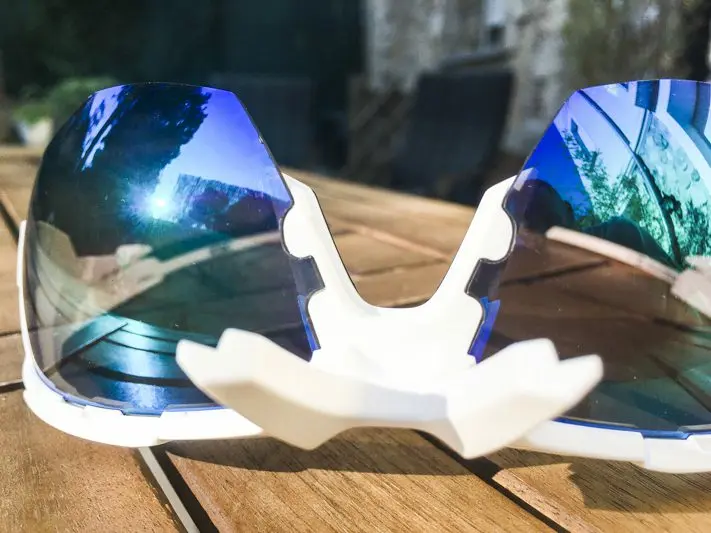
The lens change is indeed very well secured. The nose bridge never opened inadvertently. Even if poorly engaged (i.e., just lowered), the bridge does not lift despite heavy jolts on rough roads. So there is no risk of encountering a problem with a disengaged lens during a ride.
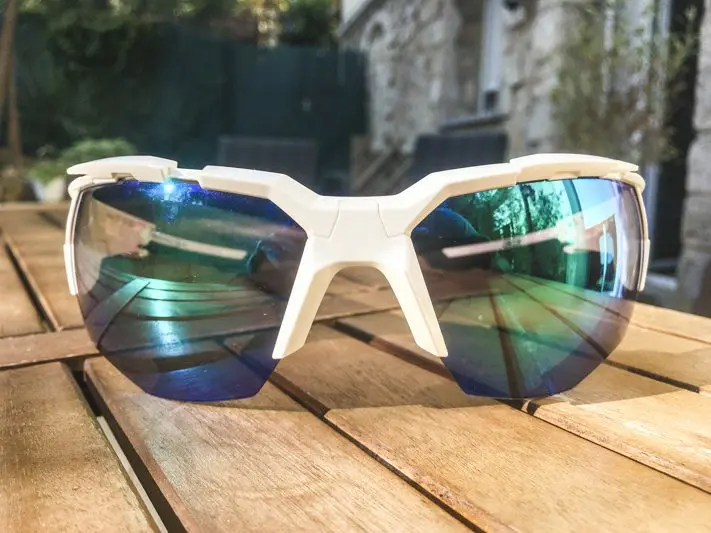
Open and close the vents
There remains this ventilation system. These sliders positioned above each lens are ingenious. When slid outwards from the frame, they release two micro-openings at the top of the lens that allow airflows to pass through. If slid too far, the sliders come off the rail and, without a stop point, there is a risk of losing them. This is what happened during our first test. Fortunately, we were still in front of the house and it never happened while riding.
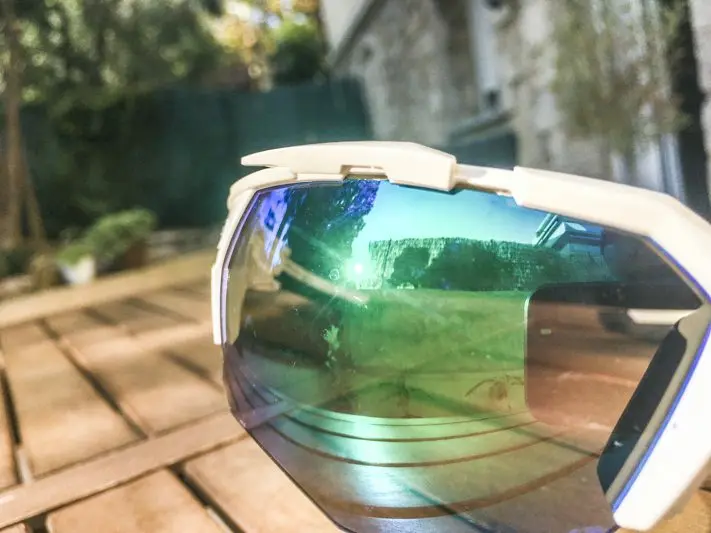
Moreover, the system is not that easy to use on the road. To slide the slider and open the vents, it requires at least two fingers: the thumb to press on the side of the targeted slider’s temple and the index finger to slide it. Or even the index and middle fingers. With sweat, the need to steer, the urgency if you are in a competition, vibrations, etc., it was impossible during our tests to succeed with just one finger. It is also difficult to close them, because in this direction, pressing with the thumb is useless. You have to use the opposite hand, on the other side of the frame, and then use one or two fingers to close it, which means using both hands and therefore… letting go of the handlebars for a few seconds. Not easy in training, even less so in a race or triathlon when you are in position on the extensions.
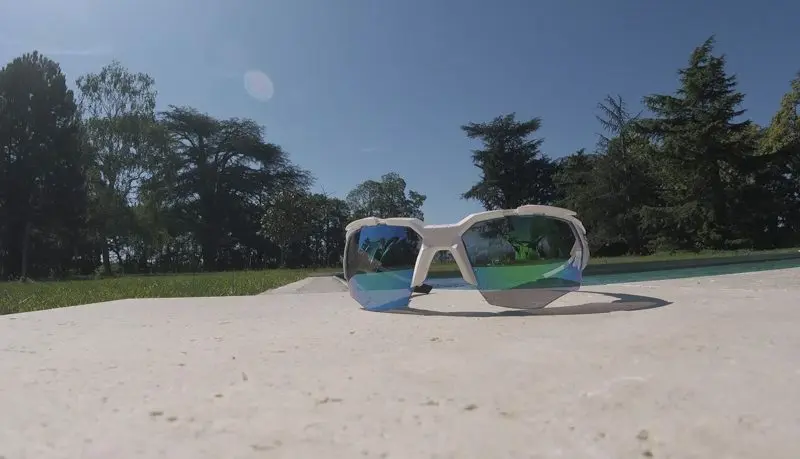
Nevertheless, this system, as well as the anti-fog treatment of the Zeiss lenses, proved almost flawless. Only once did fog blur the vision, on a climb of several kilometers, under an August scorching sun, at an unmentionable ascent speed. In short, in tough conditions. Apart from this episode, whether the ventilation mechanism was open or not, the vision was never impaired. The same goes for running, despite much lower speeds.
For €169, with 14 available colors, 7 different lens types, undeniable vision quality, and innovative technical solutions for adjustment, comfort, and safety, the Orions offer good value for money. We would have liked a clear screen for rain as a bonus gift in the box, but they are certainly a good thumbs-up from KOO to help you perform and protect yourself.

| KOO ORION Glasses |
| ***** PROS : lens quality, weight, ventilation system, adjustable temples, stability CONS : ventilation system not so easy to use, sliders not retained, non-adjustable nose pads Open polycarbonate frame |
| CONTACT: https://kooworld.cc |
=> SEE ALSO: All our Gear articles
Share the post "KOO Orion Glasses Review"