Share the post "How to choose your saddle?"
Pain or other discomfort in the saddle area is one of the limiting factors for all categories of riders. Beginners and experienced riders alike are all confronted at some point with this question: which saddle should I choose to avoid butt pain while riding? The number of models available in all brands’ ranges should be enough to solve the problem. Let’s see how to finally choose the right saddle in 5 steps.
By Guillaume Judas. Photos: @3bikes.fr / Pedaled / Bikefitting.com / DR
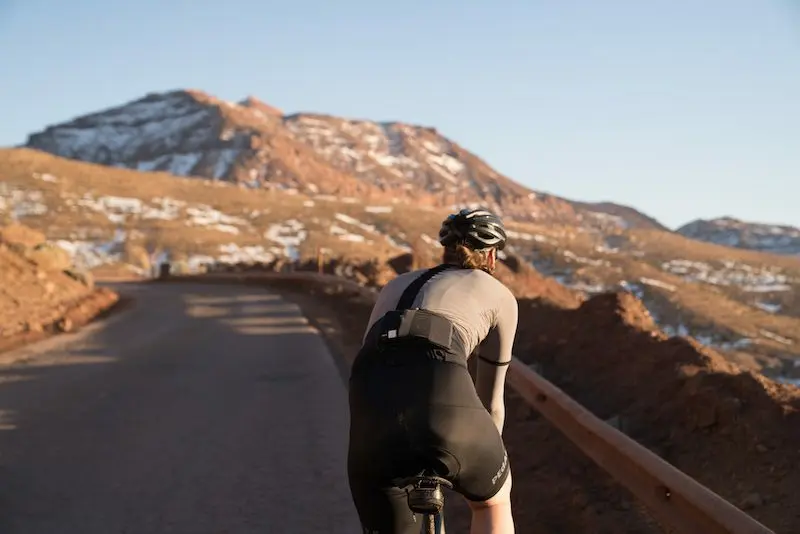
The ideal saddle is unfortunately not universal. Its choice depends on your anatomy (female, male, height, weight, etc.) and your posture on the bike (and therefore your discipline: road, triathlon, mountain biking, etc.). Consequently, its adjustment and the overall position are also essential for complete satisfaction. It should also be remembered that the saddle is one of the three points of support on a bike, and not the only one, along with the pedals and the handlebars. A saddle is therefore not a seat. A bad posture, or bad habits, inevitably cause a bad distribution of weight, which eventually leads to pain. This implies a form of physical commitment that consists of systematically lifting your butt off the saddle in case of a pothole, manhole cover, or speed bump on the road. Just as you should limit as much as possible long coasting sessions where you completely relax on the bike, which are sources of many vibrations.
Three causes of pain
Saddle-related pain can have three main causes, and always sets in after a few hours or a few rides. There is pain related to poor pressure distribution, pain related to friction, and finally pain related to particular sensitivity of the genital area. Fortunately, saddle manufacturers now offer tools to help you select the ideal model from their often-plethoric ranges, which will allow you to proceed by elimination.
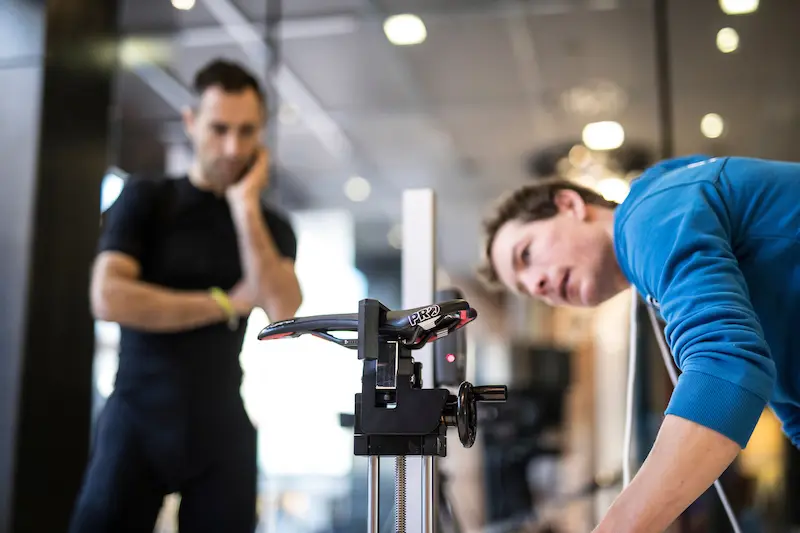
Brand methods The different saddle brands offer numerous models, at all price points. Specialized, Fizik, Selle Italia, Pro, Prologo, or San Marco each have their own method to guide you. This can range from a detailed questionnaire, an impression of the ischial tuberosities, measuring thigh circumference, or even measuring overall flexibility. Some brands also offer test models for a few rides, available at your bike shop. |
STEP 1: the discipline
Road, triathlon, or mountain biking require a different saddle position, not really in terms of height, but especially in relation to the cockpit. The time trial or triathlon position implies riding very low in front, and therefore automatically shifts the weight to the nose of the saddle. Conversely, on a mountain bike, the cockpit is higher and the body weight is more often carried on the rear of the saddle. On the road, it’s somewhere in between, and even then, it depends on the type of riding (competition or touring). There are adapted models for each discipline.
STEP 2: saddle dimensions and shape
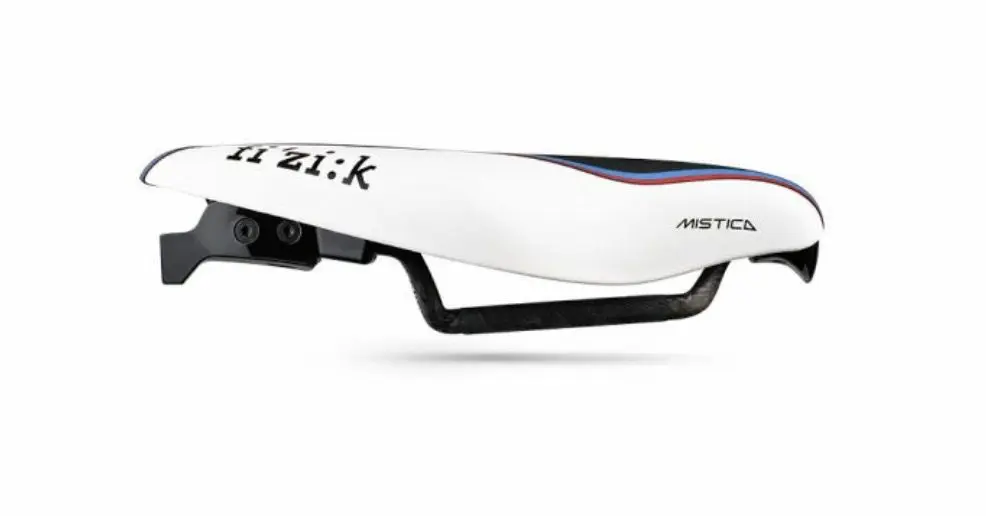
To avoid problems related to poor pressure distribution, it is advisable to select a saddle whose width of the rear (the back part of the saddle) corresponds to the distance between the two points of the ischial bone (the “pointy” part under each buttock), but also a saddle whose front part corresponds to the distance between the two thighs, more or less wide for good support. To do this, you will find several saddle widths from all manufacturers, which allow both small and large riders, or women and men, to find the adapted model.
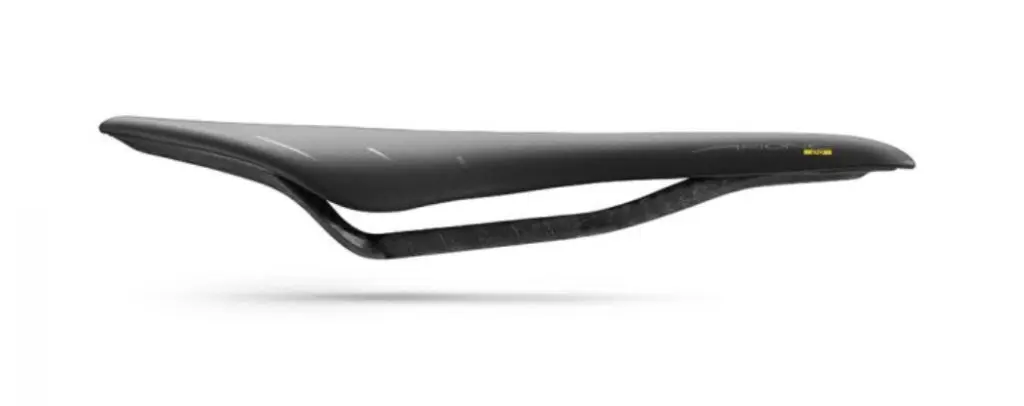
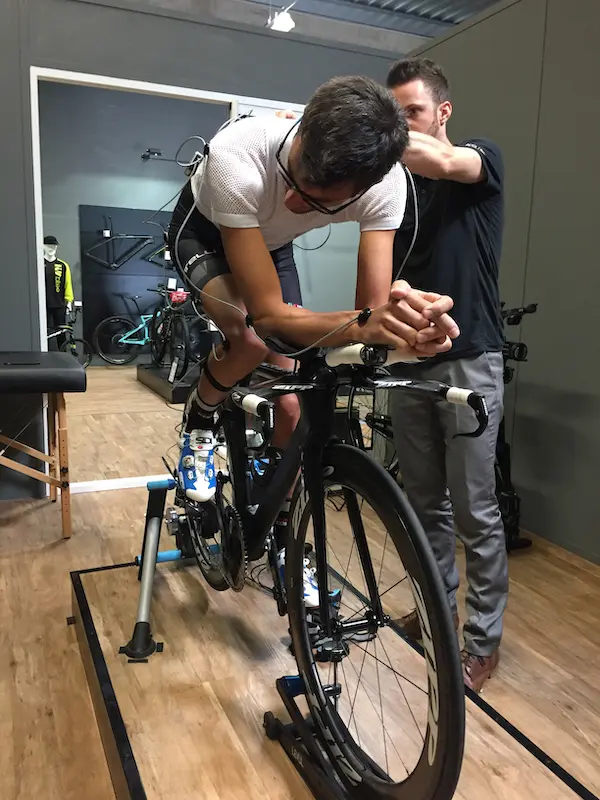
But the saddle profile is at least as important for perfect positioning and limiting pressure. There are saddles with a naturally curved shape, with a front and rear part significantly higher than the central part, flat saddles when viewed from the side, and saddles with an intermediate shape. This choice depends on the cyclist’s flexibility and the degree of pelvic retroversion when in position with hands on the handlebars. To be clear, if you are flexible, you can ride with a flat saddle. In addition, it is of course essential to take care of your position on the bike, often to the millimeter, in terms of saddle height and setback, saddle-to-handlebar distance, and saddle tilt. Having your overall position adjusted by a professional is also a serious option to consider if you can’t resolve your recurring saddle pain.
STEP 3: selecting the saddle padding
By padding, we mean the density level and thickness of the foam located between the saddle shell and its cover. But the flexibility or firmness of the shell also contributes to the feeling of comfort. However, contrary to popular belief, a soft saddle is not necessarily synonymous with comfort. First, it is easy to understand that a “soft” saddle makes position adjustments under the cyclist’s weight more complex to achieve, and that it destabilizes the proper fixation of the pelvis with each pedal stroke, which proves to be a handicap in the case of sports practice.
Contrary to popular belief, a soft saddle is not necessarily synonymous with comfort.
Too soft padding then promotes friction in the crotch, quickly causing redness, burning, pimples, or cuts, which are very unpleasant for continuing your ride. Finally, this same type of padding always ends up moving between the shell and the cover, thus deforming the saddle profile and putting you in direct contact with the hard part of the saddle. As for a shell that flexes more or less under your weight, if it initially filters vibrations, it also risks deforming in the long term, and seriously modifying your pressure points after a few thousand kilometers. The softest saddles are therefore to be reserved for occasional riders, or for those who ride short distances. To avoid friction and ensure stable and firm support, more assiduous riders will prefer a firmer saddle (rigid shell and higher padding density), which is often higher-end than a soft saddle.
STEP 4: in case of discomfort in the genital area
This discomfort can manifest as tingling, temporary loss of sensation, or frequent urges to urinate. It can be the result of nerve compression in the cycling position. However, by correctly following steps 2 and 3, you already have every chance of avoiding it, especially by taking care of the saddle’s tilt adjustment, which should be horizontal, or even very slightly tilted forward. For the most resistant, there is still the solution of a saddle with a cutout shell in its center, which completely relieves pressure on the perineum. Be aware, however, that this type of saddle can cause other discomforts, such as pressure on the ischial bones or friction from folds formed by the cycling shorts. For specific practices such as time trials, choosing a saddle with a truncated or very thick and padded nose can prove largely judicious given the forward position induced by a very low cockpit, which puts a lot of stress on the perineum in terms of support. It is also unnecessary to specify that to avoid friction and annoying folds, perfect crotch hygiene and well-fitting, good quality cycling shorts (with an adapted chamois, preferably seamless) are essential. Beginners must absolutely avoid wearing underwear under their cycling shorts.
STEP 5: material choice
A saddle consists of a shell (often made of thermoplastic, which can be reinforced with carbon or fiberglass), padding of varying firmness and thickness, a cover made of plastic, leather, or synthetic leather, and rails made of stainless steel, aluminum, or carbon. There are minimalist saddles that consist only of a shell and carbon rails (or a plastic or natural rubber shell) and provide minimal comfort only through the flexibility of the shell under load. Unreinforced shells are relatively flexible and tend to sag over kilometers, which changes the shape and profile of the saddle. More or less dense padding ensures support and durability. A good saddle for intensive use therefore has a fairly firm shell and padding to perform its function long enough without causing discomfort. This is often the case when moving upmarket. As for the cover, it should be neither too smooth nor too rough, to avoid slipping too much on the saddle while maintaining good freedom of movement. Saddles with leather covers are the most durable, but also the most expensive. Finally, the rails only affect the final weight of the saddle. However, it is important to ensure that the seatpost clamp accepts carbon rails, for example, as they are thicker.
In conclusion
Therefore, one should not expect too much from a saddle in terms of passive comfort. It is not a seat where one slumps with all one’s weight, but rather a full-fledged support point. It is by following all the selection steps as outlined above that you will be able to choose the saddle that suits you. You, and not necessarily someone else.
=> SEE ALSO: All our Gear articles
Share the post "How to choose your saddle?"