Share the post "Cycling, triathlon: should you worry about your prostate?"
An organ of virility, youth, and pleasure, the prostate is a source of much concern for cyclists and triathletes. Are long hours of training, road shocks, and saddle friction dangerous for this fertility organ, which is the size of… a walnut?
By Pierre-Maxime BRANCHE. Photos: Cyril Sar and flickr.com
Did you say “prostate”? The size of a walnut, the prostate produces the fluid that makes up semen. It is located under the bladder, in front of the rectum, and is traversed by the urethra, which expels urine during urination and transports semen during ejaculation. Rest assured, there is no need to worry too much. In this area, problems related to cycling rarely concern the prostate. Rather, they are mechanical issues of the perineum, lesions, irritations, boils, or the third testicle syndrome. There is also compression of the pudendal nerve, which supplies the penis and causes numbness and possibly erectile dysfunction for varying lengths of time.
Disorders are subject to various variables such as age, weight, accumulated continuous practice time, and frequency of physical exercise.
Similarly, according to a study for the Italian saddle brand SMP, specialists in perineal protection with their cut-out products, the most recurrent problems and pathologies related to sitting are, on the one hand, tingling in the perineal area, linked to reduced blood supply due to prolonged compression of local circulatory channels, and on the other hand, chronic perineal pain or even consequent erectile dysfunction. These disorders are subject to various variables such as age (often over 50), weight, accumulated continuous practice time (at least 10 years), and frequency of physical exercise (more than 3 hours per week). Does this mean that the prostate escapes these issues?
Possible Congestion
Not entirely… because cyclists can suffer from certain prostate congestions. Prostatitis, as they should be called, are regularly observed when the perineum has rubbed for a long time against a hard saddle or after many kilometers ridden on the nose of the saddle. These are infectious problems in the form of difficulty urinating, a delay in the onset of the urinary stream, or when it splits in two. If you experience these difficulties, taking an anti-inflammatory suppository in the evening for a few days is enough to set everything right. Nevertheless, many men, around the age of fifty, encounter these problems. If they recur, it is best to consult a doctor.
Cycling does not cause prostate cancer or its enlargement. On the contrary, sustained physical activity helps limit the onset and progression of this disease.
However, cycling is only a trigger; the cause of this suffering may lie elsewhere. One must look beyond cycling, especially since even if trauma is possible, cycling does not cause prostate cancer or its enlargement. On the contrary, sustained physical activity helps limit the onset and progression of this disease.
Check your position
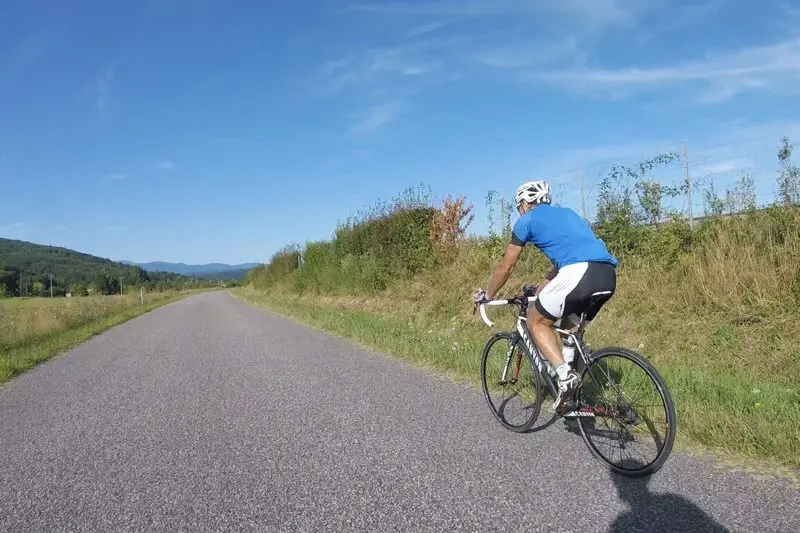
Fortunately, cyclists are not defenseless against the risks of friction, stress, and trauma from sitting! In all cases, check your position on the bike, especially the saddle height and arm extension, i.e., the saddle-to-handlebar distance, which causes a greater or lesser forward tilt of the pelvis. The more the pelvis tilts, the stronger the compression points on the perineum and thus the prostate. Very often, cyclists change saddles due to discomfort, whereas in most cases, the problem lies primarily with adjustments, such as saddle height and setback, tilt, and cleat engagement. For example, check that your saddle nose is not too high: a saddle tilted too far upwards causes neurological compression, leading to discomfort and pain.
=> SEE ALSO: How to choose your saddle
A massage with a neutral cream will provide temporary relief, but the irritation of the subcutaneous tissue is very likely to persist. In the long term, surgery may be necessary, with prolonged rest of four to six weeks, knowing that this operation will not prevent a possible recurrence.
Cut-out saddle, the solution?
To reduce pressure and stabilize perineal comfort, all saddle brands offer cut-out products. In principle, everything seems simple and logical: the saddle either has a central comfort channel (a lowered part of a few millimeters) or a completely cut-out center, like SMP saddles. This channel allows for ventilation of the intimate areas in contact with the saddle. The pelvic viscera experience less or no crushing, and consequently, blood circulation maintains a natural, complete, and continuous flow. Is this the ideal solution? Not necessarily, because when saddles are cut out, the pressure simply shifts to the sides. While a part of the seating area is relieved, this only increases pressure elsewhere, on the rest of the support, which can accelerate chafing. However, they are highly recommended for women, who are even more sensitive than men, and even then, only if the choice in terms of density and width is optimal. Likewise, do not sacrifice to the fashion phenomenon and the race for lightness. The most comfortable models are the widest because saddle-related problems are lateralized. Unfortunately, comfort is often sacrificed for performance. One would not remain seated for hours and hours on an uncomfortable chair. So why would one do so on a bicycle?
=> SEE ALSO: All our Coaching articles
Share the post "Cycling, triathlon: should you worry about your prostate?"